
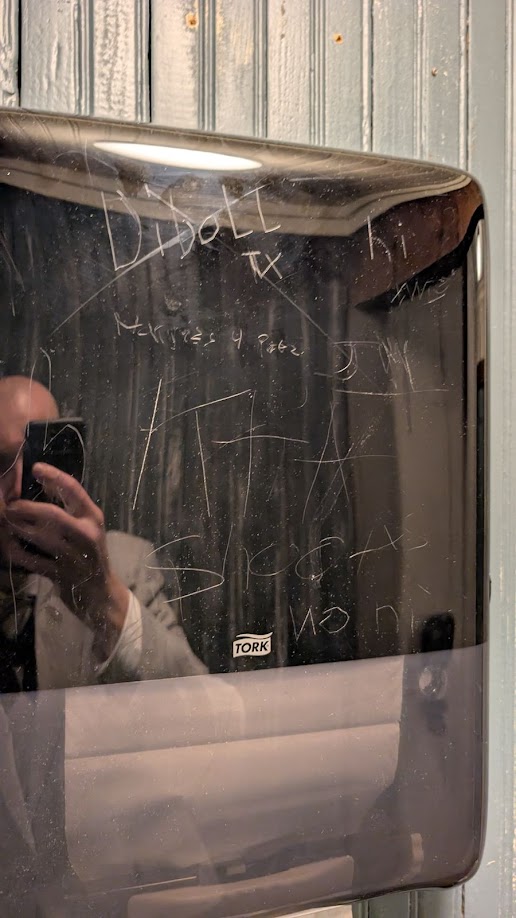
There is something profoundly democratic about a bathroom stall. No velvet rope, no blue check, no institutional imprimatur—not even a username. Just a flat surface, a stylus, and the uncorked bile of a writer who neither sought nor needed your permission. And while many a self-serious theorist has long since baptized digital platforms as the new agora, I submit for your approval a more humble counter-public: the wall; scratched, scribbled, and sprayed with the analog palimpsests of modern discontent. Since the digital turn, rhetorical scholars have fallen over themselves to theorize the tweet, the meme, the post, the endless scroll.…
Author: Jonathan Marine
Jonathan Marine
Jonathan M. Marine earned his PhD in Writing and Rhetoric from George Mason University in May, 2025, where he also served as Co-Director of the Northern Virginia Writing Project. His research focuses on writing engagement, longitudinal writing development, graffiti rhetorics, and the pedagogy and theory of James Moffett.