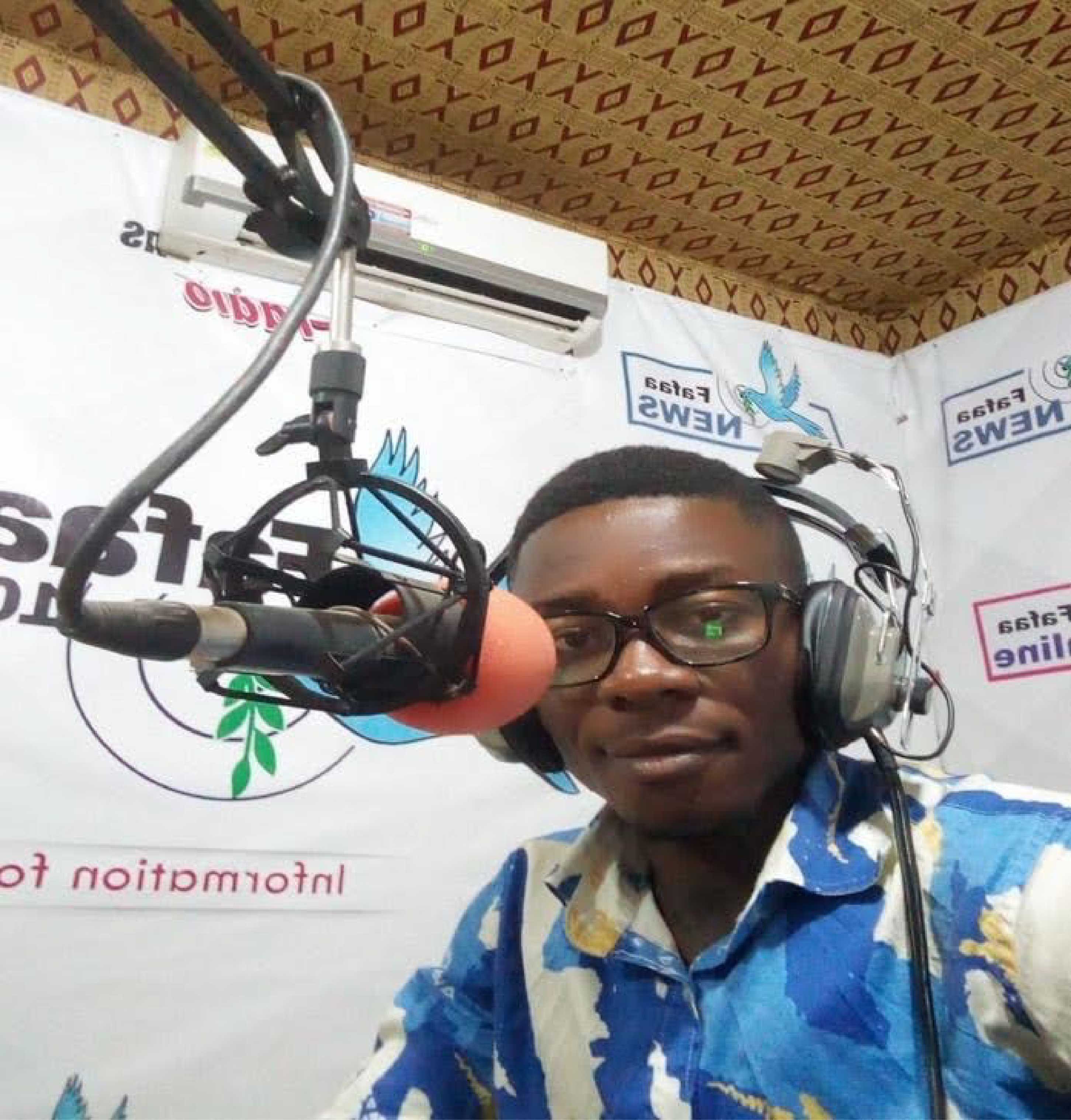
Before I ever taught first-year writing, I learned an important lesson about communication in a radio studio. As a sports journalist, I was not just reporting news. I was shaping how people would receive it. Right before the sport segment, I often played short sport jingles (sometimes remixed) mixing beats, slogans, with timely bpm (beats per minutes). The jingle wasn’t extra! It was rhetorical! It announced a shift in genre (sport is coming), invited listeners into a new tempo and built anticipation.
That early experience in a radio studio shapes my teaching today. In the studio, I learned that meaning can be made through blending words, sounds, timing, rhymes all together. In my first-year writing classroom, I see students doing the same thing when they turn a research paper into a research poster which I called ‘a multimodal remix poster’. In composing the poster, students move across semiotic borders: across words, images, layout, color, and data to communicate to their audience.
In this post, I share one teaching practice that helps students connect multimodality, audience awareness and social justice. The assignment: multimodal remix poster helps students to build what I call semiotic cross-border awareness. By this, I mean the ability to recognize and strategically move across meaning-making resources (text, visual, spatial design, and digital tools).
My use of semiotic border crossing is informed by scholarship on multimodality and multiliteracies. Kress and Van Leeuwen explain that communication works through the orchestration of multiple semiotic resources, while the New London Group argues that literacy teaching should value the coordination of multiple modes in meaning-making. In this blog post, I demonstrate that ‘multimodal remix poster’ can be leveraged as a way to empower students to orchestrate multiple semiotic resources effectively, enhancing their agency to communicate and compose within the multimodal worlds they already inhabit. In this sense, I argue that it advances social justice by creating space for students whose ways of meaning-making extend beyond alphabetic texts to draw on diverse semiotic resources, including visual, spatial, and aural modes, to communicate their ideas while also developing their skills in accessible multimodal design (Takayoshi & Selfe; Selfe).
Why Remix Posters? Why Now?
In many FYW contexts, research writing is still treated as if meaning only resides in alphabetic text, not fully accounting for the fact that students already live in a multimodal world. They interact with and learn through videos, memes, slides, infographics, and visual resources in-and-out of classroom contexts. This means that when classrooms treat multimodality as optional, we are narrowing the idea of what counts as writing while limiting students’ potential to succeed as effective communicators across contexts. This concern has been raised by New London Group and scholars such as Selfe and Takayoshi, Yancey and Wysocki, who argue that teachers should help students draw from multiple modes in meaning making which include words, images, sound, space, and gestures.
That is why ‘remix’ becomes a powerful teaching resource! In my FYW course, students first write their research paper. They then transform their research paper into a research poster for a public audience. The goal is to help students see how meaning changes when ideas move from one form to another—for example, by remediating research paragraphs into visual layouts or image-text pairings.
Before students begin designing their posters in Canva, I encourage them to first complete a mapping activity in which they analyze audience, purpose, context, and genre while also considering their design choices (Arola et al.). They sketch a rough plan of the poster on paper or digital notebook. Students decide on what semiotic modes to use by first identifying their intended audience and then considering what form will communicate clearly to them. In that plan, they identify the main claim, the most important evidence, the audience they want to reach and the kinds of visuals or data they may need. I ask questions such as: what does your audience need to understand first? What information can be shown more clearly in a chart or image rather than alphabetic text? What layout or heading structure helps readers to move through the poster easily?
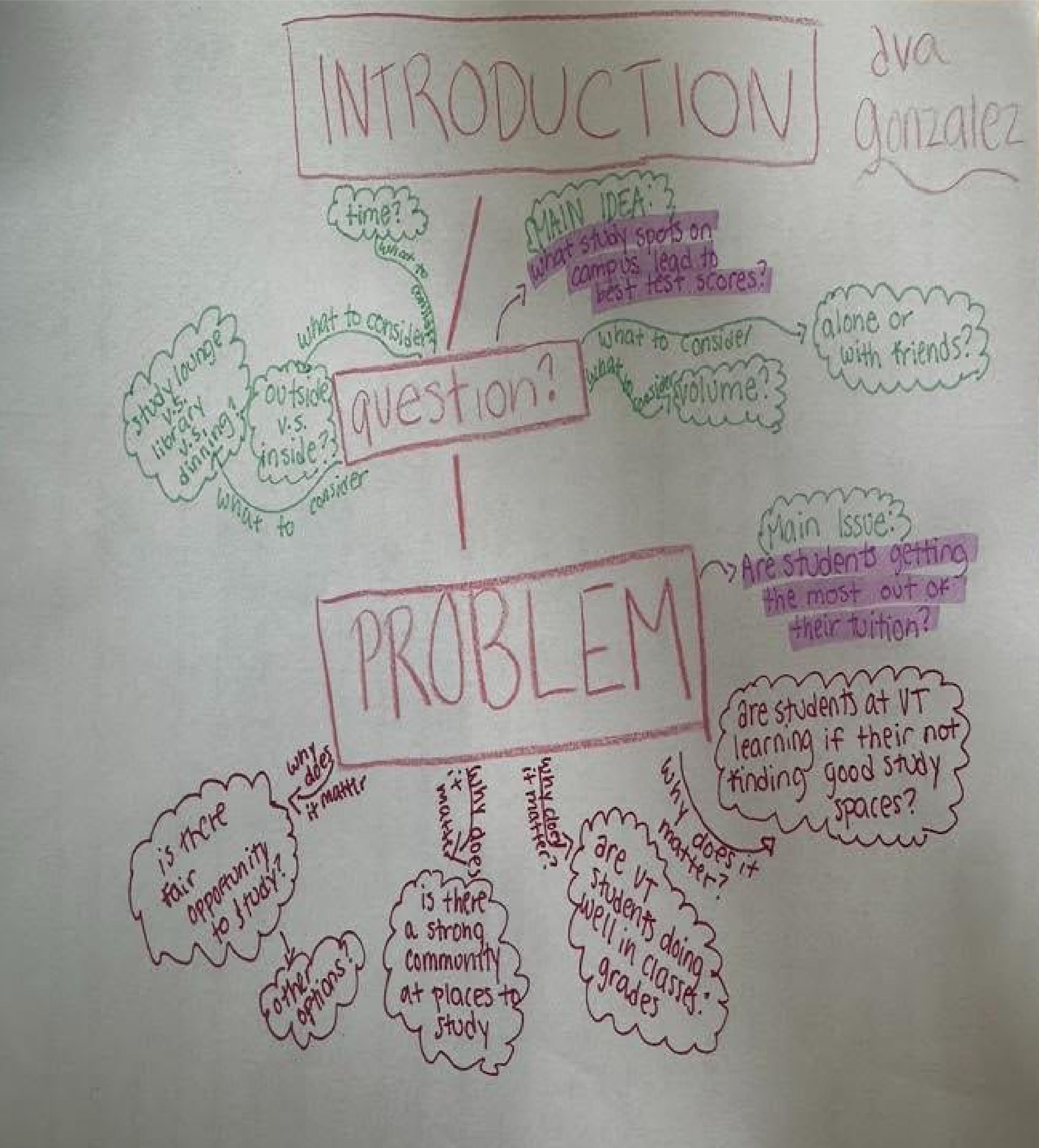
This approach is important because it shows how students begin developing awareness of semiotic modes. Students test these choices through classroom discussion with peers, and reflecting on what each mode can do. This early planning helps students slow down and think rhetorically before they start designing. This mapping stage matters because it gives students the space to make deliberate choices and understand that multimodal composing depends on audience, context, and purpose. Rather than rushing straight into Canva, students first think through the relationship between their research argument and the semiotic resources that can help them communicate such ideas to their audience.
Semiotic-Border Crossing as Human-Centered Praxis
I also describe this remix assignment as human-centred because it begins with audience needs. Students are not only asked what they want to say but also what their audience needs in order to understand, care about and remember the message. In class discussion and reflections, I have seen students begin to recognize that a poster is a set of rhetorical choices rather than a simpler version of composing. They talk about cutting down text, choosing stronger headings, selecting visuals carefully and arranging information so that readers can follow it. This fosters the development of human-centered multimodal design skills that are responsive to and accountable for the experiences and needs of their audiences.
Based on Shipka’s work, one way I know students begin developing this awareness is through the choices they articulate in their own reflections on the remix poster. One student explained that writing the research paper felt like following rules whereas designing the poster made her think about what really mattered and how to respond to her audience. She further noted that she used visuals, statistics and diagrams to raise fast fashion awareness in simplified ways that alphabetic texts alone could not accomplish very well. Comments like this suggest that students begin to see multimodal composing as a rhetorical process of selecting resources based on audience and purpose.
In so doing, remix posters give them an alternative rhetorical pathway where resources that do not show up in the research papers are made visible. As Palmeri argues, when we treat remix as legitimate composing practice and recognize that writing can happen through text, visual, digital, embodied and other semiotic modes (Selfe; Wysocki et al.), we are doing justice work by embracing diverse forms of non-alphabetic communication, expanding what counts as writing, valuing multiple literacies and creating rhetorical pathways for knowledge construction. If we hold these very well, we are widening the rhetorical possibilities in multimodal composing.
The Tool Matters: Why We Use Canva
We use Canva as our primary design tool because the interface is user-friendly. Most students state that the template reduces some of the fear that comes with layout, color, images, charts, even if they do not see themselves as designers. Canva makes revision visible. Students experiment with image placement, captions, color contrast, shapes, icons, charts, data visualization, and other resources. This helps to see composing as a process where writers select multiple resources to engage in meaning making.
A Student Example: Puff to Damage and the Rhetoric of Visual Urgency
One student whom I call Chen created a research poster titled: “The Impact of Vaping on American Youth: Health and Environmental Concerns.” What makes Chen’s work powerful is how she crosses semiotic borders to make her augments. In her reflection, she explained that she wants her poster to communicate to the American youth the dangers of vaping clearly to her audience. One way she did this was through color. She said she used a red and white background to communicate the dangers and health risks of vaping. Her explanation suggests color choices are a rhetorical move. This also aligns with Kress and van Leeuwen’s point that visual elements like color can carry social meaning and help how viewers interpret a message.
Chen also states that she places two lungs at the center of the poster, one healthy, one darkened and one damaged with the phrase, “PUFF TO DAMAGE” beneath them. In her reflection, she noted that she chose this contrast so the audience could see the harmful effects of vaping. From my perspective as instructor, this is a strong example of how visual contrast can do explanatory work quickly, making the issue of vaping legible and emotionally striking to her audience.
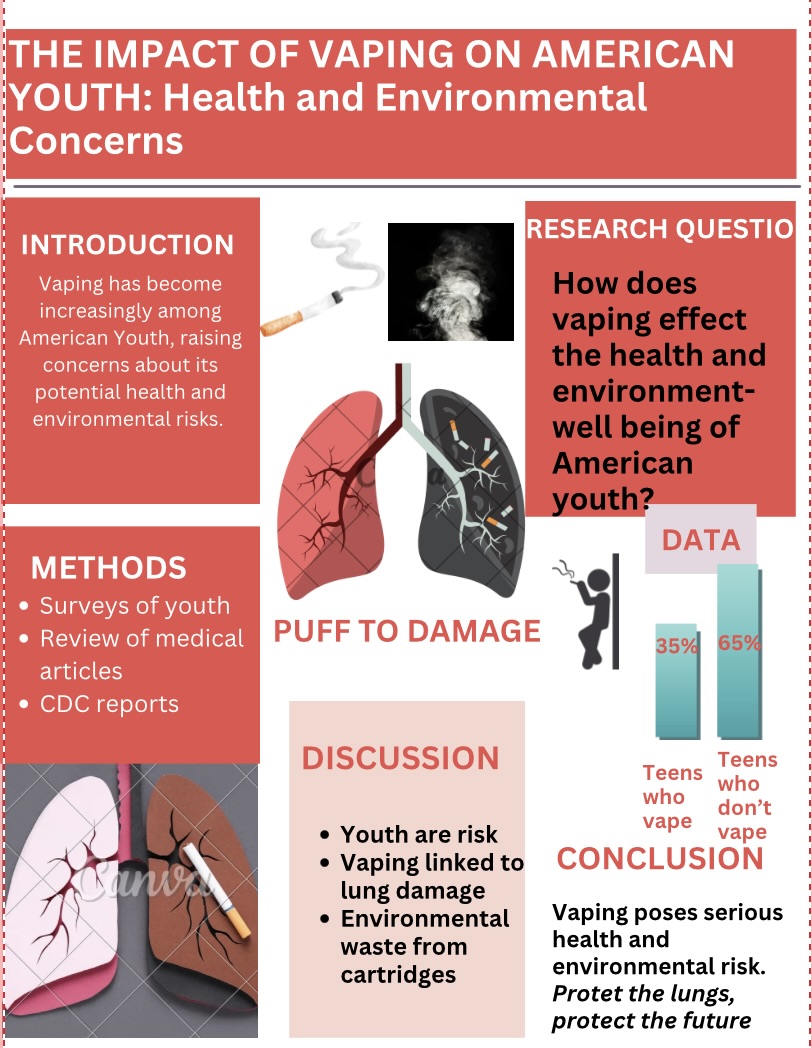
Chen further states that she included a bar graph comparing teens who vape (35%) and those who do not (65%). In her reflection, she contends that charts and statistics are useful because they offer numerical evidence from the research paper into visuals to help grasp information more quickly. In other words, the graph works as another semiotic resource by turning data into a visual. Chen also organizes the poster into labeled sections with boxes and headings. In her reflection, she explained the structure (introduction, methods, research questions, discussion, etc.) would help readers move through the poster without getting lost.
Chen’s remix and reflection shows that students can develop awareness of how text, visual and other semiotic modes work together to make their posters readable and respond to audience needs.
What Students Learn (Beyond Design)
This remix project builds rhetorical knowledge in concrete ways. These observations are based on students’ reflection, classroom discussion, and presentations of posters.
- Students learn that writing is negotiation: They stop seeing writing as filling a template and start seeing it as aligning with choices across audience, context, and purpose. This aligns with scholarship on multimodal composing as purposeful orchestration of semiotic modes (Shipka; Kress and van Leeuwen).
- Their reflection shows growing awareness that meaning making can travel across modes. Students learn that meaning making is visible through multiple modes. They discover that statistics can become a bar chart and claims can become an image-text pairing.
- Through classroom discussion, students learn accessibility as part of composing practice. We talk about readable fonts, color contrast, white pace, and clear headings as ethical rhetorical design.
- Students learn that modes have different affordances. When students choose text, visual, and colors, they begin to understand that each mode has its own affordances and carry meaning (Kress and van Leeuwen).
A Quick Teaching Guide: How to Run this Remix Project
- Start with a research paper (the border norm): students complete a research paper to understand academic genre expectations.
- Introduce the Remix as ‘crossing borders’: It is about redesigning meaning across modes, from alphabetic text to multiple modes (text, visual, colors, etc). I help students to understand this by showing sample posters and asking them to compare those posters with traditional essays. We discuss what changes when information moves from alphabetic text to make a multimodal text.
- Teach design as rhetorical decision making: I use visual analysis (Kress and van Leeuwen) to spark these discussions. We examine the sample posters and ask questions like what do you notice first? What makes this poster easy or difficult to follow? How do color, layout, contrast, spacing, headings and images guide your attention? Through this process, students begin to see multiple resources in the posters as rhetorical choices that can shape meaning making.
- Audience specificity: Students must name a real audience: peers, youth, parents, teachers, etc. Once they name that audience, I ask them to think about what that group needs to understand that issue clearly.
- Multimodal reflection: Students record a three-minute explanation of multimodal choices they make. In this reflection they discuss why they chose particular resources (images, colors, layout, headings, etc) and how choices are shaped by audience, context, and purpose.
Multimodal Remix as Justice-Oriented Practice
I often tell my students that remix posters involve a multilayered research process, a process that demands new rhetorical skills, new ethical questions and attention to audience, context and purpose. In my journey as a broadcast journalist, remix began for me with sport jingles-sound layered with urgency and timing. In the classroom, remix becomes a way to help students see that meaning is always designed, situated, and shaped by available semiotic resources. When students learn to cross borders with awareness, they practice a form of multimodal literacy that is human-centered through appropriate choices. It is also justice-oriented because it expands on whose knowledge practices are valued in FYW. In this sense, remix as justice-oriented literacy therefore provides spacesfor students whose ideas may not be well articulated in alphabetic text alone to communicate through multiple modes such as visual, spatial, and aural.
Works Cited
Arola, K., J. Sheppard, and C. Ball. “Writer/Designer: A Guide to Making Multimodal.” St.
Martin’s: Projects Bedford (2014).
Shipka, Jody. “A multimodal task-based framework for composing.” College Composition &
Communication 57.2 (2005): 277-306. https://doi.org/10.58680/ccc20054030
Kress, Gunther, and Theo Van Leeuwen. Reading images: The Grammar of Visual Design.
2nd ed. London: Routledge, 2006. Print.
New London Group. “A pedagogy of multiliteracies: Designing social futures.” Harvard
Educational Review 66.1 (1996): 60-92
Palmeri, Jason. Remixing composition: A History of Multimodal Writing Pedagogy.
Carbondale: SIU Press, 2012.
Selfe, Cynthia L. “The Movement of Air, the Breath of Meaning: Aurality and Multimodal
Composing.” College Composition & Communication 60.4 (2009): 616-663.
Shipka, Jody L. Toward a Composition Made Whole. Vol. 163. University of Pittsburgh Pre,
2011.
Takayoshi, Pamela, and Cynthia L. Selfe. “Multimodal composition: Resources for teachers.”
Thinking About Multimodality.” Hampton Press (2007): 1-12.
Wysocki, Anne. Writing New Media: Theory and Applications for Expanding the Teaching ofComposition. University Press of Colorado, 2007.