I had grown tired of the sound of my own voice. By the third day of the semester, I recoiled at the thought of another term of my own voice echoing across five composition classrooms. As I prepared my next lesson, I was struck by an unexpected idea: What if I didn’t talk? What if I stayed intentionally silent? What possibilities and meanings might be made in the absence of my voice?
Uncertain but intrigued, I spent the next several days sketching plans and gathering materials for what would become my first Silent Class. What began as a tentative classroom experiment would soon challenge my assumptions about how participation is recognized — and how learning becomes visible — in the writing classroom.

Please be seated
the first slide read, followed by
Welcome! We will begin soon.

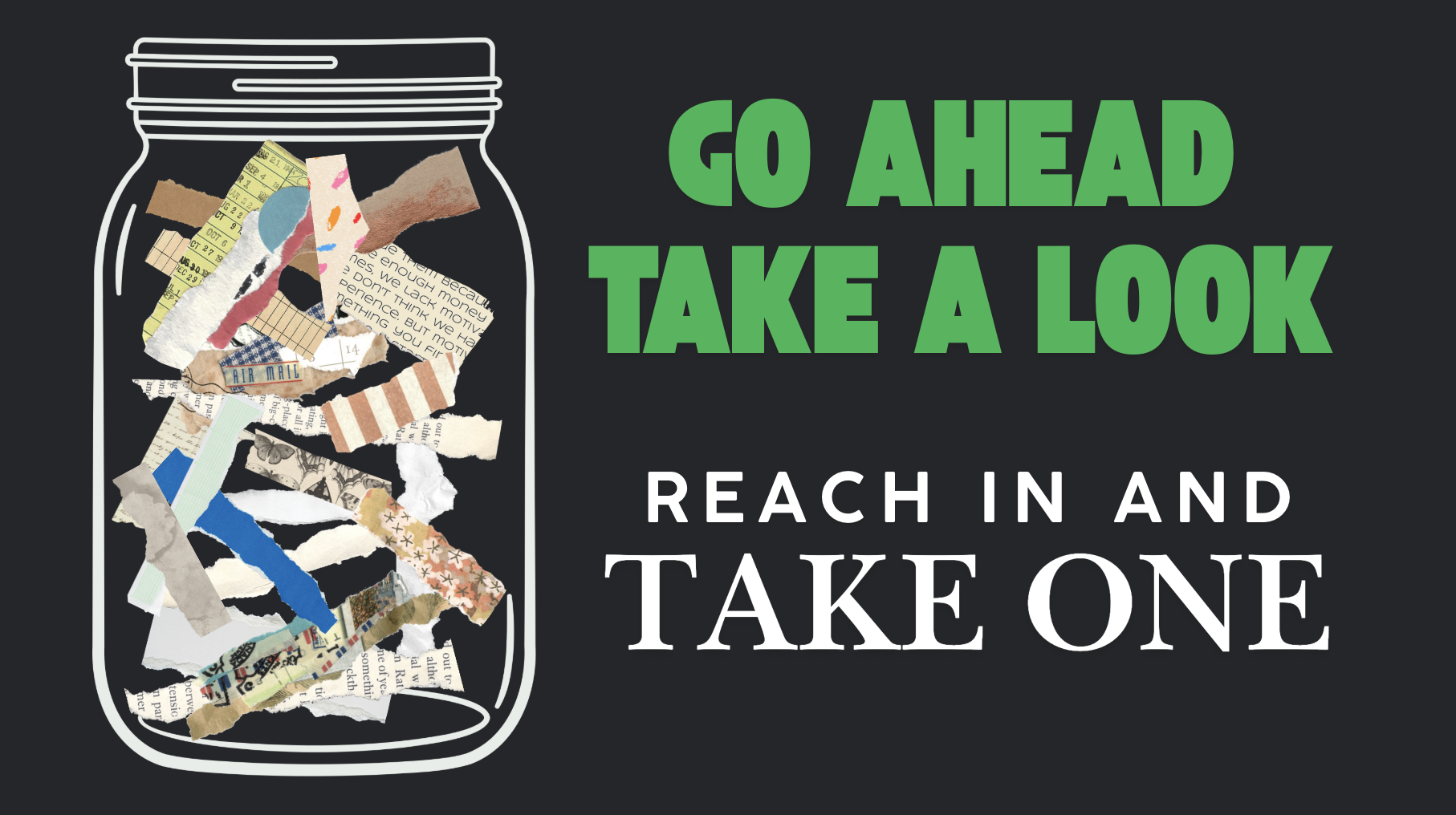
A few students immediately took to their seats and watched as I paced the classroom floor, strategically placing objects — museum postcards, wooden blocks, a jar of paper strips, crayons, puzzle pieces — on desks around the room. Others carried on their typical beginning-of-class chatter with little regard for my movements.
I slowly raised the volume of the projector speakers until their voices subsided beneath soft music.
Are you ready?
The next slide asked.
If you can read this, look ahead and nod.
I waited silently as watchful students nodded and nudged last-minute chatterers to attention, as phones were placed face-down on desks or slipped into backpacks, as the room settled and fixed its eyes on the front of the classroom — on me.
Only then did I click to the next slide.
This presentation contains instructions.
You will not hear my voice. There will be no spoken directions. Watch carefully.
Confusion. Bewilderment. Slight consternation. Giggles from the back row. Students stared at me, then at each other, then at the screen behind me. Some seemed to wait for an explanation that never came. Others tested whether I was serious by asking questions aloud. I smiled but did not answer.
I did not speak. I did not clarify. I did not rescue their uncertainty.
What surprised me most was not that they looked to me for direction, but that many assumed they, too, were required to remain silent. They sat with questions rather than turning to one another, hands hovering above materials, waiting for permission to proceed. Only after I gestured toward their neighbors — an open-palmed motion, a nod, an exaggerated shrug — did conversation resume. Slowly at first, then all at once.
They had not been waiting for instructions. They had been waiting for authorization.
In that moment, I began to see how deeply students are trained to look to the teacher as the primary source of knowledge formation.
In many U.S. classrooms, participation depends heavily on rapid verbal response, and silence is often treated as a problem. Because oral participation frequently functions as a primary sign of learning, quiet students can be read as disengaged or underprepared and teachers are trained to fill silence quickly — to explain, rephrase, rescue (Hao, 2011). Yet, these assumptions privilege particular communicative styles — linguistic fluency, public confidence, and speed of response — while obscuring other forms of attention and meaning-making.
My silent-class experiment was not simply about withholding speech; it was about questioning whose forms of participation are recognized as learning. When verbal immediacy is treated as evidence of intelligence or preparation, students who need time, collaboration, or embodied engagement can be misread as disengaged. Designing moments of intentional silence became one way to redistribute communicative authority and create inclusive, human-centered conditions for sense-making — conditions in which different kinds of thinking can be seen and valued. Some educators describe this intentional withholding of teacher speech as performative silence (Hao, 2011; Trahan, 2013), a pedagogical move that can open space for new forms of interaction. What interested me most, however, was not silence as novelty, but how shifting instructional modes might reveal forms of thinking that typically remain invisible.
Understanding silence in this way also required confronting its practical and ethical limits. Since it was early in the semester, my lesson plan focused on the writing process and on overcoming writer’s block. The lesson also became the longest slide deck I have ever made. Preparing the silent class forced me to slow down and examine each instructional decision — every transition, every object, every moment of waiting. I was also keenly aware that removing spoken instruction could introduce new access barriers. Slide-based communication assumes visual engagement and shared processing pace. Although no students in these sections had disclosed visual impairments, the experience prompted me to think more carefully about how silence intersects with accessibility.
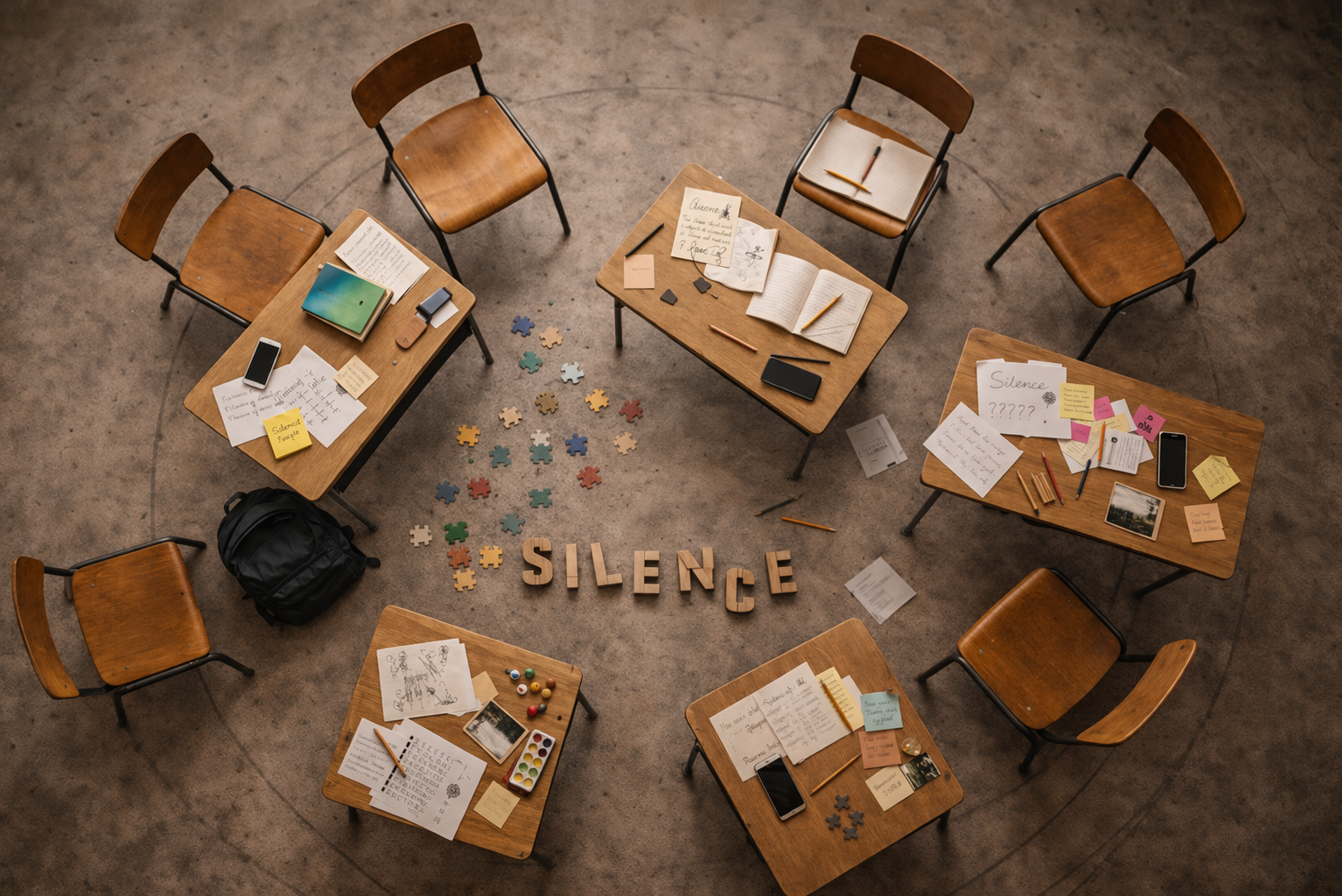
Without speech, I had to rely on other modes – visual cues in the form of written text and gesture, but also sound, material prompts, and peer explanation — so that understanding did not depend on visual engagement alone. So students worked with abstract art postcards to prompt writing, puzzles to model essay organization, and wooden “writer’s blocks” on which they inscribed their apprehensions about writing. These multimodal materials did more than support comprehension; they redistributed interpretive responsibility across the room.

What emerged surprised me. Once students understood they could speak to one another, the room changed. Chairs turned. Bodies leaned across tables. Hands pointed to slides and picked up objects. Questions that would normally move toward me instead circulated among students. They demonstrated, mimed, and negotiated meaning collaboratively. When confusion arose, they did not stop working; they experimented. Writing became social before it became textual.
Without my voice, communication was not lost; it was redistributed.
Authority had not disappeared; it had begun to circulate.
Multimodality has long been a touchstone of my pedagogy. Humans make meaning through more than language alone — through gesture, spatial arrangement, movement, visual attention, and shared interaction — and writing instruction benefits when these multiple channels are intentionally designed. Multimodal learning environments can also function as humanizing and accessibility practices, widening the ways students participate when verbal performance is not the sole measure of engagement. Considered this way, intentional moments of silence can disrupt classroom routines and familiar participation rhythms, revealing who usually speaks, who waits, and how authority takes shape.
The heightened engagement I observed that day was not only a response to novelty, although disrupting routine certainly captured students’ attention. For some learners, the silent class seemed to align more closely with preferred modes of participation: observing before speaking, working through ideas collaboratively, or engaging physically with materials. In the silent class, confusion did not signal failure but collective reasoning. Students solved problems together that I normally solved for them. Authority shifted: knowledge no longer flowed primarily from the front of the room but emerged through shared interpretation.
Of course, silence is not a single condition. To be silenced is to have speech denied; to design moments of quiet can open space for other forms of communication and attention. Learning to interpret that difference is part of building more inclusive classrooms. And while I do not see silence as a permanent condition of instruction, I offer it as one possible pedagogical strategy — a way to interrupt familiar participation hierarchies and expand how students contribute to shared knowledge-making.
I did not stop teaching when I stopped talking. What changed was how knowledge formed — and where students looked first for meaning. My sudden silence contributed to the wonder, surprise, and heightened engagement I witnessed that day, but the deeper shift came from my willingness to let meaning emerge without stepping in too quickly.
Since then, I have not stopped talking in my classes. But I now leave more space than I once did — moments when I resist the urge to clarify and students must interpret, negotiate, and notice together. Writing, I have come to believe, does not begin with words. It begins when students stop listening for the teacher’s voice and start trusting their own.
References
Hao, R. N. (2011). Rethinking Critical Pedagogy: Implications on Silence and Silent Bodies. Text and Performance Quarterly, 31(3), 267–284. https://doi.org/10.1080/10462937.2011.573185
Kurzon, D. (1998). Discourse of Silence. Amsterdam: John Benjamins.
Saville-Troike, M. (2006). “Silence: Cultural Aspects.” In Encyclopedia of Language and Linguistics, edited by Keith Brown, 379–381. Amsterdam: Elsevier.
Trahan, H. A. (2013). The Silent Teacher: A Performative, Meditative Model of Pedagogy. Liminalities, 9(3).