
As we begin one academic year and look back at the last, the DRC Fellows share their reflections on their projects, collaborations, and takeaways from the Fellowship. It was wonderful to work with each of the Fellows this year, and to see the ways in which connections with DRC advisory board members, directors, and other fellows developed. Additionally, all of the fellows co-presented at Computers and Writing this year and interviewed the past and current editors of Computers and Composition. We wish the Fellows the best on the next part of their journey and appreciate all their contributions! Thais Rodrigues…
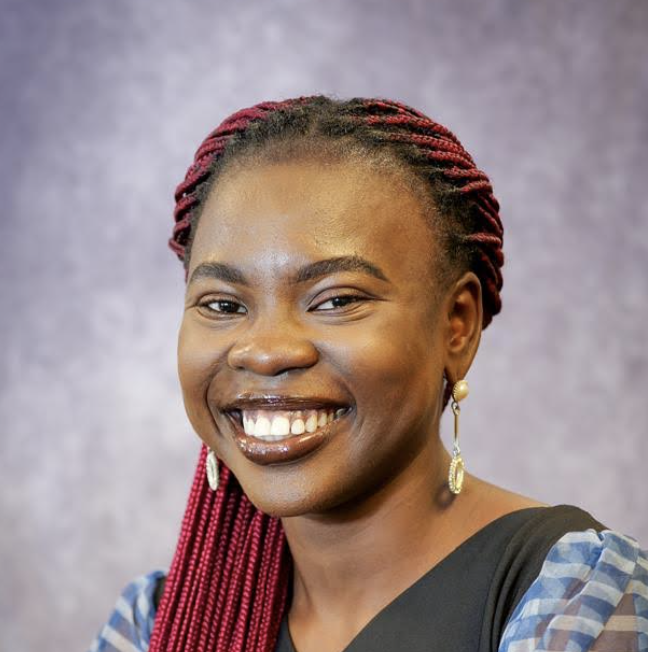
Author: Funmilola Fadairo
Ali Alalem, Thais Rodrigues Cons, Nicole K. Golden, Erin Miller, Mehdi Mohammadi, Funmilola Fadairo
Funmilola Fadairo is a PhD student in the Language, Writing, and Rhetoric track within the English Department at the University of Maryland. Her research explores how technological and multimodal forms depict African sensibilities across time.
Dr. Itchuaqiyaq is an Associate Professor of Technical and Scientific Communication and the Founding Director of the Center for Sustainable Engagement in the Arctic at Virginia Tech University. She argues that technologies can lead us to outsource our thinking while emphasizing the importance of prioritizing our own reasoning, valuing physical interactions, and investing in analog practices to achieve sustainability at the individual level. As an Inupiaq scholar, she shares examples that illustrate the potential loss and flattening of cultural knowledge when AI systems homogenize distinct cultural practices. She also points out that language data has become a valuable commodity and…
Dustin Edwards is an Associate Professor of Rhetoric and Writing Studies and the Director of the Writing Center at San Diego State University. His research examines the unmet promises and lived harms of extractive technologies. More specifically, his work draws together how communities navigate the land, labor, and water struggles that have made large-scale computation and global connectivity possible. He is author of Enduring Digital Damage: Rhetorical Reckonings for Planetary Survival, which won the 2025-26 Computers and Composition Johndan Johnson-Eilola Distinguished Book Award. With Mél Hogan and Zane Cooper, he is at work on a second book, tentatively titled Critical Data…
Though we may not realize it, data centers are an indispensable part of virtually all contemporary composition and rhetorical work. For example, any scholar who studies digital rhetoric or uses their iPhone to take pictures of archival artifacts for later analysis utilizes the power of a data center somewhere in the world. Data centers happen to be so peculiar that they need yet another veiled term, “the cloud”, to obfuscate the true narrative behind how this digital infrastructure works. Behind this supposed cloud lie buildings, rare earths in hardware components, heat exhaust, water consumption, and maintenance staff keeping this infrastructure…