Part 1: Driving to the Grocery Store
I don’t know exactly when the Flock cameras arrived. They blend into the infrastructure built around cars—the stop signs and speed limit signs, parking meters, street lights—all the information that drivers need, erected on metal posts or wrapped in reflective coating for all to see. Flock cameras, however, don’t need (or don’t want) us to notice them. All black, sitting fifteen feet off the ground, their cameras are shrouded by a small solar panel, but their design is unmistakable.
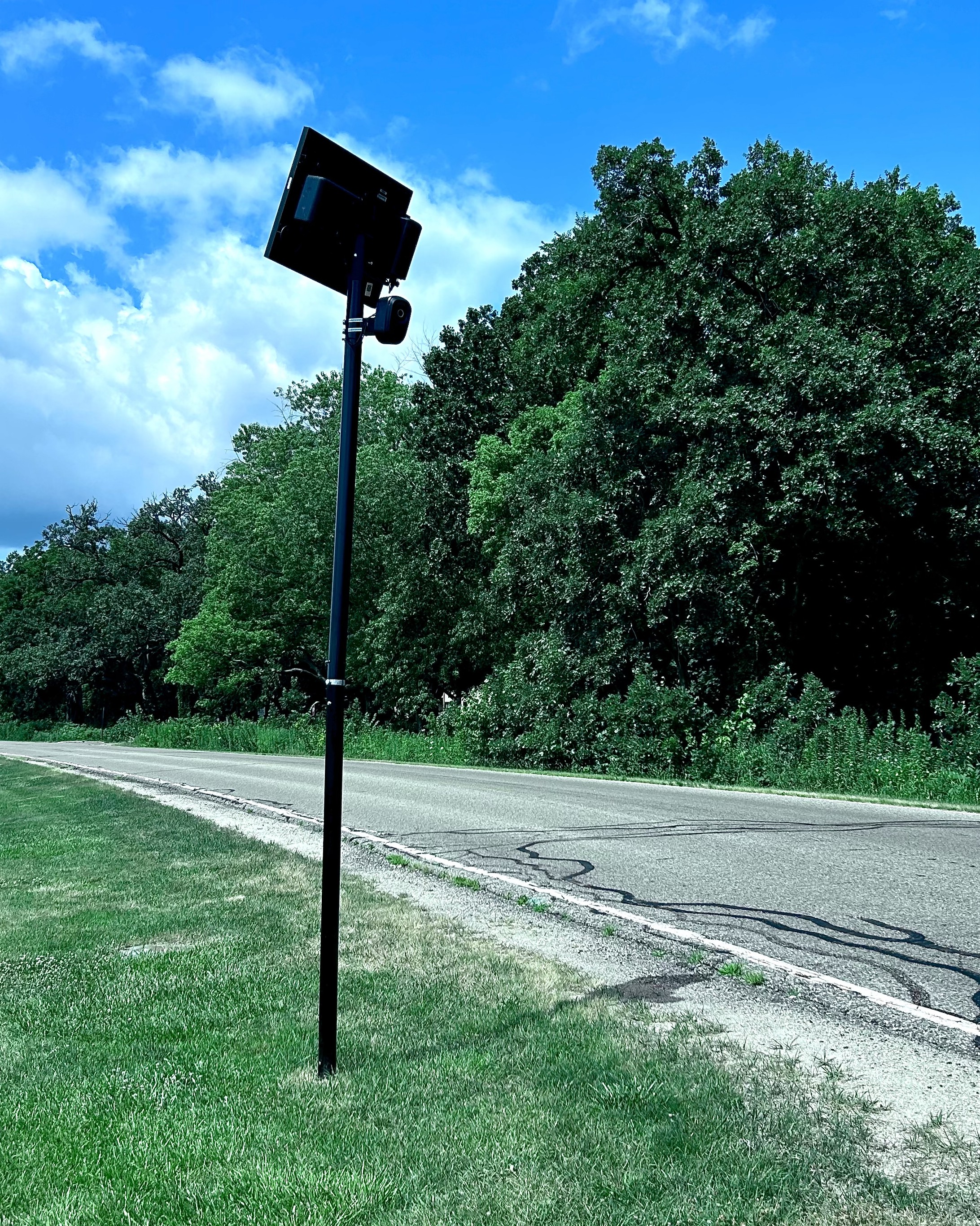
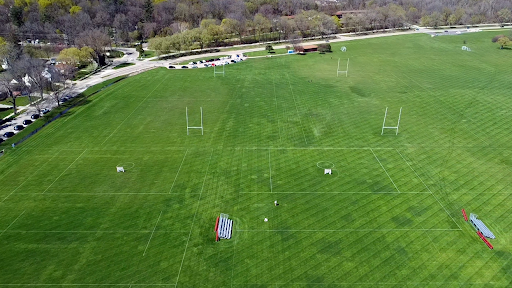
That day, I was on my way to the grocery store. The primary entrance and exit to my neighborhood of university-owned graduate housing is at the foot of a small hill that opens onto an expansive field. In the warmer months, people use it for ultimate frisbee, soccer tournaments, and playing fetch with extremely athletic dogs. In the winters, as was the case when I first noticed this Flock camera, the field rests under a blanket of crisp white snow. A road runs between the hill and field, and this intersection marks the end of my neighborhood. To get in and out, I have to drive down the hill and turn left or right. At the other end of this intersection is a small university parking lot for employees of the nearby hospital and folks who want to use the field. The entrance to this lot is adorned with signs explaining the rules of parking there, and the Flock camera was placed near these signs, as if it were any other piece of infrastructure.
As I looked left and then right before making my turn, I locked eyes with this new (to me) Flock camera. Where did that come from? I wondered. How long has it been there?
My concern over the camera grew as I drove across town. News of ICE officials and other federal authorities running rampant in Minneapolis was coming out daily—hearing about their violent practices of kidnapping, maiming, and even killing people was unavoidable (MPR News). In neighboring Wisconsin, Madison residents were out on the streets protesting despite freezing temperatures (Mentzer and Kaeding). My own research on immigration rhetoric shaping ICE tactics kept me in close contact with these events, too. My mind immediately went to immigration enforcement. Whose camera is that? What are they using it for?
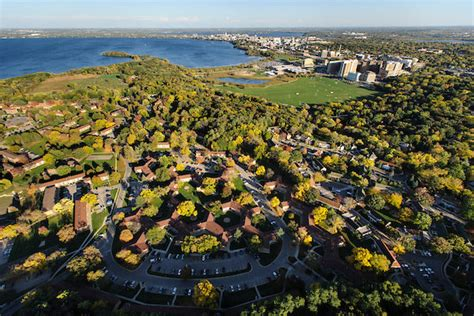
You see, my neighborhood is made up of graduate students and their families. The housing market in Madison is flooded with new mid- and high-rise apartments and old converted houses—all of them expensive—and finding affordable housing often requires searching a full year in advance. Grad students, who often don’t know their admissions status until March or April, are stuck picking over the dregs of available apartments or applying to the university housing waitlist. University housing is often cheaper and more reliable than other housing in the city, and it’s an easily identifiable choice for those traveling from far away, especially for international students and low-income students. So why is there a Flock camera at the foot of this neighborhood?
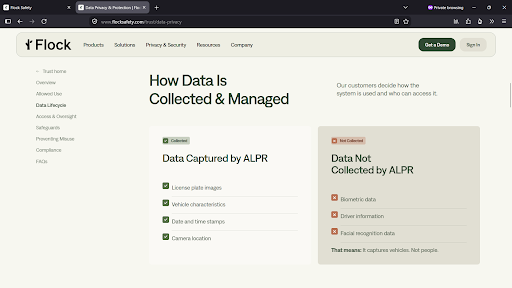
When I got home from the grocery store, I googled “flock camera uw madison” and was surprised to find that the university had been using Flock cameras for months already. The camera I saw could’ve been erected as early as the previous summer (Jacobs, “Flock”). The University of Wisconsin-Madison Police Department (UWPD), like police departments across the country, had signed a contract with Flock in summer 2025 under the promises of collecting license plate information that would aid in “investigations and crime prevention” (Kirchman). The contract involved installing eight automated license plate readers (ALPRs) in strategic locations around campus, including one at the entrance to the graduate housing neighborhood, one in the university hospital district, and one outside of the iconic Memorial Union, to name a few.
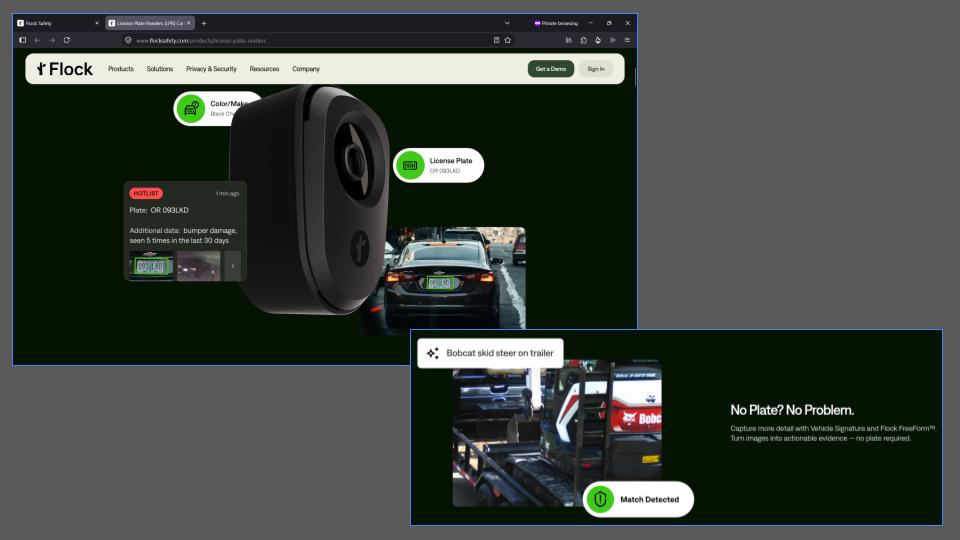
ALPRs are automated to photograph the back of a vehicle when it passes in view of the camera, capturing a digital photo of the vehicle’s license plate and other identifying features that may be found on the back of a car, such as vehicle make and color, dents, or trailers (Flock, “License Plate Readers [LPR]”). Flock then extracts these identifying features as data points and stores them in a searchable database for their subscribing agencies. Flock also collects metadata, such as the time and frequency with which the vehicle passes by the camera, which can be searched, too. One pass in front of an ALPR can generate several data points associated with the specific vehicle. All of this led me to ask: how much data about my car and my driving habits does Flock have?
This blog post is inspired by my personal experience with a Flock camera in my neighborhood. Additional research on these cameras and the company that makes them did little to assuage my anxiety, and in fact, made me feel more anxious when I realized how little I can learn about this tech and its uses. What did help me, though, was writing that I found online from fellow community members. I wasn’t alone in my fears, and there was already collective action taking place to address the use of these cameras in my town. What follows is rhetorical analysis of the Flock discourse that circulated around the UW-Madison campus in the first part of 2026. I pay particular attention to how corporate and local stakeholders rhetorically constitute “community” through appeals to safety and with various forms of surveillance and sousveillance, both of which describe the practice of ‘watching’ from different positions of power and which work to justify the use of or resistance to this technology.
Part 2: Datafication, Surveillance, and Sousveillance
While this blog post is primarily concerned with how stakeholders rhetorically constitute community, I think it’s important to explain how the specific processes of datafication, surveillance, and sousveillance work to shape these understandings. Mejias and Couldry describe datafication as the combination of two processes: “the transformation of human life into data through processes of quantification, and the generation of different kinds of value from data” (3). The contract between UWPD and Flock ‘datafies’ human life by turning driving into data points that can be searched as part of an investigation. The contract also promises value for both parties—data for UWPD’s investigations and data and money for Flock’s profit (Jacobs, “Flock”).
Contracts like the one between Flock and UWPD represent a typical transaction within surveillance capitalism, in which people’s data is extracted, bought, and sold in “new markets of behavioral predication and modification” (Zuboff 75). Importantly, the data being generated comes from the surveillance of people living their everyday lives, people who were not consulted when this contract was made and who did not consent to being monitored. The data being collected comes from a group of stakeholders—the public— who gain little value from their lives being datafied and who have much to lose when it comes to their privacy and data ownership.
In this way, surveillance and sousveillance help explain the power imbalance that exists among these stakeholders. Both terms have their roots in “veillance” or “watching” (Newell 257). Surveillance studies scholars typically cast governments and corporations as “watchers” who have a vested interest in collecting information on individuals, the “watched” (Anderson 9). When the “watched” “look back,” this practice is called sousveillance (Anderson 9-10). Sousveillance is the name for those practices which attempt to undermine corporate and/or government secrecy and demand greater transparency, and it applies to any practice from whistleblowing to copwatching. The primary distinction between everyday individuals and corporate or government ‘watchers’ is the accessibility of their data, with data about individuals being widely available to state and corporate interests while the inverse—data about the state and corporations—is widely unavailable.
This power imbalance is due in part to the habitualization of data collection about individuals (Mejias and Couldry; Beck). Not only do individuals share personal information with local and federal governments in order to participate in daily life (think: addresses, drivers licenses, employee identification numbers, etc.), but they also share data knowingly or unknowingly with digital platforms, creating what Beck calls a “digital identity” that approximates one’s real world identity (129-30). Individuals who create online profiles willingly share personal information when creating their account, but they’re also subject to less obvious forms of data collection, such as one’s search history, number of clicks on a website, and more (129-30). Inversely, corporations like Google have been studied for their “black hole” behavior (Anderson; Zuboff). With relatively little known about the data they collect and what it’s used for, activists have speculated about the possible dangers of these technologies being embedded in our communities, and crowd-sourced preventative measures and policy responses are popping up all over the country (see Resist and Unsubscribe for one example).
In my search to figure out where this camera came from, I came across online materials from UWPD and Flock disclaiming the intended and prohibited uses of ALPRs. I also found crowd-sourced websites explaining the many vulnerabilities that come with this technology and steps to increase transparency. Later, I even heard from faculty in my department about the Faculty Senate’s ongoing discussion about Flock cameras on campus, which led me to even more university community work. Records of this discourse are available online, giving us access to evidence of this local case study after the fact. In addition to my own experience as a community member, I include screengrabs and links to this evidence below for my audience.
Across these sources, I noticed that the concept of community was rhetorically constituted through surveillance and sousveillance practices as well as appeals to safety, which work to justify the use of or resistance to this technology. I argue that Flock and UWPD prescribe a definition of community that supports their use of surveillance technologies like ALPRs, while community groups constitute themselves in part through their sousveillance practices—by taking collective action in response to a perceived threat. In this way, Flock cameras have inspired public discourse about public safety, the collection and use of data, and the very definition of community.
Part 3: Prescribing Community
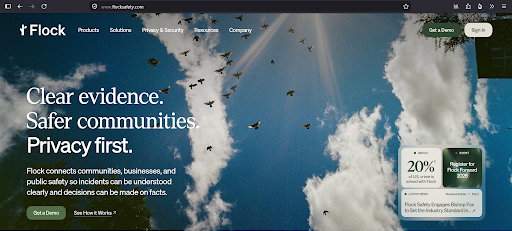
After clicking around Flock’s website, I found that the basic message from Flock about community is that their services work by “connecting” communities to keep them safe (Flock, “Homepage”). They claim to accomplish this by signing contracts with local law enforcement agencies, installing ALPRs in communities, and collecting data and metadata about passing vehicles for law enforcement agencies to use as evidence in their investigations (Flock, “License Plate Readers [LPR]”). Flock cameras combine features of classic surveillance (think: cameras and tape-recorders) and data surveillance because they use cameras to take photos of passing vehicles and then extract vehicle data from these photos. They claim—and UWPD reiterates this claim—that these practices solve crimes more efficiently and more accurately (Kirchman; UWPD). However, it’s worth pointing out that, while these cameras may result in more efficient crime-solving, this process requires they also collect data about every single vehicle that passes by them—whether they’re associated with a crime or not. This form of surveillance suggests that, according to Flock, the community is safer because everyone is monitored at all times. The sheer amount of data collected by ALPRs means that ‘safe communities’ are rendered as assemblages of searchable data to both Flock and their subscribers, “connected” through an infrastructure of surveillance.
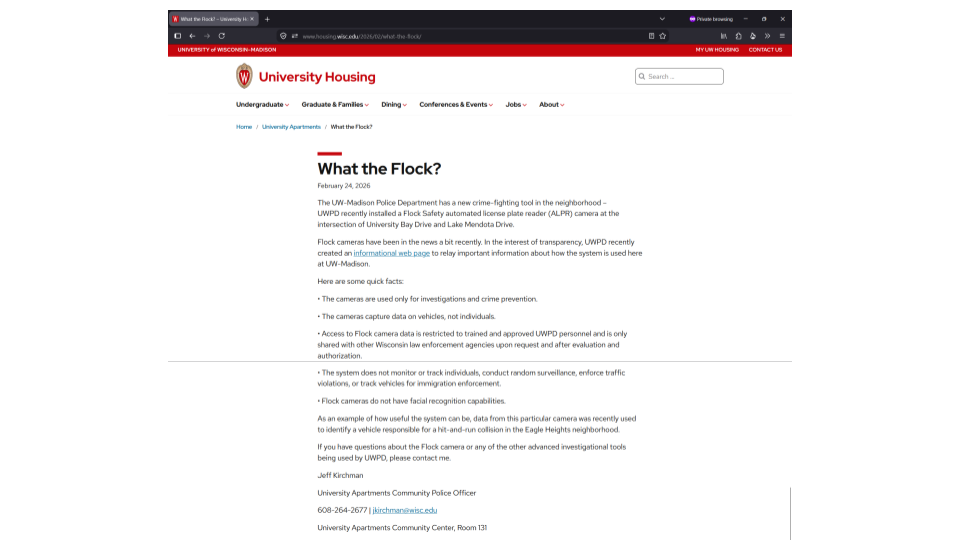
For their part, Flock and users like UWPD are adamant that their ALPR cameras do not capture data about people—only vehicles. The cameras themselves are not equipped to collect biometric data or details about drivers (Kirchman; UWPD; Flock, “Myths vs. Facts”). However, their appeals to safety reveal the difficulty with attempting to distinguish people from their vehicles. To put it another way, it’s impossible to completely isolate vehicle data from people—and that’s the point. Every vehicle is registered to someone and driven by someone, meaning data about a car passing by can be linked to a specific person or people, in much the same way as a laptop’s search history is associated with its owner. This link matters because it’s not the vehicles that are committing the alleged crimes being solved with this technology, it’s potentially the person driving the vehicle. Therefore, even though Flock only collects vehicle data, the connection between a vehicle and a person is vital to their crime-solving, safety-enhancing promises. This is another way in which Flock’s version of community is constituted through the mass surveillance and datafication of a mundane aspect of personhood—driving—a fraction of the data of which is actually used to increase “safety.”
In a meeting with the University Committee, a faculty organization within UW-Madison, UWPD Chief Brent Plisch claimed that the use of ALPRs is permitted because “there is no expectation of privacy for a vehicle, specifically people’s license plates, when it’s being operated on a public property” (Jiang). License plates are an important feature of bureaucracy—they work by enforcing vehicle registration, operation, and traffic laws on those who own and operate the vehicle. Again, however, these license plates only work because they link a driver to a vehicle. A car can never be ticketed or taken to court, arrested or charged with a crime—it’s the driver or owner of the car who is ultimately responsible in these cases. Before ALPRs, license plate searches might have happened in ad hoc situations in which police officers identified “reasonably suspicious” vehicles for additional investigation. Now, with ALPRs, the data on any vehicle that passes by is already there, waiting to be searched, shared, or sold. This conceptualization of privacy matters because it transforms the potential of surveillance into the expectation of surveillance without acknowledging the intrinsic connection between car and driver, thereby invading the privacy of individuals who get around by car.
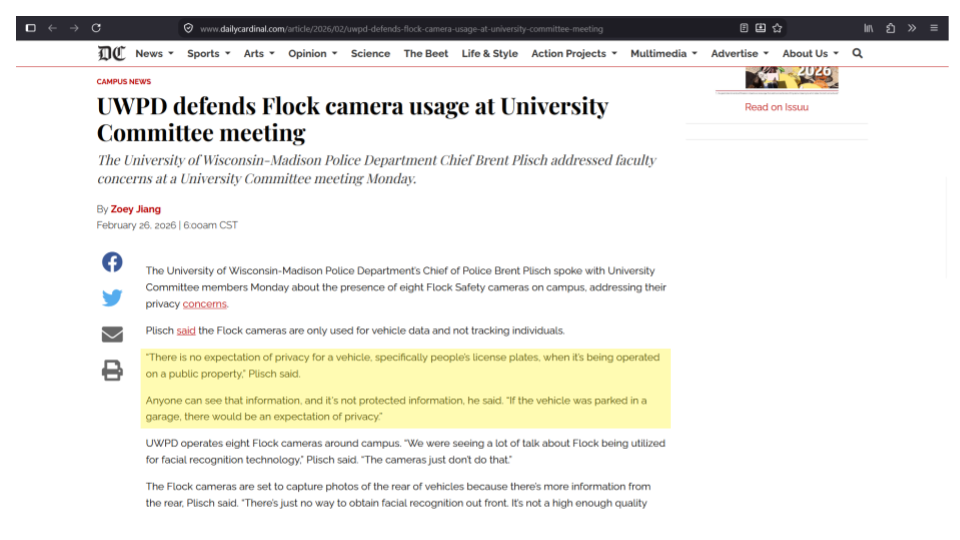
Also in this meeting, Plisch acknowledged that Flock Safety as a platform is about as safe data-wise as any other contract-based, third-party service, and compares their contract with the university’s use of Workday to manage personal and employment data for all university employees. He says about the risks associated with working with Flock, “Could Flock violate that contract? Absolutely they could. But so could Workday. Workday could sell all employee information” (Jiang). This comparison only further solidifies what I find to be a surveillance-based definition of community. Not only does Pilsch refuse to directly acknowledge the privacy concerns raised in the meeting, but when deflecting he describes university community members in terms of data, and privacy concerns in terms of data transactions, although these are not nearly all of the concerns that arise regarding this technology. For example, even those granted access to Flock infrastructure can abuse the technology, as has been the case in police departments across the country (Jiang; Kerhin; Fox6 News Digital Team). To Flock and UWPD, the people that make up the UW-Madison community seem to be more like a data set than anything else, and the ‘connections’ and ‘safety’ referenced in their language seemingly amount to institutional control—compulsory ‘connection’ to the institution and its contractors, and ‘safety’ of the data collected from community members. All of this amounts to a prescribed version of community that can only be understood through datafication and surveillance.
Part 4: Sousveillance as Community
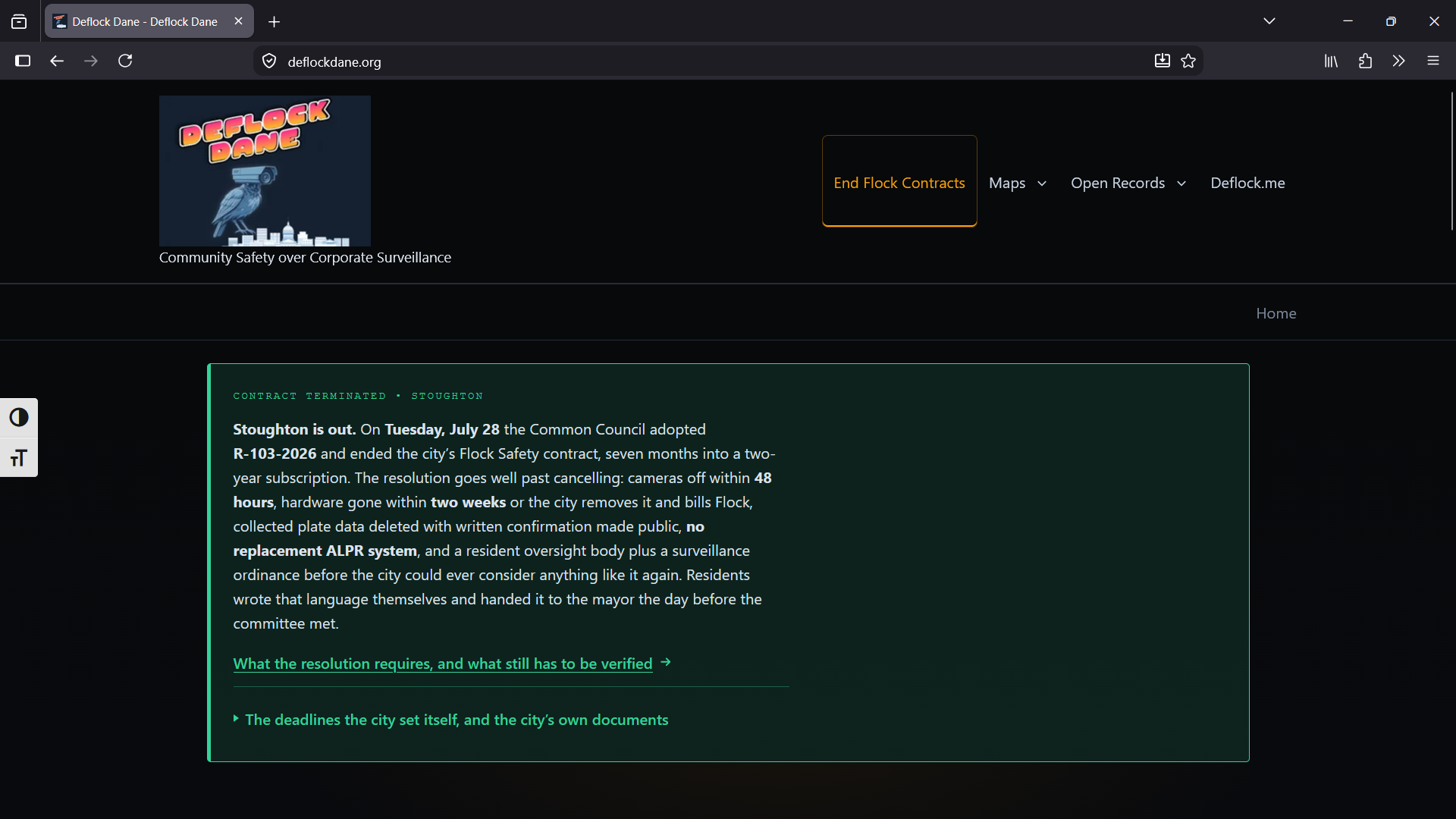
In opposition to the surveillance practices of Flock and UWPD, the website DeFlockDane.org and the university’s Academic Staff Assembly and Faculty Senate constitute community through their sousveillance practices, namely, their commitment to sharing information with the public and working on policy reforms. DeFlockDane.org is a county-wide, crowd-sourced, open-access website where contributors share ALPR mapping data, press releases, contracts, and other official documents from local government and law enforcement agencies. The website even offers resources for drafting records requests, making this process accessible for interested community members (DeFlock Dane, “Wisconsin”). To users and contributors of DeFlockDane.org, ‘safety’ means safe from “corporate surveillance” (DeFlock Dane, “Homepage”).Crowd-sourced websites like these work by confronting the secrecy associated with these companies and technologies and demanding transparency. Safety is not a top-down decision made by surveillance technology companies and law enforcement agencies, but rather an ongoing discussion among the public. In this way, DeFlock Dane builds community through the sousveillance practices of sharing information and promoting discourse about what it means to be safe.
In addition to the local website, UW-Madison’s Academic Staff Assembly and Faculty Senate are two more community groups actively participating in sousveillance—albeit from a relatively more powerful perspective. The Academic Staff Assembly and the Faculty Senate are part of the university’s system of shared governance and represent academic staff and faculty respectively in “matters of university-wide impact” (Office). As two primary governing bodies on campus, both groups hold quite a lot of institutional power, which is why it’s notable that both discussed resolutions asking UWPD “to cancel their contract with Flock and remove the cameras on campus” (“Faculty Document 3311rev”). The resolutions also asks UWPD to make their surveillance contracts available with the campus community and submit to civilian oversight (“Academic Staff Document #864”). To support these resolutions, the authors put forward several facts about Flock cameras, including that it’s a cloud-based technology connected to other cameras and agencies outside of the university, Madison, and even Wisconsin, and the potential for abuse of this technology, especially for immigration enforcement. It also expresses concerns about the use of facial recognition, a feature that’s not present in ALPRs but is present in other Flock products.
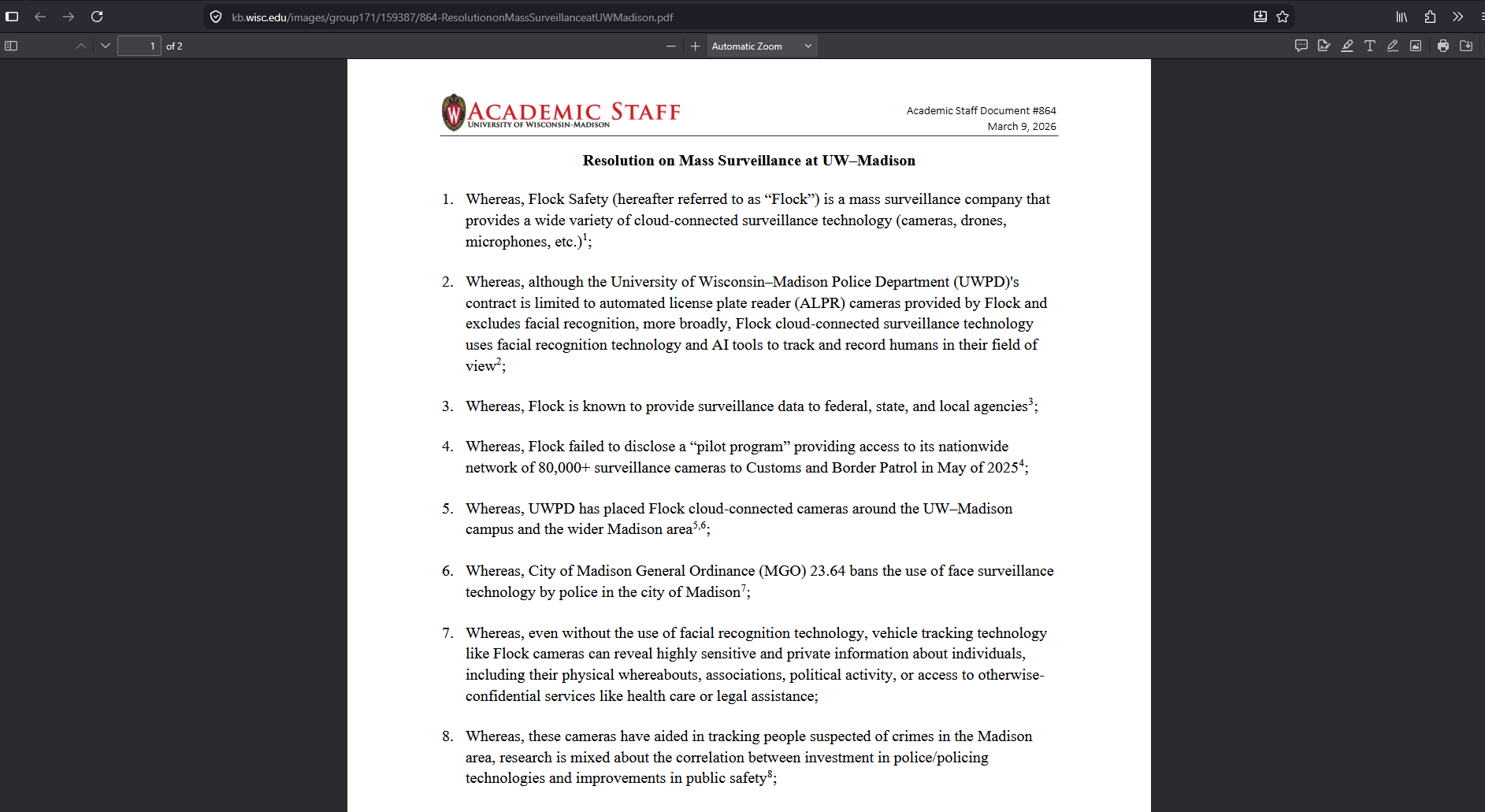
The Academic Staff Assembly discussed and passed the “Resolution on Mass Surveillance at UW-Madison” in March 2026, making them the first university governing body to do so. In the Faculty Senate, Flock cameras on campus were first discussed on April 6, 2026, with the reading of the “Resolution on Mass Surveillance and Shared Governance at UW-Madison.” This resolution was similar to the Academic Staff Assembly’s but adds consideration for the university’s data policies and points out UWPD’s unilateral decision-making. The Faculty Senate was scheduled to vote on the resolution on May 4, 2026, but it was later tabled for the fall semester (Jacobs, “UW-Madison police”). In any event, their framing of Flock cameras on campus presents an alternative definition of community. These resolutions constitute evidence of community by responding to a new shared threat—the datafication and surveillance of community members without their consent.
Part 5: “Looking Back” and “Talking Back”
In this blog post, I’ve examined the rhetoric that circulated around the use of Flock cameras on the UW-Madison campus in the first part of 2026 to understand how different stakeholders constitute community through datafication, surveillance, and sousveillance practices. If, as I have argued earlier, we agree that vehicle data is only useful because of its connection to people, then the use of ALPRs represents a form of datafication in which people’s everyday movement is collected. Even if this data is not relevant to an investigation or any type of searching, it is still held by Flock and their users for a period of time before being deleted. In this way, Flock and their users prescribe community by presenting their services as a solution to potential threats, promising safety through continuous, widespread surveillance. Their decisions about what constitutes threat, safety, and community were exclusive decisions made without open discussion. Conversely, community groups like the university’s Academic Staff Assembly, Faculty Senate, and DeFlockDane.org have engaged in information sharing, dialogue, and voting, coming to the agreement that ALPRs constitute a threat to the community because of their secrecy and lack of transparency.
By first invoking community safety to justify the installation of ALPRs, Flock and UWPD set off a chain of discourse across the community about what safety means to different stakeholders. Increased community surveillance inspired collective sousveillance practices that promoted civic dialogue and policy reform, practices that might best be summarized by DeFlock Dane’s logo: “Community Safety over Corporate Surveillance” (“DeFlock Dane, “Homepage”). In this case study, sousveillance works by both “watching back” and “talking back” in the form of public discourse and policy work, making sousveillance a set of both material and rhetorical practices.
In the months since I first noticed that Flock camera, the city of Madison and UWPD both ended their contracts with Flock. UWPD announced their decision on July 3rd, but it wasn’t until August 3rd that the camera at the foot of my neighborhood was taken down. I remember leaving my house to get coffee and shouting for joy when I saw the camera laying face-down in the grass. Joy for myself and for my neighbors, for people who drive up and down this road for work or to enjoy the lakeshore path on Lake Mendota. Joy at the thought of being able to move a little more freely, without the constant feeling of being watched every time I leave my home.
That being said, UW-Madison and the city of Madison at large still have more to discuss when it comes to community safety. While it’s clear by now I’m not a huge fan of cameras and their surveillance potential, I’m glad there were cameras across town earlier this summer—phone cameras, which were pulled in haste when passersby saw a Black man being surrounded by Madison police, forced to the ground, beaten, tased, and murdered in less than two minutes. What happened to Corey Ruiz is only widely known because community members decided to “watch back” (Moen et al). Madison police do not wear body-cameras, meaning there’s less evidence of their behavior with which to hold them accountable. Multiple video recordings of this murder are sousveillance in action, increasing transparency to hold those in power accountable.
Residents of Madison and the larger Dane County area raised awareness through digital activism, protests at the capitol and on street corners, and with policy appeals. Their practices of “watching back” inspired forms of “talking back,” or the continued discourse that shows that our community is committed to one another, our safety, and the truth.
Dedicated to Corey Ruiz and the city of Madison, a place I love critically.

Works Cited
“Academic Staff Document #864.” Academic Staff Assembly, University of Wisconsin-Madison. https://kb.wisc.edu/images/group171/159387/864-ResolutiononMassSurveillanceatUWMadison.pdf.
Anderson, Patrick D. “Of Cypherpunks and Sousveillance.” Surveillance and Society, vol. 20, no 1, 2022, pp.1-17. https://ojs.library.queensu.ca/index.php/surveillance-and-society/index.
Beck, Estee. “The Invisible Digital Identity: Assemblages in Digital Networks.” Computers and Composition, vol. 35, 2015, pp.125-40, https://doi.org/10.1016/j.compcom.2015.01.005.
DeFlock Dane. “Wisconsin Open Records Request — Drafting Tool.” DeFlock Dane. https://deflockdane.org/wisconsin-open-records-request-tool/.
—. “Homepage.” DeFlock Dane. https://deflockdane.org/.
Office of the Secretary of the Faculty. “Faculty Senate.” University of Wisconsin-Madison. https://secfac.wisc.edu/senate/.
“Faculty Document 3311rev.” Faculty Senate, University of Wisconsin Madison. https://kb.wisc.edu/images/group222/shared/2026-05-04FacultySenate/3311rev-Coversheet-Surveillance.pdf.
Flock. “License Plate Readers (LPR).” Flock Safety, 2026. https://www.flocksafety.com/products/license-plate-readers.
—. “Homepage.” Flock Safety, 2026. https://www.flocksafety.com/.
—. “Myths vs. Facts.” Flock Safety, 2026. https://www.flocksafety.com/trust/myths-facts.
Fox6 News Digital Team. “Milwaukee police officer charged with misconduct over Flock searches.” Fox 6 Milwaukee, 24 Feb 2026. https://www.fox6now.com/news/milwaukee-police-officer-charged-misconduct-over-flock-searches.
Jacobs, Becky. “Flock cameras at UW-Madison draw criticism from students, employees.” The Cap Times, 25 Mar 2026. https://captimes.com/news/education/flock-cameras-at-uw-madison-draw-criticism-from-students-employees/article_53484ce2-599d-46f2-91b2-0dc58586cb6d.html.
—. “UW-Madison police to remove contentious Flock cameras from campus.” The Cap Times, 6 July 2026. https://captimes.com/news/education/uw-madison-police-to-remove-contentious-flock-cameras-from-campus/article_150acf6c-c335-45f4-95dd-ab99d7f9b910.html.
Jiang, Zoey. “UWPD defends Flock camera usage at University Committee meeting.” The Daily Cardinal, 26 Feb 2026. https://www.dailycardinal.com/article/2026/02/uwpd-defends-flock-camera-usage-at-university-committee-meeting.
Kerhin, Brian. “Menasha police officer accused of using license plate recognition system to track his ex.” Fox 11 News, 9 Jan 2026. https://fox11online.com/news/crime/menasha-police-officer-accused-of-using-license-plate-recognition-system-to-track-his-ex-girlfriend-cristian-morales-misconduct-in-office-flock-domestic-abuse-restraining-order-cash-bond.
Kirchman, Jeff. “What the Flock?” University Housing, University of Wisconsin-Madison, 24 Feb 2026. https://www.housing.wisc.edu/2026/02/what-the-flock/.
Mejias, Ulises A. and Nick Couldry. “Datafication.” Internet Policy Review, vol. 8 no. 4. 29 Nov 2019. DOI: 10.14763/2019.4.1428.
Mentzer, Rob and Danielle Kaeding. “Gatherings across Wisconsin protest ICE shooting of Alex Pretti.” Wisconsin Public Radio, 26 January 2026. https://www.wpr.org/news/gatherings-across-wisconsin-protest-ice-shooting-alex-pretti.
Moen, Corey, et al. “Full Video: Police involved fatal shooting in Madison.” Channel 3000, 22 July 2026. https://www.channel3000.com/news/full-video-police-involved-fatal-shooting-in-madison/article_2b47a3cd-49dc-46b5-bb20-8448f784378f.html.
MPR News. “The latest on ICE in Minnesota.” Minnesota Public Radio. https://www.mprnews.org/live-updates.
Newell, Bryce Clayton. “Introduction: The State of Sousveillance.” Surveillance and Society, vol. 18, no. 2, 2020. pp. 257-261. https://ojs.library.queensu.ca/index.php/surveillance-and-society/index.
Resist and Unsubscribe. https://www.resistandunsubscribe.com/.
UWPD. “ALPR Cameras at UW-Madison.” University of Wisconsin-Madison. https://uwpd.wisc.edu/data-policies-resources/alpr-cameras-at-uw-madison/.
Zuboff, Shoshana. “Big Other: Surveillance Capitalism and the Prospects of an Informed Civilization.” Journal of Information Technology, vol. 30, 2015. pp. 75-89. https://doi.org/10.1057/jit.2015.5.