As we begin one academic year and look back at the last, the DRC Fellows share their reflections on their projects, collaborations, and takeaways from the Fellowship. It was wonderful to work with each of the Fellows this year, and to see the ways in which connections with DRC advisory board members, directors, and other fellows developed. Additionally, all of the fellows co-presented at Computers and Writing this year and interviewed the past and current editors of Computers and Composition.
We wish the Fellows the best on the next part of their journey and appreciate all their contributions!
Thais Rodrigues Cons
It has been an immense privilege to return for a second year as a DRC Fellow. This year, I was excited to expand the types of projects I had worked on. One of the highlights was co-leading the Blog Carnival with Ali. I could not have asked for a better partner to go through a process that felt very similar to an editorial experience, from writing and circulating the CFP to reviewing and editing submissions and, finally, publishing the work of our amazing contributors. Another important project was Nicole’s and my contribution to the Syllabus Repository, which allowed me to experience another very rewarding editorial process, particularly through the work happening on the backend.
Across these projects, I was able to be more intentional about my commitment to social justice and socially just pedagogy, whether through technical and professional communication (TPC) in the syllabi we curated or through multimodality in the Blog Carnival. I especially appreciated seeing how contributors approached these questions from different contexts–disciplinary, pedagogical, and institutional.
These projects also felt like a meaningful complement to my first year as a fellow, when much of my work focused on professional development, mentorship, and my own transnational positionality. Returning for a second year gave me the opportunity to build on those interests while exploring new kinds of collaborative and editorial work. I am very grateful for another year with the DRC community and for everything I have learned from our fellows, contributors, and leadership.
This year also brought a more structured mentorship experience with members of the DRC board, which I really valued–it shows how much thought the DRC leadership, Naomi, Simone, and Alyse, puts into improving the DRC fellowship experience each year. One meaningful opportunity was collaborating with other fellows to interview Drs. Cindy Selfe, Kristine Blair, and Jason Tham and co-write a piece for the Computers and Composition 50th anniversary special issue. That process was both a joy and an honor. Being able to contribute, even in a small way, to a historical landmark for a journal that has been a staple of our field felt especially relevant at a moment when stable journals, scholarly communities, and disciplinary homes feel more important than ever for the digital rhetoric community.
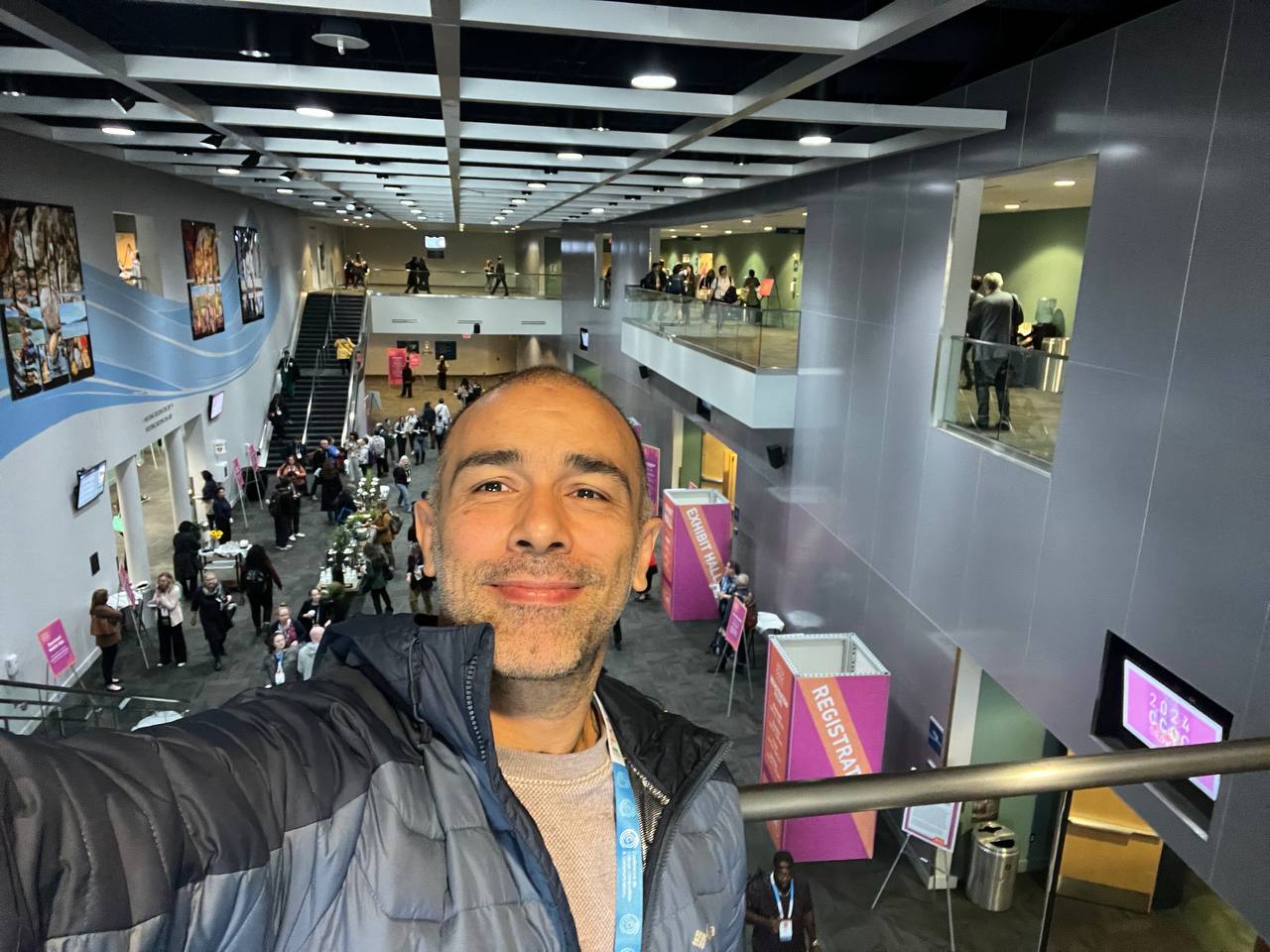
Finally, it is always a great joy to extend the DRC community into conference spaces; this year, I got to meet and reconnect with colleagues at CCCC in Cleveland and ATTW in El Paso. I was sad that I could only be virtually at Computers & Writing this year, since it has become such an important space for connecting, but I am already excited that we will get to welcome everyone to Tucson next year! 🌵
These conference experiences reminded me that the DRC is larger than a fellowship to create projects together, but an established community that continues across different spaces and generations in the field–and that I’m forever grateful to be a part of. I hope to give back all the through mentoring and dialogue in the following years of my career.
Ali Alalem
The DRC fellowship has been a rewarding professional development experience. Not only have I connected and collaborated with talented emerging scholars from different backgrounds, but I have also worked on projects I am passionate about and developed skills instrumental to my future success.
The highlight was collaborating with Thais and Nicole on two separate projects: a Blog Carnival and a Hack and Yack post. It was a unique experience to co-lead Blog Carnival 24 on Multimodality, Social Justice, and Human-centered Praxis with Thais. I developed tremendous skills through the multilayered process of the project, which involved co-drafting the CFP, soliciting submissions from other scholars, co-managing submissions, making editorial decisions collaboratively, sending feedback, communicating with contributors, and ultimately publishing a diverse range of high-quality contributions. I was both impressed and inspired by the multimodal, justice-oriented praxis these scholars and educators are implementing. It was also a delight to connect with and learn about fellow scholars with shared interests outside the fellowship. Equally meaningful was working with Nicole on developing a resource on integrating podcasting in the classroom as a tool for social justice pedagogy. I was amazed by how smoothly we wove both of our experiences and perspectives into one cohesive Hack and Yack post. Throughout this project, I enjoyed collaboratively finding research-based information to support praxis, thinking critically about classroom practice, reflecting on past experiences, and evaluating design choices.
Another experience that stood out to me was working with other DRC Fellows on the scholarly article in which we interviewed the current and past editors of Computers and Composition. Tracing the journal’s history, I was fascinated by its enmeshment in social justice since its inception and how its mission is even more critical in the current moment. This gave me a renewed sense of confidence in the work I have been doing for the past few years. I also gained invaluable skills by co-planning with other Fellows, crafting the interview questions together, shaping the conversation, integrating the multimodal elements, and writing the introduction collaboratively. I am filled with gratitude for having had the opportunity to sit with Drs. Selfe, Blair, and Tham and contribute to such an important scholarly conversation. I also couldn’t be more thankful to Dr. Naomi Silver for trusting us with this work and helping us along the way.
Finally, I appreciate the effort that DRC leadership has made to ensure that we thrive. The monthly meetings helped me stay on track and learn about the impressive work other Fellows were doing on their own projects. Having Dr. Antonio Byrd as a mentor also enabled me to gain important insights and receive the guidance I needed. As a DRC alumnus, I am both proud and grateful.
Nicole Koyuki Golden
My past year with the Sweetland Digital Rhetoric Collaborative (DRC) has been wonderful. I really enjoyed working with such a passionate and intelligent cohort of fellows, and I’m so grateful for the supportive mentoring and guidance from Alyse, Naomi, and Simone. One of my favorite aspects of the Sweetland DRC fellowship was definitely the environment; although we all collaborated from many different parts of the country, the genuine community created in our online spaces cannot be understated.
Another highlight of my time as a fellow this year was attending the 2026 Computer & Writing Conference where I shared one of my DRC projects. I’m really proud of the work of myself and my collaborators–Thais and Ali, respectively–in our two projects. Not only did we collaborate thoughtfully and intentionally with one another but our research is exciting as both projects connected social justice to composition classrooms in distinct ways. The throughline of social justice across both projects showcases my own philosophy as a teacher-researcher that justice is an essential component of everything I do. Sometimes this shows up in small-scale ways, such as one class session, and other times justice can be felt throughout a lengthy process, like communicating with colleagues over time.
My experiences as a Sweetland DRC fellow have been so meaningful–to my understanding of digital rhetoric, to my sense of community in the field, and to my graduate studies–especially as I look ahead to the end of my tenure as a graduate student. I’m incredibly grateful for the opportunity to be part of the DRC community this past year, and I’m excited to stay connected into the future. Please come say hi to me at Computers & Writing or elsewhere!
Erin Miller
I had so much fun being part of the DRC this year! I definitely felt a little unsure about my place in the field of digital rhetoric before joining, but being welcomed into the DRC helped me feel more confident that I am an active participant in the field. The DRC’s model of two projects + one conference presentation was a great way for me to generate and talk through my ideas about digital rhetoric with others.
My first project, a yack post I co-authored with Funmi, was the fulfillment of a passion project I’ve been thinking about for over a year. Not only did I get a chance to think more deeply about the rhetorical power of data centers, but I also got to have several deep, meaningful conversations with Funmi about data centers and their place in the world relative to the Global North and Global South. Working together on this project made me a better writer and researcher, and a more attentive collaborator. Thank you, Funmi!
After taking a stab at writing about data centers, I was inspired to address another technology that had been affecting me—Flock cameras. I took on this project solo, and the difference in work-flow was noticeable. I never lost the passion for the project, but opportunities for discussion dwindled, especially as the DRC Fellowship started winding down in the summer months. One of the most valuable aspects of the DRC Fellowship is the fellowship—the chance to work together on something with a new collaborator—so I would definitely caution future graduate fellows to keep that in mind if they’re considering solo projects!
My experience presenting at Computers and Writing only further proves my point. Funmi and I teamed up again to talk about the “lifecycles” of Google Docs and ChatGPT prompts, and we were joined by Mehdi, who spoke about the cosmotechnics of writing. Our panel generated a lively discussion between us and our audience members, and I’m still thinking about some of the points that were made and how they relate to my research and pedagogy. If nothing else, the work I did with the DRC helped solidify my interest in digital rhetorics of technology and how we as humans experience them.
I have a whole host of people to credit with making my time as with the DRC so rewarding. Thais, Nicole, Ali, Funmi, and Mehdi were an amazing group of fellows to work with, and I was so impressed by the work that they did. Their insights and their technical execution of blog carnivals, interviews, and podcasts were astounding to watch develop. Naomi, Simone, Sunshine, and Alyse supported us graduate fellows through every step of the fellowship. They checked in on projects, offered useful feedback, coordinated hybrid conference panels, connected us to faculty mentors in the field (hi, Laura!), and met each of us with warmth and compassion. As someone who has made an academic home in one institution for the last four years, participating in the DRC was a really great experience in getting out of my comfort zone and meeting new people.
Funmilola Fadairo
Online publishing used to be a huge part of my life before academia and I always assumed it would fizzle out until I joined the DRC fellowship. This past year has provided me with the opportunity to express my ideas without being constrained by the timelines that typically govern academic publishing. I am particularly grateful for the liberty to work on projects that align deeply with my interests. One of my major highlights was working with Erin on The Rhetorical Power of Data Centers. It opened my eyes to the inherent value that comes from working with another brilliant mind to address key concerns in today’s digital world. Being a DRC fellow allowed me to center marginalized perspectives in digital rhetoric by providing Global South perspectives that are often underrepresented.
This fellowship has also provided me with the opportunity to meet incredible individuals shaping the technical communication and digital rhetoric space. I would say that my experience as a DRC fellow had a lot of interviews involved since I was able to interview five researchers in my field during my time here. First, I had the opportunity to interview Dr. Cindy Selfe, Dr. Jason Tham and Dr. Kristin Blair as I contributed to the Computers and Composition 50th anniversary issue, which was also my first academic publication. Also, through my AI Rhetoric: Behind the Tech video series, I was able to interview Dr. Dustin Edwards and Dr. Cana Itchuaqiyaq, who both provided insightful perspectives on how artificial intelligence is impacting our world. Presenting alongside other DRC fellows at the Computers and Writing conference was also a major highlight for me, especially with Erin and Mehdi on the same panel, providing in-depth perspectives to wicked problems.
I have always believed that academic work should transcend the walls of the university to provide a more direct impact on the public. Through the projects I worked on as a DRC fellow and the mentorship I received as I navigated these projects, I can boldly say that I was able to achieve that. It was really incredible to see how much Naomi, Simone and Alyse were committed to ensuring that we got all the help we needed to execute all our projects, regardless of how ambitious some of them were. Interacting with the other DRC fellows online and physically has also been a major part of this experience, it’s always a pleasure when people doing impressive work collaborate with each other. I am thankful for the incredible people I got to work with throughout this fellowship.
Mehdi Mohammadi
This was a difficult year for me personally. Following the killing of protesters in Iran and then the war in Iran, it was often difficult to separate academic life from what was happening back home. There were moments when writing, research, conferences and the ordinary routines of graduate school felt strangely distant from the events I was following and thinking about every day. I also want to acknowledge that there were times when I was not able to be as present or active in the DRC community as I would have wanted, and I apologize for that. I’m especially grateful for the understanding and generosity I experienced from the people around me during those moments. At the same time, the DRC gave me a community and an intellectual space in which I could continue working through questions that have become increasingly important to me: how technologies participate in our lives and writing, whose assumptions and values become embedded in them, and how differently technology can be understood across cultural and political contexts.
One of the highlights of my fellowship was co-editing Blog Carnival 25, [Blank]-in-the-loop Writing: Rethinking Processes, Tools, and Workflows, with Derek (Dr. Mueller). He is one of the most supportive and most knowledgeable scholars I’ve ever worked with. Developing the carnival gave me an opportunity to think beyond simplified narratives of either human or machine authorship and instead ask what else might be in the loop when we write. We drew from conversations around rhetorical load sharing and we invited contributors to fill in that blank themselves and examine the people, technologies, infrastructures, routines, frictions and refusals that shape their composing processes. I especially valued the collaborative editorial process with Derek and the opportunity to create a space where contributors could approach these questions critically, seriously and playfully.
At Computers & Writing with Erin and Funmi, I talked about what happens when writing increasingly becomes data to be processed, classified and optimized by digital infrastructures and AI. I was especially interested in what might get lost in that process, that is cultural specificity, ambiguity, memory and the different ways communities use writing to make sense of and relate to the world. And my Yack post explored how generative AI might be changing not only who or what writes, but our experience of writing through time. I argue that when AI generates language for us, parts of the usual process of thinking, anticipating, composing and revising can become compressed or skipped so that we increasingly encounter writing as something that has already arrived rather than something we gradually compose. I also should thank some people: Simone is the salt of the earth, a Good Samaritan, genuinely kind, deeply compassionate, remarkably gracious, incredibly big-hearted, endlessly thoughtful, exceptionally caring, wonderfully supportive and unfailingly generous. And Dr. Silver: thank you for your unwavering support. Also should thank the fabulous fellows: Erin, Ali, Thais, Funmi, and Nicole. I’ve learned a lot from you.