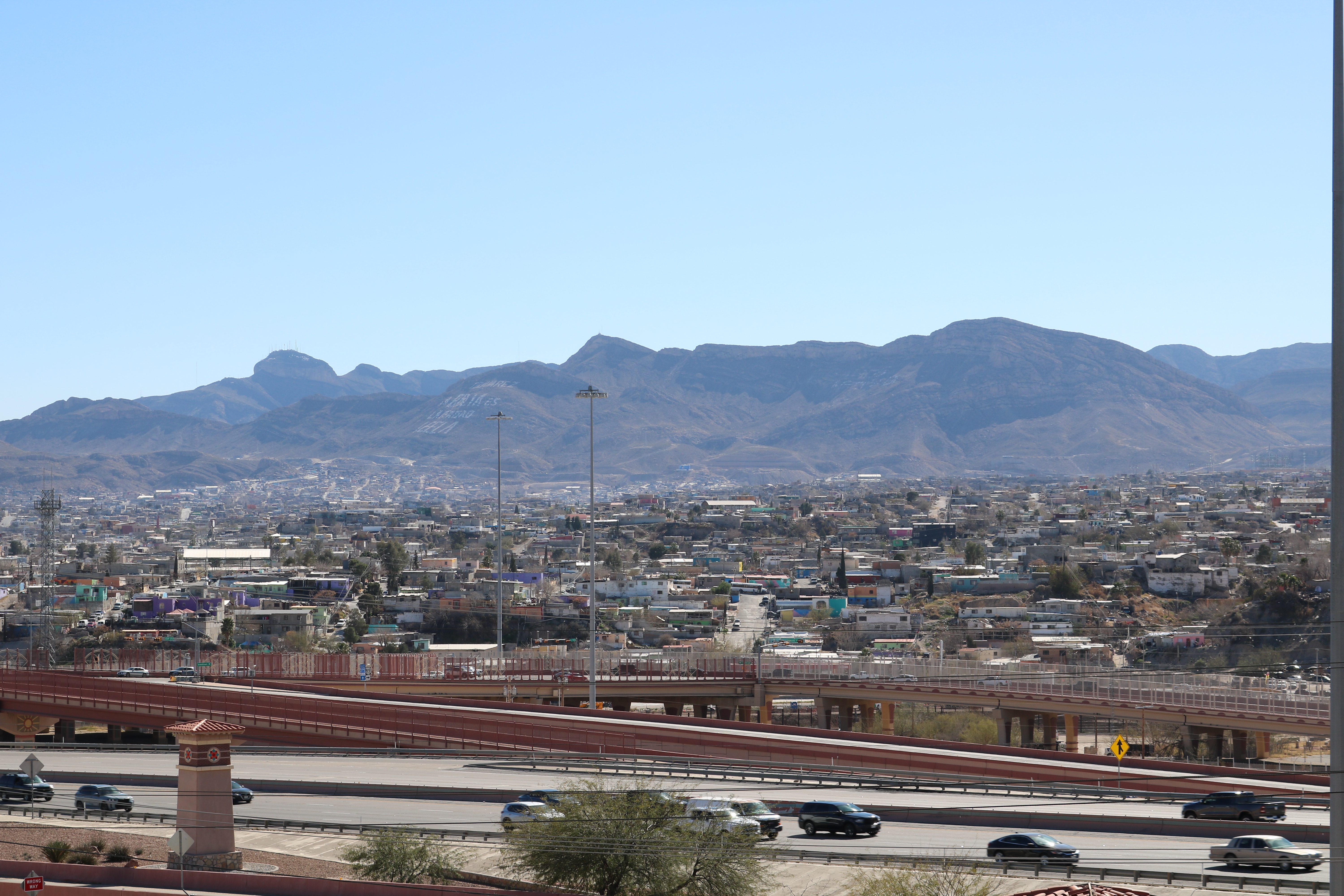
Laura Gonzales emphasizes translation as an inherently rhetorical experience – with “constantly shifting and multi-layered cultural–rhetorical processes that encompass multimodal elements such as embodied movements, sounds, and digital composing” (Gonzales and Turner 2020) – that belongs even in monolingual writing classrooms (Gonzales 2018). Her work transformed how I teach First-Year Composition at The University of Texas at El Paso (UTEP), a Hispanic Serving Institution in my bilingual, bicultural hometown of El Paso, Texas, which is separated from its sister city of Ciudad Juárez, Mexico, by nothing more than a heinous steel border wall.
The students I teach are primarily bilingual, many of whom spend hours every day crossing national borders to obtain an education. Despite this, I neglected to understand how bilingualism would shape the way my students approached writing with machine translation tools like Google Translate.
While some students may use machine translation to save time, I fear many rely on it to shape their work into a preconceived notion of perfect writing – one that embraces Standard English and therefore devalues and illegitimizes their experiences and perspectives. Tools like Google Translate were never intended to translate large texts (Gokgoz-Kurt 2022) and lack the capability to capture tone, culture, history, sarcasm, and other elements that move writing away from the dominant culture. As Gonzales and Turner (2020) write,

[…] for many communities of color, the process and practice of translation is anything but automatic or neutral […] but is instead an ongoing, racialized, and rhetorical act that requires a navigation of material, visual, alphabetic, and embodied relationships with people, languages, communities, histories, and cultures.
Since this realization and because scholars have argued for the importance of multilingualism, translanguaging, and honoring authentic voices in writing classrooms (Mangelsdorf 2010), I’ve worked to enact a critical embodied pedagogy that as Christina V. Cedillo writes, “recognize[s]the diverse ways by which we all navigate spaces on the page and in the world.”
I aim to enact this through assignments, lectures, and readings that embrace multimodal processes (photography, drawing, music, video) in English and Spanish but also recognize writing as both a political and embodied act (Cedillo 2018).
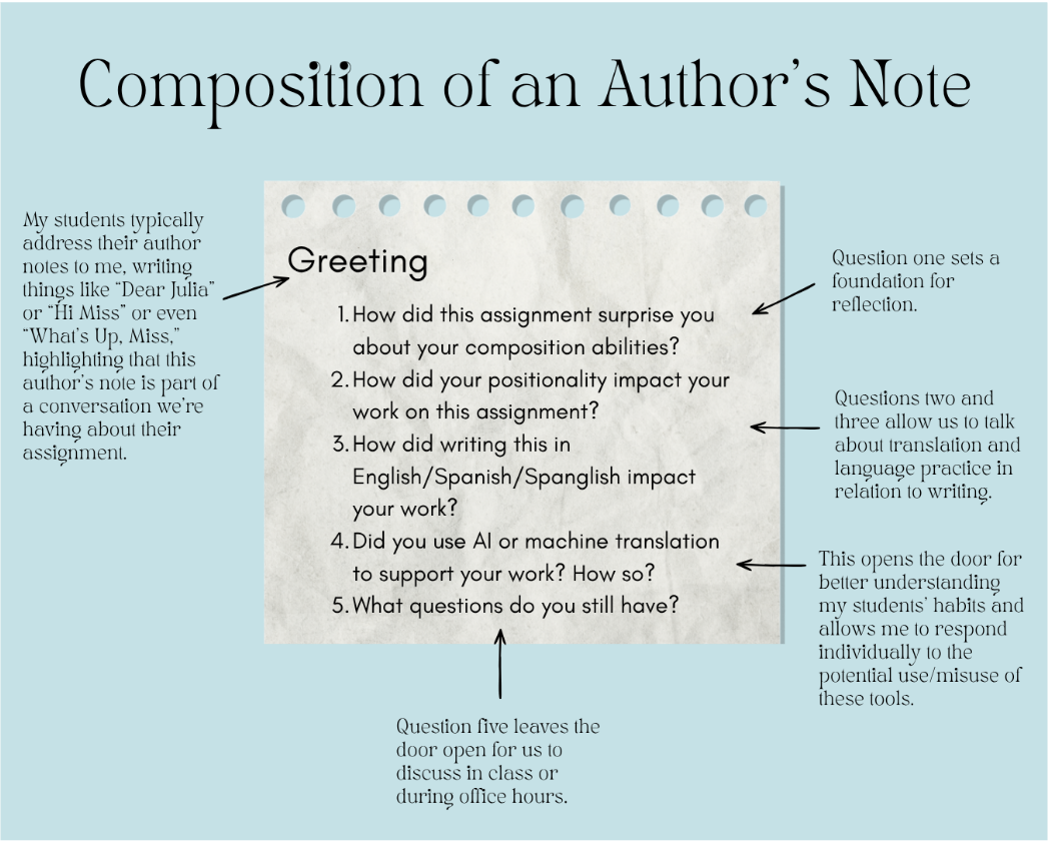
UTEP’s First-Year Composition Handbook emphasizes understanding our linguistic identities/histories to strengthen our writing (Rosenberg 2025), which guided how I developed new assignments and tweaked existing ones to model Gonzales’s multimodal approach to translation, even if my students were writing only in English, and to honor the importance of writing in one’s own voice. Furthering multimodality, I’ve also incorporated author notes for students to reflect on their composition processes, giving them space to talk about translation and meaning after completing each assignment. Through strategic questions, exemplified below, the notes encourage communication over perfection, working to dismantle the idea that machine translation knows best.
Assignment #1: Honoring Our Writing and Language
This assignment kicks off the semester to illustrate how we will utilize and interrogate rhetoric/writing, including translation practices. Students have shared songs they’ve composed, cover letters they’ve written for jobs, and text messages in which their sentences transcend both English and Spanish.
The first assignment I created asks students to look at composition within themselves and their communities to analyze how their linguistic identities and different rhetorical situations have invoked them to compose. Part one analyzes past compositions, like poetry, scholarship essays, and daily communications. In reflection, they answer questions about wording, audience, inspiration, revision, and when writing multilingually, how using English and/or Spanish impacts their editorial decisions. Part two encourages them to look at narrative/storytelling in their families and communities, using multimodal approaches such as illustration (one of Gonzales’s noted translation steps), photography, or music, while part three asks them to analyze a piece of composition in the world around them, such as advertisements or songs. This assignment is buffeted by discussions of politics, language, and translation, readings like Gloria Anzaldua’s How to Tame a Wild Tongue and Cracking the Code by Jesmyn Ward, and TEDx Talks on codeswitching.
For part two, students have shared photographs of family members whose narrative traditions inspire their own writing practices, as well as illustrations of settings in which storytelling takes place, including kitchen tables, inspired by the works of Anzaldua. Students have remarked how this assignment helps them to appreciate their own voices and composition abilities. In my feedback and through in-class conversations, I guide students to build connections between their everyday multimodal compositions to their heritage, histories, and language of choice to illustrate their rich writing/translating abilities without the use of AI/machine translation.
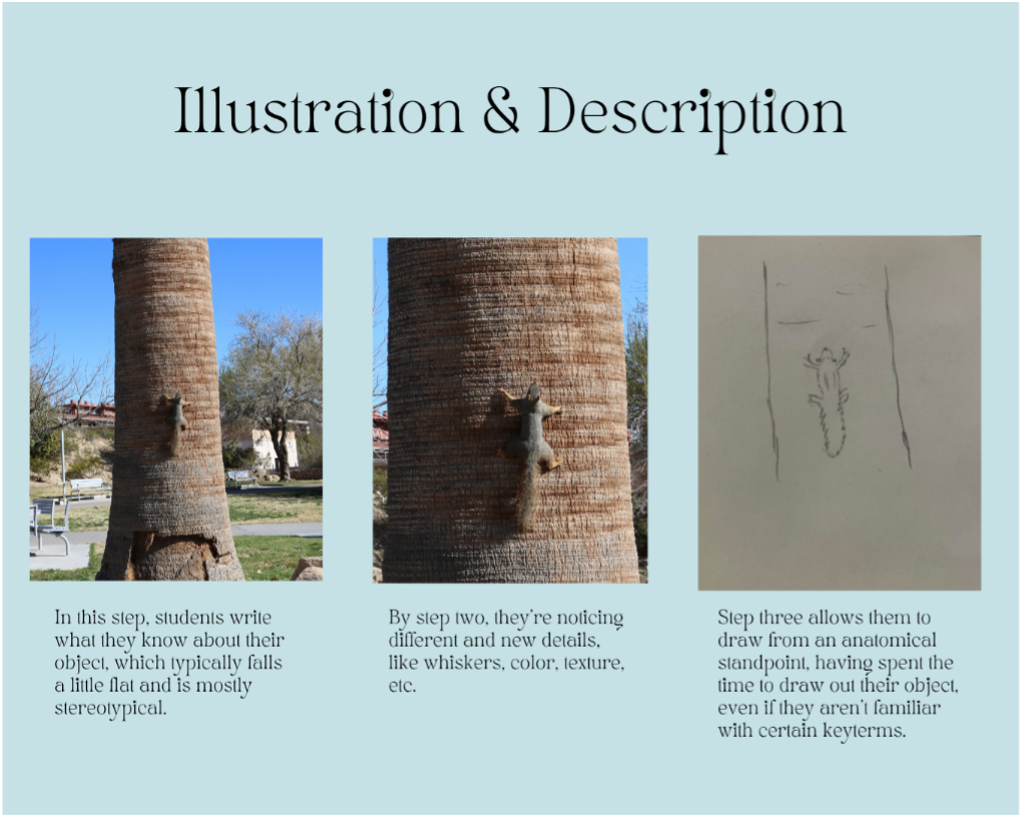
Assignment #2: Illustration and Description
Because illustration is an often-important component of translation (Gonzales and Turner 2020), the second assignment, from our textbook Habits of the Creative Mind, utilizes drawing as a way of seeing, interrogating, and reflecting. In this assignment, students find an organic object (plants, animals, rocks) and go through three rounds of description, which ends with illustrating the object. While I don’t evaluate the quality of the illustration, the goal is to slow down, analyze details they may have missed, and engage with how words and pictures connect – much like how one may sketch during the translation process to fill gaps in vocabulary. In their reflections, students have remarked how pushing themselves to more strongly describe their object has enriched their vocabulary and descriptive writing, making for good practice switching between English and Spanish writing.
Assignment #3: Machine Translation and Letter Writing
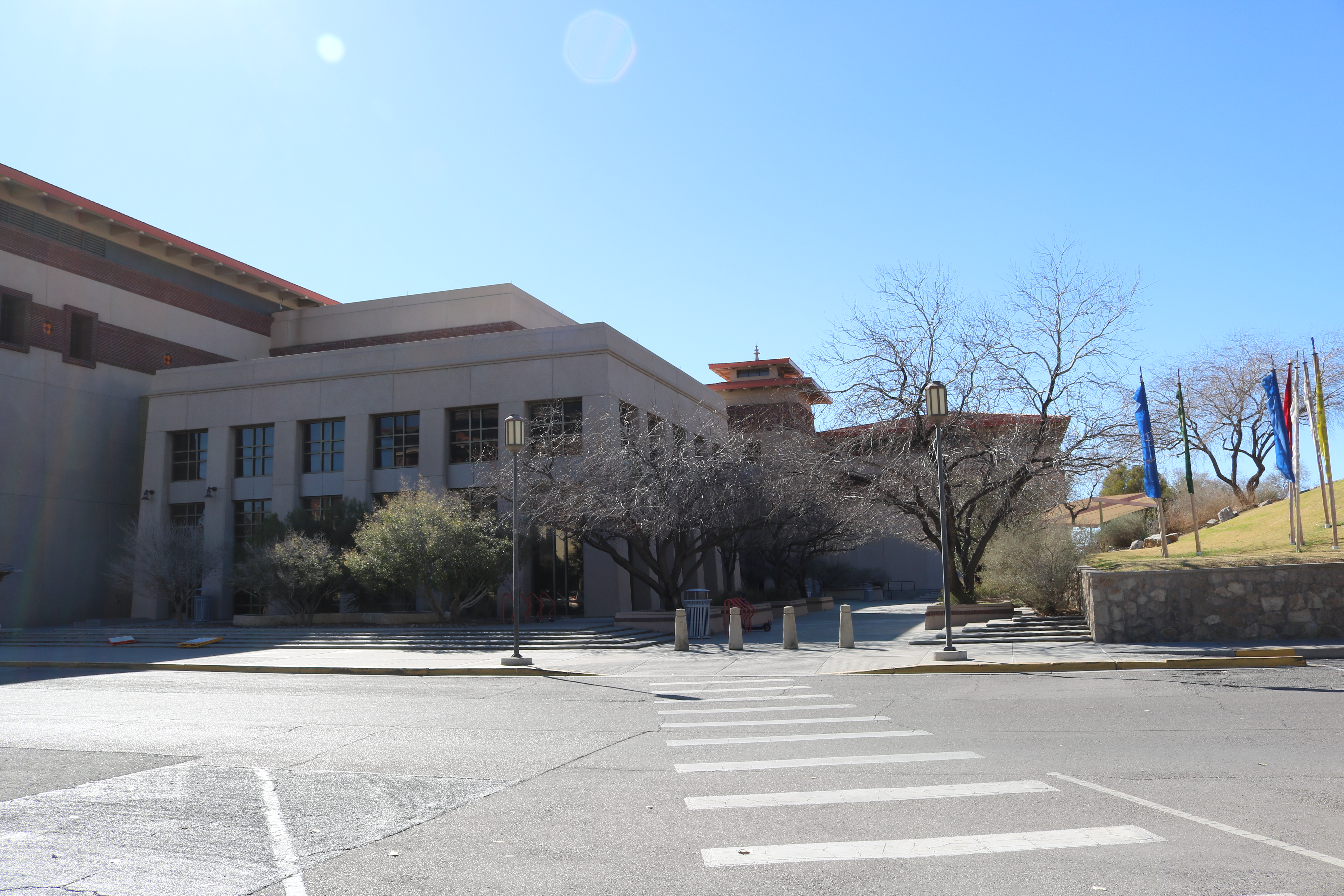
This assignment introduces how machine translation/AI tools strip language of culture and voice. First, students write a letter to their ten-year-old selves about a specific language experience in their desired language (UTEP Handbook 2025), reflecting on experiences shaped by culture, education policy, and politics. They then rewrite/translate the assignment using AI/machine translation and write author notes on what it got right or wrong and how they can do it better. Because they are writing about a personal experience shaped by politics and culture, they see the ways in which AI hallucinates, and machine translation fails to capture the personal/sociocultural influences on language. We build to this assignment by reading Ocean Vuong, whose writing is inspired by his own life, attending a presentation on ethical AI use, and visiting a museum located at UTEP to view local art, scientific research, and historical artifacts – seeing the effects of authentic human composition and inquiry.
Through these efforts, I hope to foster a socially and linguistically just classroom where students engage with their work in multimodal, multilingual ways. I’m fortunate to teach and compose in a community where multiple languages not only thrive but also interact with one another deeply, and I’m excited to create an environment where translation and authentic voices are elevated over machines.
Works Cited
Cedillo, C. V. (2018). What does it mean to move?: Race, disability, and critical embodiment pedagogy. Composition Forum, 39. https://compositionforum.com/issue/39/what-does-it-mean-to-move.php
Gokgoz-Kurt, B. (2023). Using machine translation in EFL writing: A scoping review. In P. Stapleton & J. Qin (Eds.), Technology in Second Language Writing (1st ed., Vol. 1, pp. 45–62). Routledge. https://doi.org/10.4324/9781003279358-4
Gonzales, L. (2018). Using Translation Frameworks to Research, Teach, and Practice Multilingual/Multimodal Communication. In Sites of Translation: What Multilinguals Can Teach Us about Digital Writing and Rhetoric (pp. 113–122). University of Michigan Press. https://doi.org/10.2307/j.ctv65sx95.11
Mangelsdorf, K. (2010). Spanglish as Alternative Discourse: Working against Language Demarcation. In Cross-Language Relations in Composition (pp. 113-126).
Miller, R. E., & Jurecic, A. (2023). Habits of the Creative Mind. (3rd ed.). Bedford/Saint Martin’s.
Rosenberg, L. (2025). First-Year Composition Handbook – University of Texas at El Paso. Hayden-McNeil.
Turner, H. N., & Gonzales, L. (2020). Visualizing translation. Kairos: A Journal of Rhetoric, Technology, and Pedagogy 25(1). Retrieved from http://kairos.technorhetoric.net/25.1/topoi/turner-gonzales/index.html