June 2012

Defining Digital Rhetoric with 20-20 Hindsight

by lizlosh June 25, 2012 Blog Carnival

Like Doug Eyman, who began this blog carnival a few weeks ago, I started trying to define the phrase “digital rhetoric” about a decade ago.
There were already many conversations going on in which the phrase was being bandied about.

Read the full article →

The Thing about Networks, or Big Data Rhetoric

by jentery June 21, 2012 Blog Carnival
Infographic: DHSI 2012

“Big data.” It’s in the air. For instance, IBM claims that ”[e]very day, we create 2.5 quintillion bytes of data—so much that 90% of the data in the world today has been created in the last two years alone.” In 2008, Nature ran an interesting special on big data.

Read the full article →

Accessing digital rhetoric: Sh*t academics say

by Melanie Yergeau June 17, 2012 Blog Carnival

I thought that things would change once I received my PhD. Not large things, mind you, but meaningful things, nonetheless. Things like panel moderators introducing me as Dr. Yergeau rather than an inspiring young adult with a special story. Things like psychologists talking to me at a rate higher (yes, HIGH- ER-) than seven words per minute.

Read the full article →

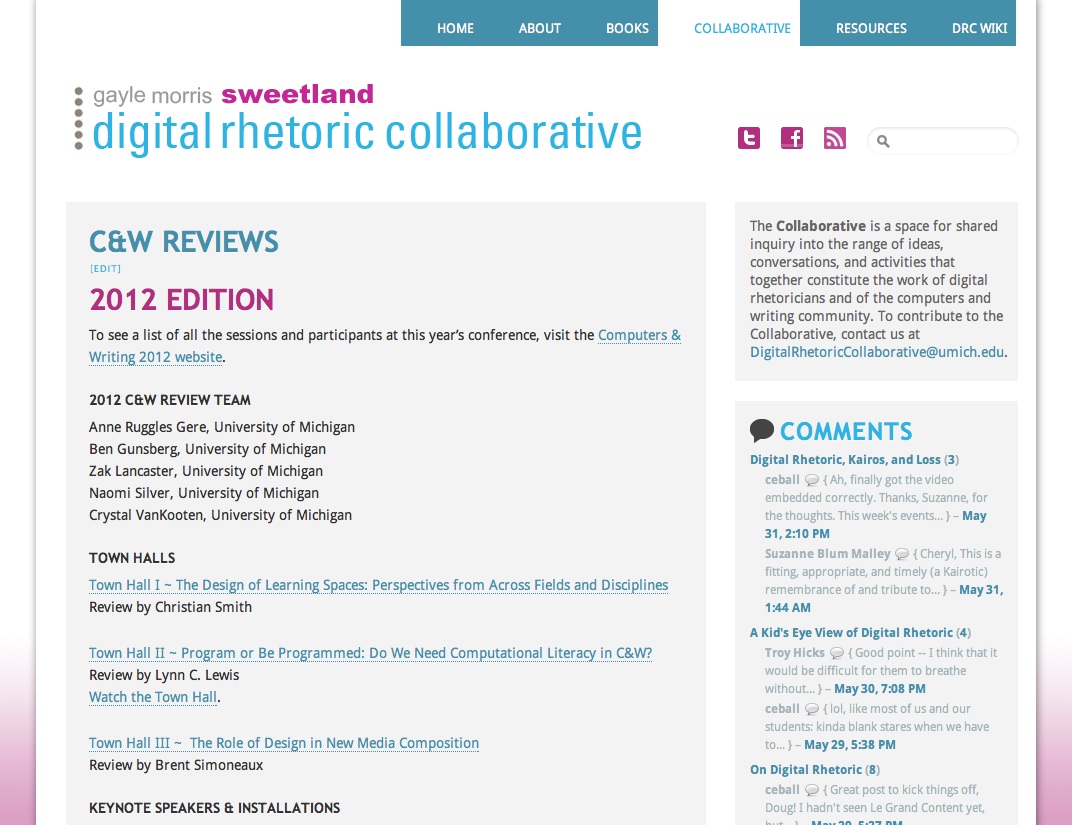
Read the C&W Reviews, 2012 edition!

by Naomi Silver June 12, 2012 C&W Reviews
Screenshot of 2012 C&W Reviews page

Extra, extra!  Read all about it!  Announcing the 2012 Computers & Writing Reviews.

Thanks to an amazing team of 14 reviewers and 3 editors, responding to tight deadlines and quick turnarounds with grace and aplomb, the latest edition of the C&W Reviews is ready for your viewing pleasure.

Read the full article →

Digital Rhetorics: Simply Too Complicated a Phenomenon

by derekmueller June 7, 2012 Blog Carnival

Digital rhetorics1 provide a vast suite of generating principles. These principles are difficult to collect into a simple model, much less to name, substantiate, and prioritize. Fortunately, difficulties like these are much of what motivates digital rhetorics scholarship (some of which was reviewed by others in previous entries), and they are also what I find both exciting and challenging about the field.

Read the full article →