
Close Menu
    Facebook X (Twitter) Instagram
    Recent Posts
    • [Utopia]-in-the-loop in an Emergent Age of Full Automation
    • Ghosts-in-the-Loop: Bormann’s Ghost v. AI
    • Relational-in-the-Loop Writing: Reframing Rhetorical Load Sharing as a Rhetorical Assemblage
    • Accessibility-in-the-Loop: Rhetorics of Resistance, Freedom, and Care
    • Operational-Infrastructure-in-the-Loop
    • Surveillance-in-the-Loop Writing
    • Refusal-in-the-Loop Writing—or, what happened to the field that stood up to TurnItIn, Course Hero, Chegg, and paper mills?
    • Productive Friction: Breakdown, Resistance, and Power In-the-Loop Writing
    RSS Facebook X (Twitter) Instagram
    Digital Rhetoric Collaborative
    • Home
    • Conversations
      • Blog Carnivals
      • DRC Talk Series
      • Hack & Yack
      • DRC Wiki
    • Reviews
      • CCCC Reviews
        • 2026 CCCC Reviews
        • 2023 CCCC Reviews
        • 2022 CCCC Reviews
        • 2021 CCCC Reviews
        • 2019 CCCC Reviews
      • C&W Reviews
        • 2025 C&W Reviews
        • 2022 C&W Reviews
        • 2019 C&W Reviews
        • 2018 C&W Reviews
        • 2017 C&W Reviews
        • 2016 C&W Reviews
        • 2015 C&W Reviews
        • 2014 C&W Reviews
        • 2013 C&W Reviews
        • 2012 C&W Reviews
      • MLA Reviews
        • 2019 MLA Reviews
        • 2014 MLA Reviews
        • 2013 MLA Reviews
      • Other Reviews
        • 2018 Watson Reviews
        • 2017 Feminisms & Rhetorics
        • 2017 GPACW
        • 2016 Watson Reviews
        • 2015 IDRS Reviews
      • Webtext of the Month
    • Teaching Materials
      • Syllabus Repository
      • Teaching & Learning Materials (TLM) Collection
    • Books
      • On Visual Rhetoric
      • Memetic Rhetorics
      • Beyond the Makerspace
      • Video Scholarship and Screen Composing
      • 100 Years of New Media Pedagogy
      • Writing Workflows
      • Rhetorical Code Studies
      • Developing Writers in Higher Education
      • Sites of Translation
      • Rhizcomics
      • Making Space
      • Digital Samaritans
      • DRC Book Prize
      • Submit a Book Proposal
    • DRC Fellow Projects
    • About
      • Advisory Board
      • Graduate Fellows
      • 2026-2027 DRC Fellows Application
    Digital Rhetoric Collaborative

    Introduction: Neil Simpkins

    0
    By Neil Simpkins on November 16, 2015 DRC Grad Fellows

    After falling into a Tumblr community of disabled folks over years of blogging, I found myself interested in the digital rhetorical practices of disabled communities. Sites like Tumblr and Twitter, where I chattered, complained, rejoiced, and cried with folks like me going through the ringer of being disabled and trying to make life work, showed me how different digital communities create their own rhetorical practices and use technology in cripped (click here to read Sami Schalk’s definition and nuancing of this term) ways to communicate with each other and with the normate world. I find this process fascinating and want to bring conversations about cripped uses of technology and digital rhetoric in my time here with the Digital Rhetoric Collaborative.

    To me, a cripped digital rhetoric means understanding how the material, emotional, technological, and spatial dimensions (along with many others) of digital spaces let in or leave out different kinds of people. Cripped digital rhetorical inquiry questions who can access a text and asks us to consider the choices we make when we design digital texts, environments, and objects. It embraces questions of how disabled people use technology to navigate the world, and encourages us to think about how technologies that are commonplace have roots as assistive tech for disabled people (such as the growing use of voice to text in smartphone and tablet writing) as well as the values embedded in new assistive tech.
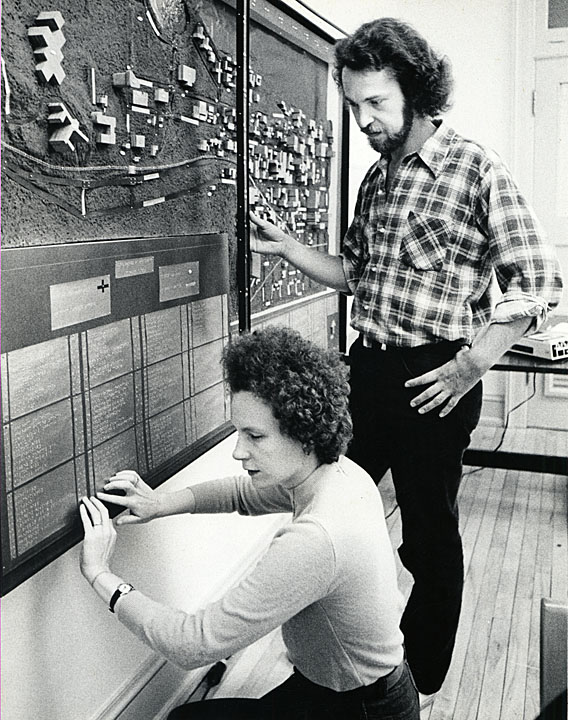
    A black and white photo of a young woman crouching to read a braille map of the University of Wisconsin-Madison campus. A tall man in plaid stands in the back touching the 3D design of the map.
    Photo by Norman Lenburg, accessed from the University of Wisconsin Collection. In the McBurney Resource Center, a woman reads a 3D Braille map of the University of Wisconsin Campus.

    A cripped digital rhetoric also asks us to tarry with and consider how and why different disabled communities create rhetorical practices as well as examine how and if these practices should be translated into different spaces. For example, a current “debate” in higher education circles takes up trigger warnings and students’ call for their use in the classroom environment. I put “debate” in scare quotes because, overwhelmingly, most participants do not take trigger warnings seriously and consider them a threat to academic freedom. The AAUP has even issued a position statement on trigger warnings, fearing their movement from the “blogosphere” to the university environment. However, an investment in cripped digital rhetoric would seek to understand the emergence of trigger warnings in digital communities of disabled people and question whether or not they could be part of a broader program of making writing classrooms in particular accessible to disabled students.

    In my time here as a DRC fellow, I hope to facilitate lots of talk and writing about cripping digital rhetoric both in and outside of the DRC webspace. If you have questions or suggestions for what this might look like, send me an email at nsimpkins@wisc.edu or tweet at me at @neilfsimpkins!

    Author

    • Neil Simpkins
      Neil Simpkins
      View all posts
    Leave A Reply Cancel Reply

    Recent Posts
    By Michael Salvo and John SherrillJune 10, 20260

    [Utopia]-in-the-loop in an Emergent Age of Full Automation

    By Charles GrimmJune 10, 20260

    Ghosts-in-the-Loop: Bormann’s Ghost v. AI

    By Adam PhillipsJune 10, 20260

    Relational-in-the-Loop Writing: Reframing Rhetorical Load Sharing as a Rhetorical Assemblage

    By Joseph TorokJune 9, 20260

    Accessibility-in-the-Loop: Rhetorics of Resistance, Freedom, and Care

    By Jonathan AdamsJune 9, 20260

    Operational-Infrastructure-in-the-Loop

    Digital Rhetoric Collaborative | Gayle Morris Sweetland Center for Writing | University of Michigan

    Type above and press Enter to search. Press Esc to cancel.