
Scalar is defined as an open source publishing platform designed to make born-digital scholarship easy for authors (Scalar). It allows the easy support for authors to collaboratively write in a variety of ways utilizing multiple media sources. It requires a minimal technical expertise of the interface as it is described as being as easy as using WordPress.
What the platform describes is a way to engage in a new type of writing and publishing for scholarship. The foundational scholars of collaborative writing Lunsford and Ede have revolutionized and defined collaborative writing with their own personal accounts and publications. Writing is described by Lunsford and Ede as “network of people engaged in various discursive practices rather than as individual authors” (p. 194). This portrayal in many ways has become a literal understanding of what we see writing today with the vast amount of digital tools that facilitate writing collaboration — a networked process. What this platform creates, I argue, is a similar assessment of collaborative writing that Lunsford and Ede discuss in Writing Together: Collaboration Theory and Practice (2012) where traditional conceptions of writing have become blurred due to the technological advances. Similarly, intellectual property and audiences have also become a major issue of discussion, as stated by Selber, and are present in the self reflective writing of Lunsford and Ede. Which therefores, calls to question certain traditional assumptions of writing and advocates for a “self-sponsored writing”, which is what this platform creates.
The origins of Scalar are at the University of Southern California Alliance for Networking Visual Culture program. The program seeks to inform our understanding of visual practices as they reshape digital culture. Their work aims to address the current economic crisis faced by many university presses while also serving for media rich digital publication (Scalar). The collaborative nature of this platform is that it pursues a goal of self publication and wider audience through a network process of different components contributing to the same goal. What induces collaboration is not separate working spaces that come together at the end, but a “substantive interaction between and among people who share goals and exchange” (Burnett et al. p. 458). Burnett et al. mention the tools that we use matter in the process of collaboration as people must come together with goals and own perspectives. Similarly, Scalar as a tool of collaboration and writing achieves that as the goal for the users is publication in a digital space.
When you create an account, the platform gives you a dashboard where one has the option of working with multiple projects. It is a simple platform that allows for a “heteroglossia of perspectives” (Burnet et al. p. 459). What this means in relation to Burnett’s interpretation is that it allows different strengths in writing to be incorporated in the book. Some authors have strong suit with digital spaces while others prefer the traditional print setting. The interface provides both. Although it does promote the digital visual components, it does not burden the user with the usage of visual components if that is not their strong suit.
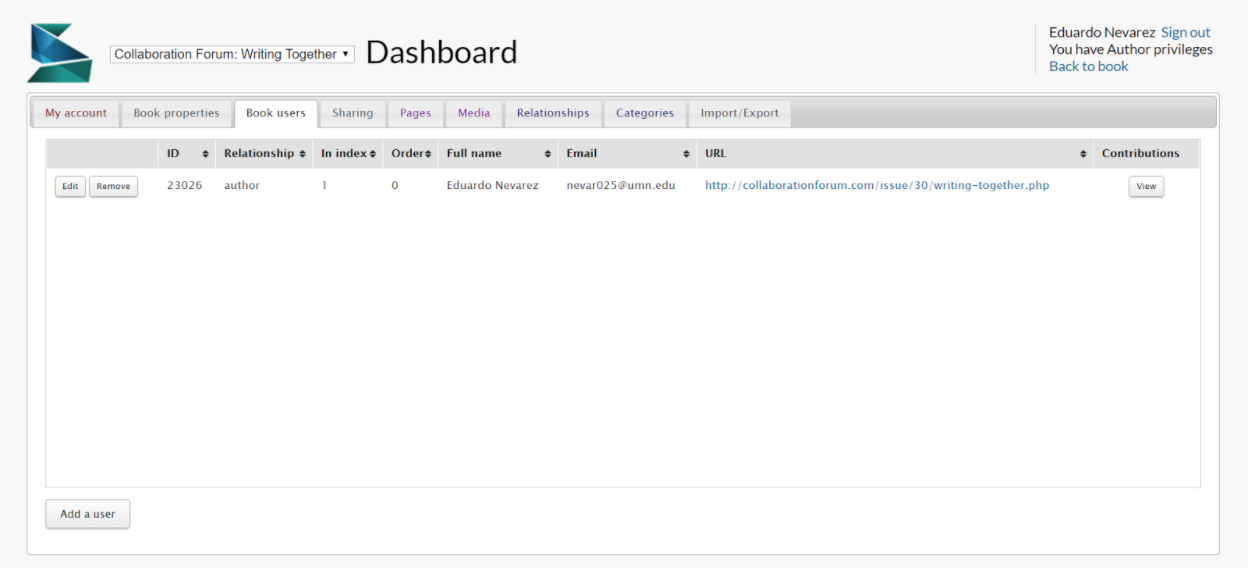
Plugins can also be incorporated to the interface to add any component that the author[s]may want to use and exhibit in the finished product. It is a real time collaborative platform that allows multiple users to make edits. The only problem is that it does not have the capability of communication within the platform so all communication has to be using an external tool or through an open dialogue of roles that need to be assigned in the process of collaboration. This may affect the outcome of the end result as one has to be aware of the changes that are being made in order to continue the virtual collaborative project. However, if the collaborating authors follow the sustained interaction components of Burnett et al. in their essay, “What do technical communicators need to know about collaboration?”, they may create a multi-platform collaboration space.
As far as what can be created with this platform, the main usage that it was created for is the publication of digital books without the economic constraints. It also is providing a new service that most technical communicators and writer/researchers have been moving into for some time now. That is a visual component; not only a visually mesmerizing work, but a publication that engages with the reader. Interactivity is a main component of the platform as it has very similar interface for a web creation platform and the same usability goals that a web designer might incorporate in the web application.
It is clearly stated that this platform was created for the sake of publishing digital books, which is closely associated with academia based also on the creators — USC. However, there are many uses for this platform since it is an open source site. It can also be argued that the emergence of collaborative media enables the access for anyone to use this platform and appropriate them with whatever their goals may be (Lowgren, 2016).
A digital book that was published with the software that represents the collaborative notion of writing is the book by Liza Potts, Melissa Beattie, Emily, Dallaire, Katie Grimes, and Kelly Turner, Participatory memory: Fandom experiences across time and space. In the credit section of the digital book, we can see a brief snapshot of the intent of the book in relation to the challenge of digital humanities and collaborative work in digital spaces. Being that not all of the authors of the book has similar goals in mind, as some are practitioners and hold professional positions in industry, the product of the work is described as a collective endeavor that incorporates each of the author’s skills and experiences making this project one that is not only for the academic’s goal of knowledge creation. This book brings forth the memory and participation of all who want to engage in the memorialization and celebration of fandom with the interactive maps and digital photos of space across time and space.
Given the importance of changing times and goals for writing, digitalized texts are a commonality for authors who seek to put their work in the web for others to engage in discourse and induce collaboration. This platform does have an advantageous position for scholars in digital studies as well as the collaborative aspects that we have read throughout the semester. There are drawbacks to using it, mentioned above, but the overall achievement of collaboration is not measured in how perfect the tool is at achieving collaboration, but how one utilizes the tool in a collaborative environment.
References
Lunsford, A. & Ede, L. (2011). Writing together: Collaboration theory and practice. New York: MacmIllan Learning.
Burnett, R.E., Cooper, A., & Welhausen, C.A. (2013). What do technical communicators need to know about collaboration? In J. Johnson-Eilola & S.A. Selber (Eds.), Solving problems in technical communication. University of Chicago Press.
Löwgren, J. (2016). Technical communication practices in the collaborative mediascape: A case study in media structure transformation. Communication Design Quarterly Review, 4(3), 20-25.
Potts, L. Beattie, M., Dallaire, E., Grimes, K., Turner, K. WIDE and CAL support staff (2017). Participatory memory: Fandom experiences across time and space
The Alliance for Networking Visual Culture (n.d). About Scalar. http://scalar.usc.edu/scalar/
