Each year at CCCC, I begin planning by creating a menu of sessions to attend based on one keyword search: food. Typically, I find one or two food-related sessions offering insights into the ways the field integrates food into teaching, service-learning, activism, and/or scholarship, and I supplement with others on multimodality and digital rhetoric alongside trips to local restaurants to create a full conference experience. My menu this year, however, included at least one food-related activity, panel, or roundtable each day. Among the sessions was D.6. Food Studies in Rhetoric and Writing: Taking Stock of Our Next Steps.
From the introduction to the wrap up, the roundtable supported knowledge sharing across participants and audience members. For those new to food studies in the field, Eileen Schell began by acknowledging that this topic isn’t new. A rise in food studies in rhetoric and writing occurred in 2007, and there’s been a steady increase since. Panelists briefly spoke about their specific food-related projects, giving us a sample of some of the ways rhetoric and writing scholars take on food studies, ranging from cookbook analysis to rural literacies and hands-on studies of foodways—food’s cultural, political, and social components—during an alternative spring break program. Designed to be more participatory, the session began with panelists speaking for about seven minutes each.
First, Abby Dubisar showed us that cookbooks remain relevant artifacts even in the time of online recipes. In her current project, Dubisar examines cookbooks from the 1960s to the present, asking how they persuade audiences to participate in civic action, analyzing the genre as a platform to “express political concerns and civically engaged identities,” and the ways cookbooks depict food as a communicative tool.
Moving from a text-based study to the land, Callie Kostelich shared insights from her current book project on the sponsorship of critical agricultural literacies. Drawing on Deborah Brandt’s (2001) concept of literacy sponsors, Kostelich noted that we’re seeing sponsorship in rural areas from an influx of landowners who are often not present and have an idealist vision of what livestock production entails. Kostelich’s work calls for us to use a food justice lens and account for the production as well as consumption of food.
The final panelist took us on a road trip. In 2024, Cori Brewster began leading students on a travel-based intersession course during spring break. Comprised of mostly “rural, first-gen, Pacific Islander, and other historically underserved students, including those otherwise unable to leave campus during spring break,” Brewster’s students have traveled to Idaho, Utah, Arizona, and California, focusing on the ways land and water are interconnected with cultural sites and our food systems.
For the rest of the session, Schell invited the panelists and audience to come together at the tables. “We want to hear more about your work, questions, or challenges,” said Schell. “You’re the future; we’re part of it.”
Sitting with Dubisar, our table shared ideas connected to the ways we work to be in support of farmers, the language choices used in immigrant cookbooks and the ways such texts connect to and use transnational feminist rhetoric, and assignments that task students with rhetorically analyzing food texts and writing recipe headnotes to present contemporary food issues. The discussion sparked conversations across tables and the exchange of ideas felt truly welcome in the space.
To end the conversation with a call to continue sharing work, Schell invited Kelli Gill (n.d.) to the microphone to share the work she does with her website, Food Rhetoric. Gill encouraged participants to submit resources (syllabi, lesson plans, etc.) to the pedagogy section to begin building a repository designed to connect folks in the field using food in the classroom and inspire others to give it a try.
Overall, the panelists called for more conversations on food, rhetoric, and writing, more interdisciplinary work, more interventions in public spaces, and more of us, coming together in academic and non-academic spaces. This roundtable, though not the beginning of food studies in the field, seemed a catalyst for developing deeper connections with scholars going forward. When I reflect on the panelists’ call to “take stock of our next steps,” researching food’s power is a central ingredient. Feeling inspired post-conference, I turned to my bookshelf and asked, what cookbooks do I have that support and memorialize food as resistance?
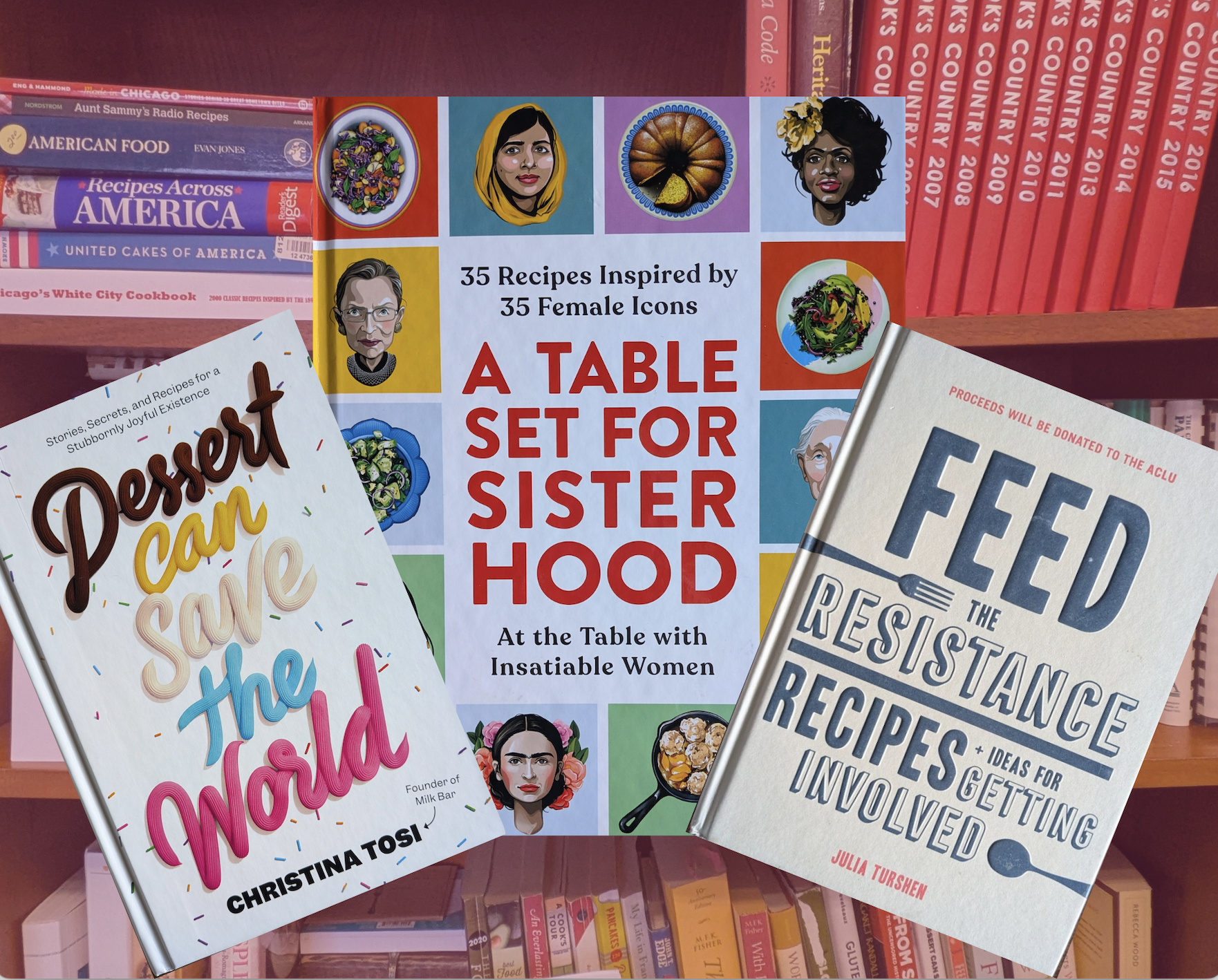
The three cookbooks featured here, Dessert Can Save the World (2022), A Table Set for Sisterhood: At the Table with Insatiable Women (2023), and Feed the Resistance: Recipes + Ideas for Getting Involved (2017), immediately stood out. The recipes and headnotes in these cookbooks empower readers to remember that “food has true power” (Turshen, 2017). Perhaps you haven’t thought of food in this way before, but whether you attended this session or find yourself reading this review, I hope the panelists inspire you to see food this way now.
References
Brandt, D. (2001). Literacy in American lives. Cambridge UP.
Gill, K. R. (n.d.). Food rhetoric: A scholarly resource. Food Rhetoric. Retrieved March 17, 2026, from https://www.foodrhetoric.com/
Tosi, C. (2022). Dessert can save the world: Stories, secrets, and recipes for a stubbornly joyful existence. Harmony Books.
Turshen, J. (2017). Feed the resistance: Recipes + ideas for getting involved. Chronicle Books LLC.