
Close Menu
    Facebook X (Twitter) Instagram
    Recent Posts
    • CCCC 2026 Session Review: EA.5 Navigating Algorithmic Literacy Practices among Digital Feminists and Activists in the Global South
    • CCCC 2026 Session Review: CA.3 Developing AI Literacy in Composition Courses
    • CCCC 2026 Session Review: D.6 Food Studies in Rhetoric and Writing: Taking Stock of Our Next Steps
    • Starting with Voice: How Language Awareness Shapes Multimodal Composing
    • From Studio Remixing to Classroom Remixing: How Research Posters Can Teach Semiotic Border-Crossing for Social Justice
    • Multimodal, Multilingual Praxis in the First Year Composition Classroom: Reflections on Promoting Social and Linguistic Justice Via Rhetorical Translation
    • Against Linguistic Flattening: Translingual Multimodality in the Age of AI
    • When the Teacher Stops Talking: A Human-Centered Experiment with Classroom Silence
    RSS Facebook X (Twitter) Instagram
    Digital Rhetoric Collaborative
    • Home
    • Conversations
      • Blog Carnivals
      • DRC Talk Series
      • Hack & Yack
      • DRC Wiki
    • Reviews
      • CCCC Reviews
        • 2026 CCCC Reviews
        • 2023 CCCC Reviews
        • 2022 CCCC Reviews
        • 2021 CCCC Reviews
        • 2019 CCCC Reviews
      • C&W Reviews
        • 2025 C&W Reviews
        • 2022 C&W Reviews
        • 2019 C&W Reviews
        • 2018 C&W Reviews
        • 2017 C&W Reviews
        • 2016 C&W Reviews
        • 2015 C&W Reviews
        • 2014 C&W Reviews
        • 2013 C&W Reviews
        • 2012 C&W Reviews
      • MLA Reviews
        • 2019 MLA Reviews
        • 2014 MLA Reviews
        • 2013 MLA Reviews
      • Other Reviews
        • 2018 Watson Reviews
        • 2017 Feminisms & Rhetorics
        • 2017 GPACW
        • 2016 Watson Reviews
        • 2015 IDRS Reviews
      • Webtext of the Month
    • Teaching Materials
      • Syllabus Repository
      • Teaching & Learning Materials (TLM) Collection
    • Books
      • On Visual Rhetoric
      • Memetic Rhetorics
      • Beyond the Makerspace
      • Video Scholarship and Screen Composing
      • 100 Years of New Media Pedagogy
      • Writing Workflows
      • Rhetorical Code Studies
      • Developing Writers in Higher Education
      • Sites of Translation
      • Rhizcomics
      • Making Space
      • Digital Samaritans
      • DRC Book Prize
      • Submit a Book Proposal
    • DRC Fellow Projects
    • About
      • Advisory Board
      • Graduate Fellows
      • DRC Fellows Application
    Digital Rhetoric Collaborative

    Tool Review Tuesday: Google Keep

    0
    By Paula M Miller on October 6, 2015 Hack, Hack & Yack

    Welcome back to Tool Review Tuesdays, a blog post series that explores how we can hack our classrooms and our research with composing, editing, networking, and other writing-related edtech tools! This is an extension of our Hack n’ Yack series, where the DRC fellows offer up some quick tips and perspective on tools they’ve found especially useful.

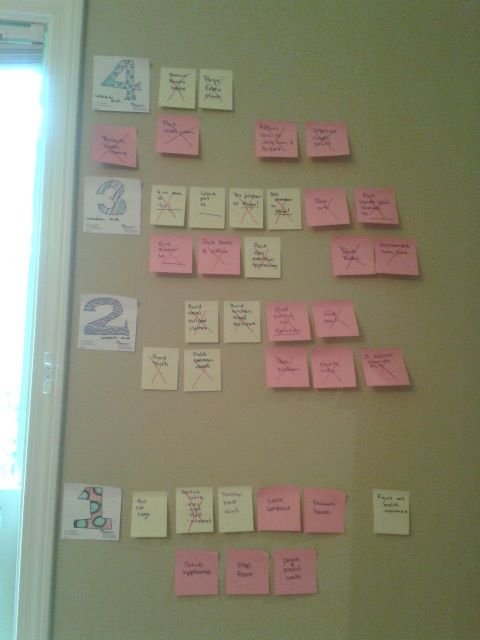
    I am a sucker for sticky notes. When I was preparing for a cross-country move almost two years ago, I put together a four week plan for packing and cleaning the house using sticky notes on the dining room wall as a collaborative to-do list. I’ve always loved using sticky notes in my agenda for their flexibility and just for the sheer satisfaction of color coding my life, giving at least a decent illusion of control. Recently, I stumbled upon a lesser-known Google app – a sticky note program that functions as a collaborative, cloud based organizational tool.

    Tool Name: Google Keep
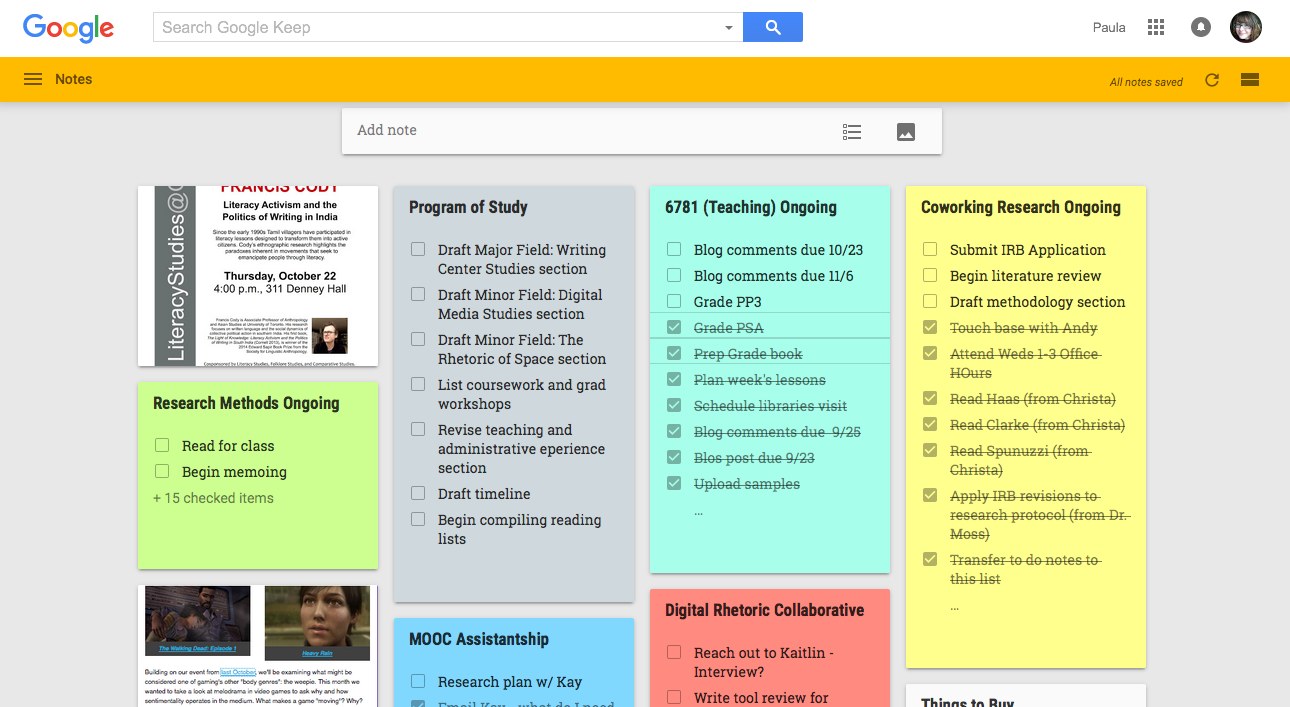
    Screen Shot 2015-10-06 at 9.19.11 PM

    What Does this Tool Do?

    This tool is essentially a super-flexible to-do list command console. It allows you to collaboratively create lists and notes which are stored in the cloud, and it integrates with Google Docs and Google Calendar for easier editing and reminder setting. It’s a quick program to learn and it’s super flexible, so it can suit many needs.

    Who is this Tool For?

    Keep is for a general audience. I use the tool for keeping my own projects organized as a sort of project status agenda, but the tool is flexible and has potential for teaching and collaborative research. When  students work on collaborative projects, I can see using Keep as a task-focused to-do list that all members can access. Because Keep notes will host images and links as well as text, students could use one note for collecting research, another for images, another for as a to-do list to keep them accountable.

    How Accessible is this Tool?

    While documentation doesn’t specify whether the tool is compatible with screen reading software, the app does integrate with Google’s “Ok Google” service, allowing users to write notes using voice.

    Will It Integrate into my Institution’s Learning Management System?

    No

    Will I Need to Pay to Use It?

    Just as with many Google apps, this is free as long as you have a google account.

    The Bottom Line:

    Google Keep, on the surface, is a basic list-making app, but because of the flexible nature of the product, it could be useful for teaching and collaborative writing. If you do end up using it for teaching, contact us and tell us how. We’d love to feature your work in the blog.

    Author

    • Paula M Miller
      Paula M Miller

      Paula is a PhD graduate fellow at The Ohio State University studying rhetoric, composition, and literacy. Her research interests lie at the intersection of writing centers and multiliteracies. You can visit her online at paula-miller.com

      View all posts
    Leave A Reply Cancel Reply

    Recent Posts
    By Nicole K. GoldenApril 12, 20260

    CCCC 2026 Session Review: EA.5 Navigating Algorithmic Literacy Practices among Digital Feminists and Activists in the Global South

    By Ezinne OkonkwoApril 11, 20260

    CCCC 2026 Session Review: CA.3 Developing AI Literacy in Composition Courses

    By Ashley M. BeardsleyApril 10, 20260

    CCCC 2026 Session Review: D.6 Food Studies in Rhetoric and Writing: Taking Stock of Our Next Steps

    By Shelby RamseyApril 9, 20260

    Starting with Voice: How Language Awareness Shapes Multimodal Composing

    By Gideon Kwashie KwawukumeyApril 8, 20260

    From Studio Remixing to Classroom Remixing: How Research Posters Can Teach Semiotic Border-Crossing for Social Justice

    Digital Rhetoric Collaborative | Gayle Morris Sweetland Center for Writing | University of Michigan

    Type above and press Enter to search. Press Esc to cancel.