Before the start of my PhD, I spent some time working as a UX writer and designer in Nigeria’s technology space. I designed interfaces and wrote copy for people whose everyday realities were very different from what most design textbooks imagined as the default user. That background reflects my pedagogical experiences teaching ENC 1136: Multimodal Writing and Digital Literacy, a first-year writing course in the English department at the University of Florida.
What does “Human-Centered” actually mean in the classroom?
“Human-centered” from a personal lens means designing a writing course where students do not have to pretend their lives do not exist in order to write well. In a traditional writing course, students are subtly compelled to bracket their identities and perform a kind of generic academic voice. Multimodal composition, when taught with intention, resists that bracketing.
In ENC 1136, students typically work on 5 major projects in the semester. Per project, they begin with a traditional essay of about 1,000 words on a topic they genuinely care about, rooted in their backgrounds and interests, bearing in mind the multimodal project created from it will be public-facing. Within the traditional essays, students also write about their reflection of the writing and design process and then discuss it in class with me and their peers. Then, they transform the essay into a multimodal project: a digital zine, a video essay or a podcast, a website, a digital campaign and a digital portfolio, thereby developing their writing, creative, technical and rhetorical skills along the way. The transformation opens up a process that asks students to make new decisions about audience, purpose and mode, and those decisions force them to think rhetorically in ways that a traditional essay form cannot fully support. In this transformation process, I teach students, through in-class guidance and tutorials on how to use digital tools that range from graphic design, to audio and video editing, to website design. Although I introduce students to a range of digital tools in class, I do not require them to use any specific platform. Instead, students are encouraged to choose tools that align with their existing skills and comfort levels. In some cases, students suggest alternative platforms that better support their ideas or are more accessible to them due to device limitations or familiarity. This flexibility shifts the classroom away from a top-down approach to technology and instead positions students as active decision-makers who negotiate their own composing processes. By doing so, the course acknowledges that digital literacy is not one-size-fits-all but shaped by each student’s background and resources. This approach draws directly on what Banks (2005) argues that access to digital composing tools must be paired with critical consciousness about who those tools were designed for and who they continue to serve.
As part of this approach, I frame multimodal composition through a social justice lens by asking students to think critically about representation and access in digital spaces. These conversations encourage students to see their projects as opportunities to intervene in existing narratives by creating work that reflects their communities more accurately and responsibly.
To effectively teach the course, the primary textbook adopted is Cheryl Ball, Jennifer Sheppard, and Kristin Arola’s 2014 Writer/Designer: A Guide to Making Multimodal Projects. In the book, they argue that multimodal composition demands rhetorical awareness across modes and should get students asking some questions like: How does sound create emotional resonance in a podcast? How does visual hierarchy guide readers’ attention in a blog post? How does captioning affect viewer engagement in video? This transformative process requires them to consider ‘modal affordances’ which means understanding that each mode offers different potentials and constraints for meaning-making, Kress & Leeuwen (2006).
Positionality as Pedagogy
I deliberately share my own work with students. I show them projects I worked on during my time working in Nigeria, and I talk openly about the choices I made and why. Gonzales (2024) argues that positionality is not just an ethics box to check but an active method, a way of being transparent about how our standpoint shapes what we produce and who we imagine as our audience. When students see that their instructor came to multimodal composition through a specific geography, industry, and cultural context, it gives them permission to do the same. It signals that there is no universal rhetor but only a person, situated in time and place, trying to communicate something real to someone else.
Below, I have documented some screenshots of some of the writings and projects that my previous students (with permission) created in class:
The first project is one from a student that transformed a personal essay about international travel into a beautifully designed zine that documented how each country created wholesome experiences for her.
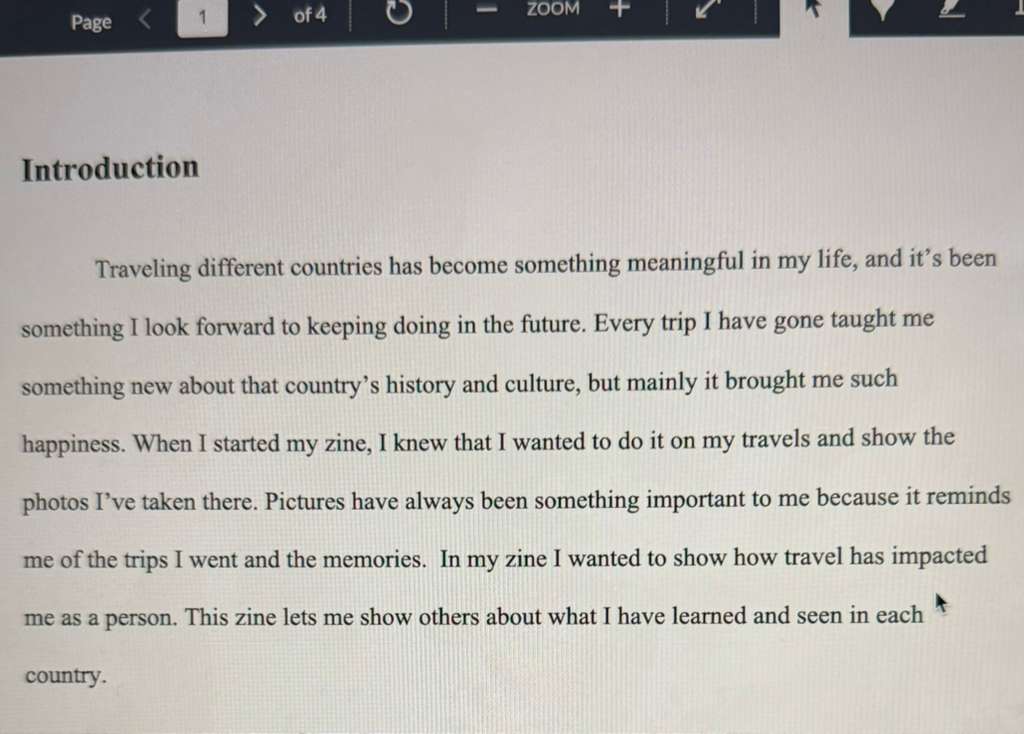
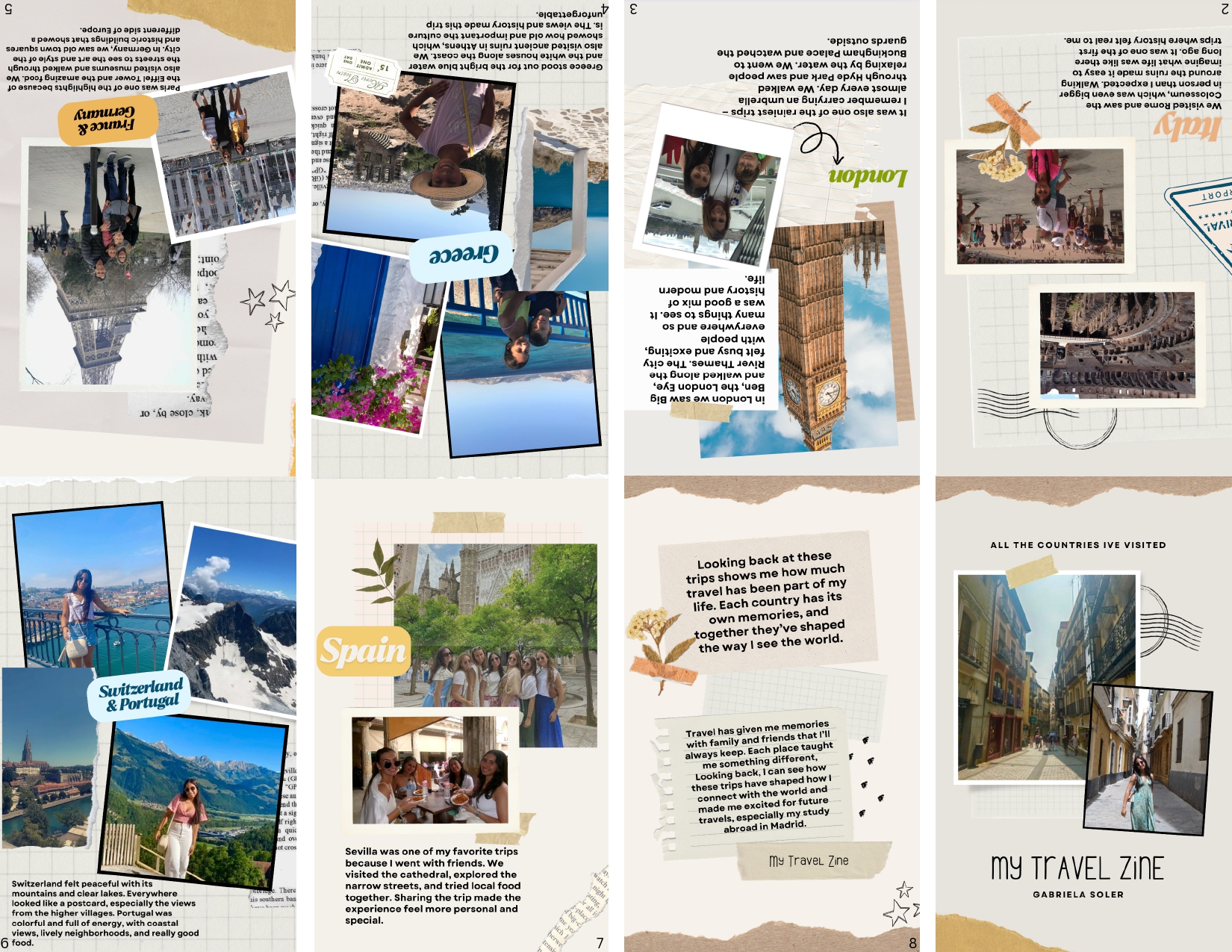
Student’s project: a digital zine documenting international travel
Another student built a website honoring his parents’ 1999 wedding in Caracas, Venezuela, exploring color theory, typography, and digital storytelling as a way to preserve something deeply personal.
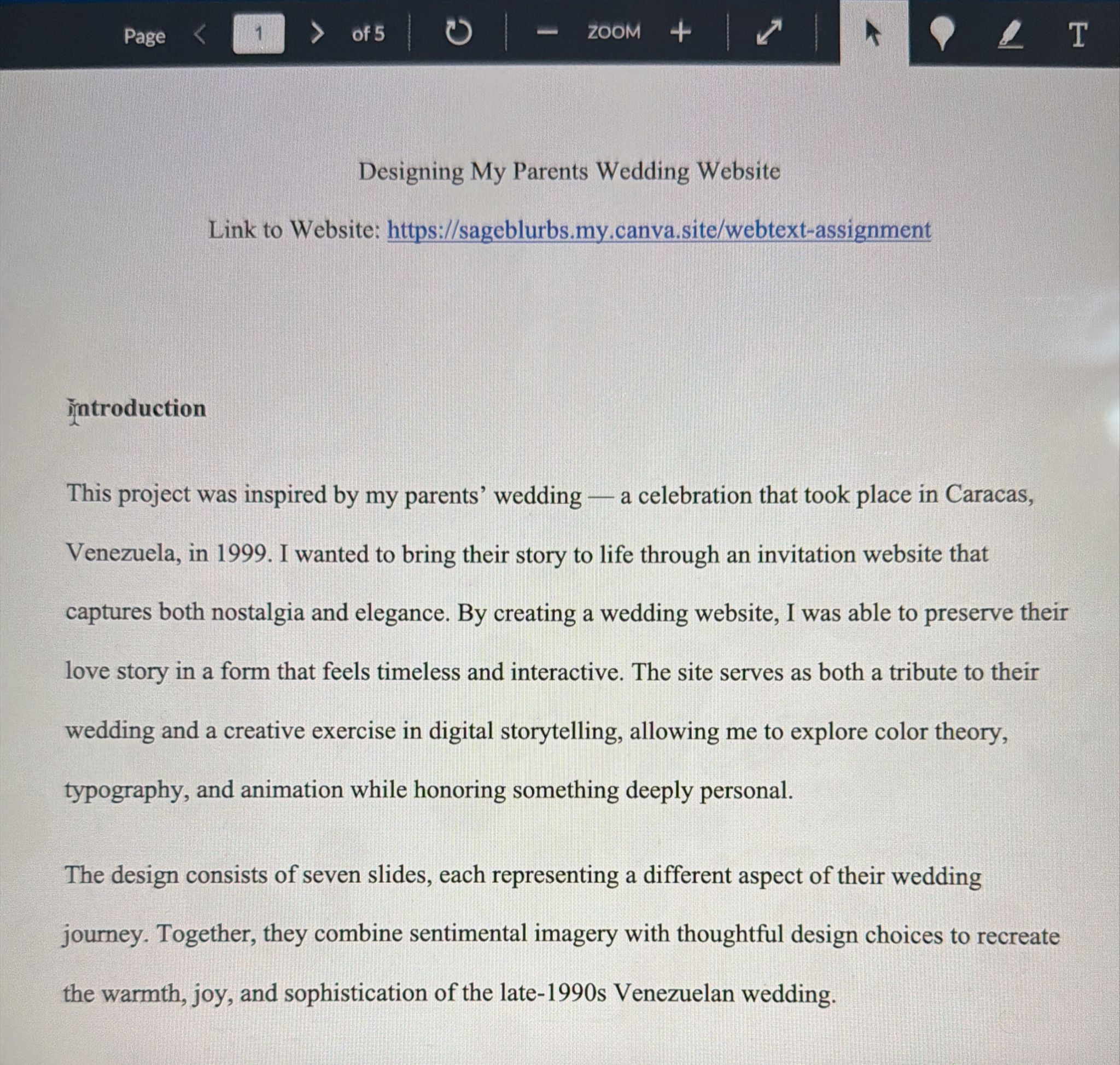
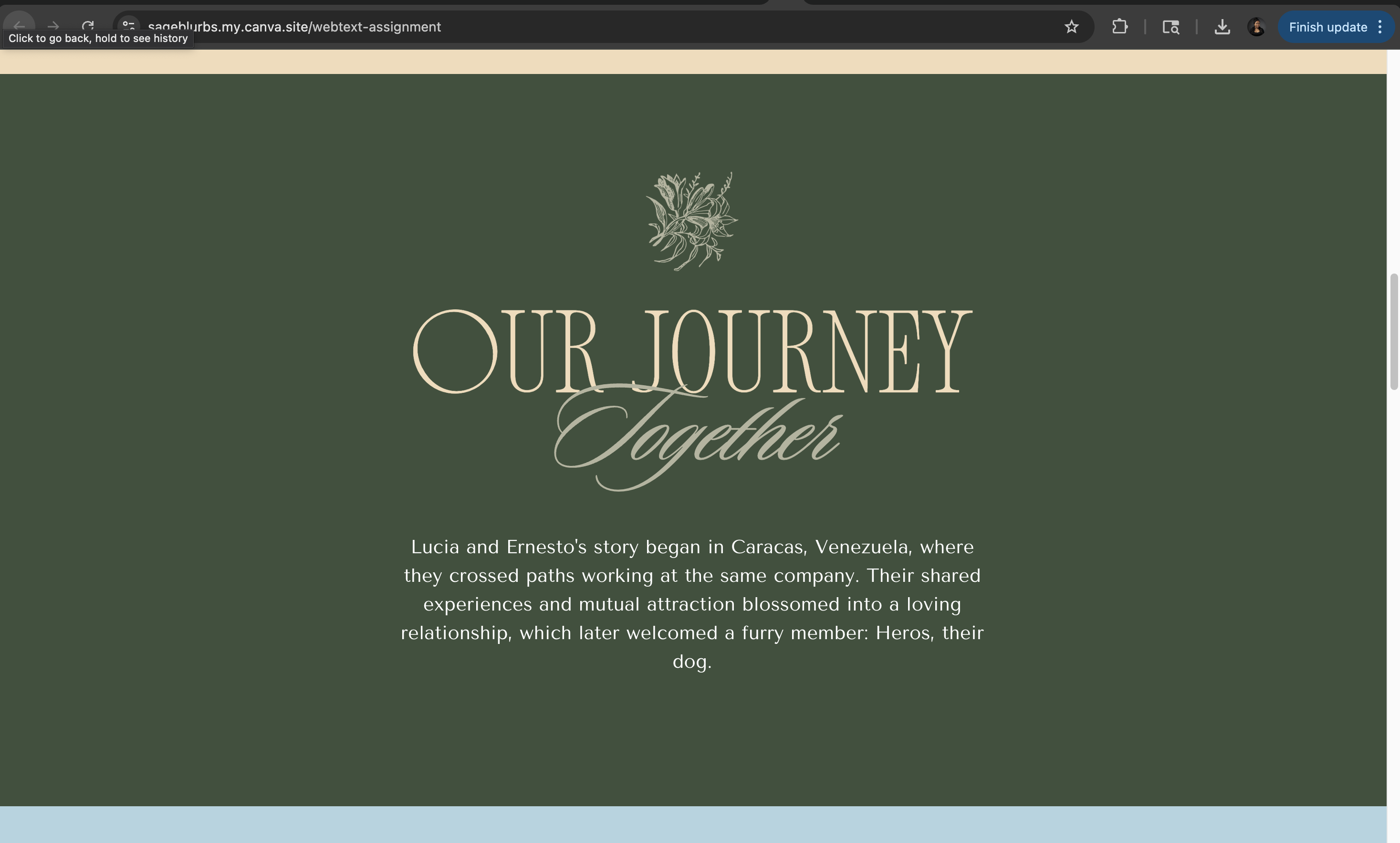
Student’s project: A wedding website for parents’ 1999 Venezuelan wedding
Thirdly, a student produced a video essay about essential dishes in Romanian culture, combining narration and visual design into a piece that introduced Romanian food traditions to audiences like me who had never encountered them. The student incorporated on-screen interactive texts/captions with carefully aligned visuals and narration to ensure the content could be understood by a wider audience, including me (the instructor) who is unfamiliar with the cultural context and other audience who may rely on text-based support. These decisions are central to the rhetorical process and prompt students to consider who can access their work and how their creative choices can either include or exclude diverse audiences.
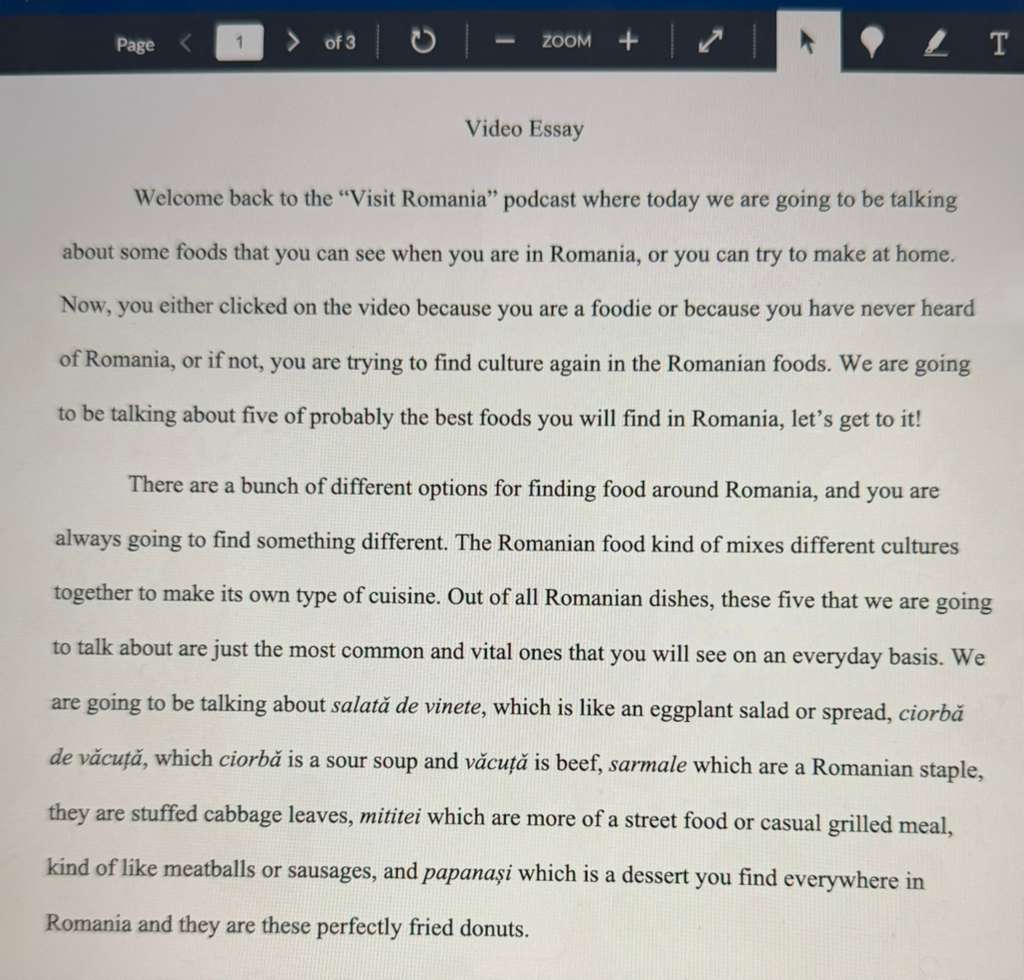
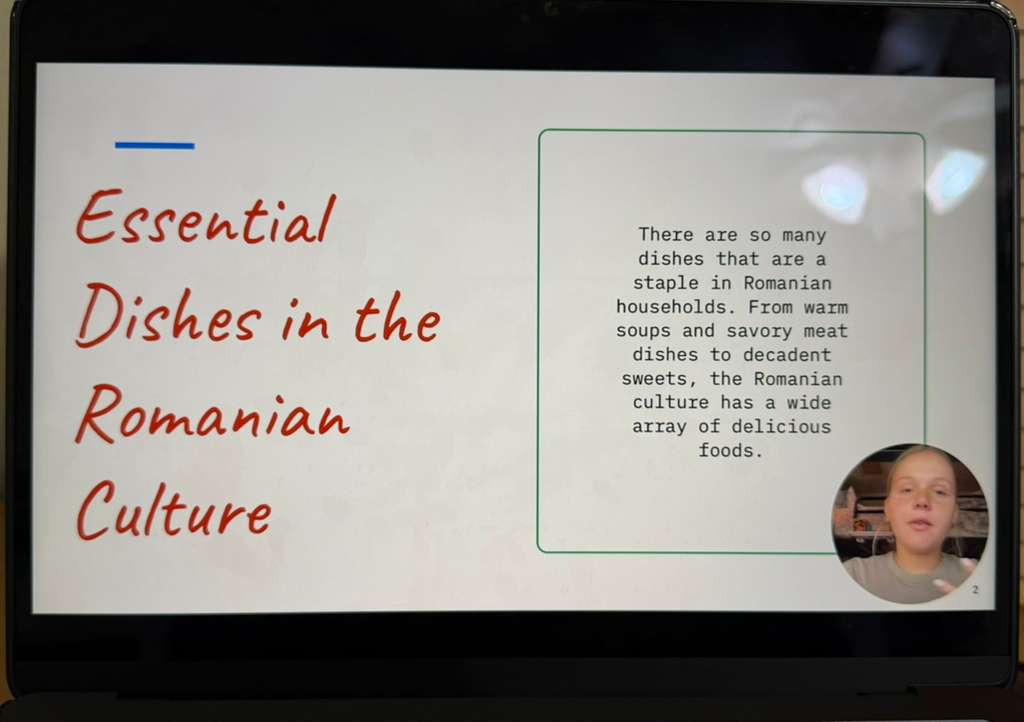
Student’s project: A video essay featuring narration and a visual slide design
Finally, one of the most important things multimodal composition does is move student writing out of the closed circuit of instructor-student exchange. For example, one of my students designed a website that was adopted for an international student organization on the UF campus. The experience of writing and creating for an audience that genuinely uses your work, is one of the most powerful things a writing course can offer.

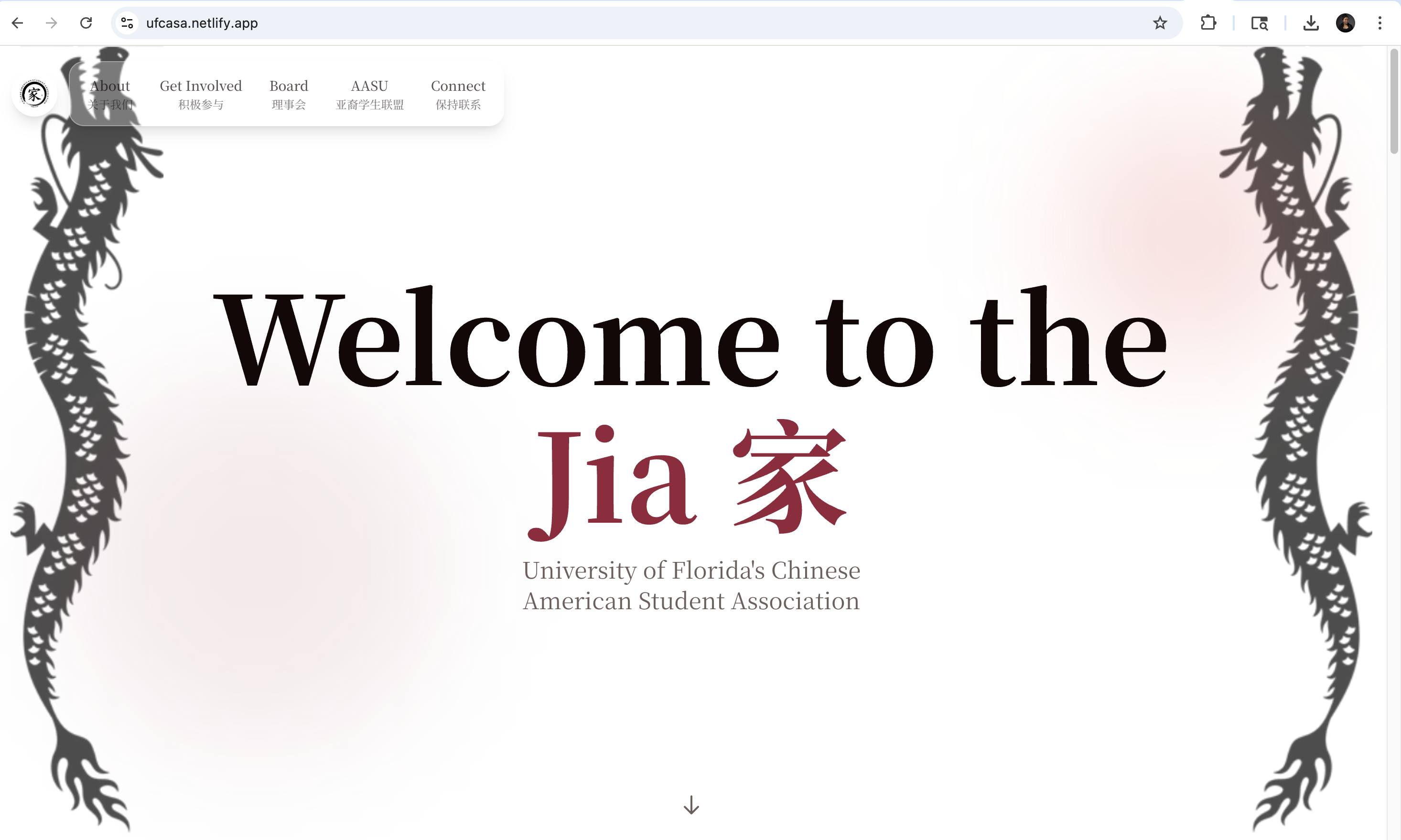
Student’s project: A comment from student’s evaluation affirming that the website designed in class has now been adopted by an international student organization
While the above projects emerge from students’ personal experiences, they also do important social justice work. For instance, the travel zine goes beyond documenting travel across countries to challenging narrow ideas about whose mobility and global experiences are made visible and valued. Similarly, the Venezuelan wedding website preserves a cultural and family history that might otherwise remain absent in dominant digital spaces, thereby offering a preservation of a part of Latin American culture. In this way, students are actively responding to gaps in representation by creating work that makes their communities more visible and valued in digital environments.
The pedagogical conditions I create in ENC 1136 reflect what Eodice, Geller, and Lerner (2025) describe as the foundations of meaningful writing: student autonomy over topics and approaches, intentional instructor guidance, authentic audiences beyond the classroom, and dedicated time for reflection and revision. I add to this a deliberate social justice orientation: I ask students whose voices are centered in the media they consume, what tools already exist to serve communities like theirs, and what it means to design something that is accessible and representative.
In times where generative AI is increasingly capable of producing text and even multimodal compositions, questions about authorship, originality, and human-centredness in writing have become more urgent. Multimodal pedagogy offers a meaningful response to these concerns by incorporating composition in students’ lived experiences, this is something that cannot be easily automated. When students create from their own cultural or personal contexts, their work has a depth and specificity that resists the standardization associated with generative AI. In this way, centering lived experience is a critical response to the growing automation of written communication, ensuring that writing remains a deeply human and socially related activity. The goal is to help students believe that they are already makers beyond being students learning to make. This, I believe, is what a social justice orientation to multimodal composition requires of us.
Works Cited
Ball, C., Sheppard, J., & Arola, K. L. (2014). Writer/designer: A guide to making multimodal projects. Bedford/St. Martin’s.
Banks, A. J. (2005). Race, rhetoric, and technology: Searching for higher ground. Routledge.
Eodice, M., Geller, A. E., & Lerner, N. (2025). Making writing meaningful: A guide for instructors. The University of Oklahoma Press.
Gonzales, L. (2024). Editor’s Introduction in Positionality and collaboration in community-engaged research. Reflections: A Journal of Community- Engaged Writing and Rhetoric. Volume 23, Number 2, Spring 2024
Kress, G., & Van Leeuwen, T. (2006). Reading Images: The Grammar of Visual Design. London/ New York: Routledge.