In my master’s degree, we began our first semester with a required pedagogy course, meant to orient us to the world of teaching first-year writing: with the understanding that we would serve as instructors of record the following year. As those who know me well can attest, I am quick to admit that I was deeply afraid of the concept of teaching, for two primary reasons. The first was guided by a set of assumptions about the classroom that arose from my prior experience as an undergraduate student––essentially that the instructor was the center, the students were the auxiliary, and my imagined hard rules of writing ruled as an unkind deity, red pens quick to dash tentative expression in favor of harsh criticism. The second was that my identity, as a neurodivergent lesbian with somewhat of a non-traditional academic journey, would not be able to genuinely enact that assumed model.
Needless to say, with considerable thanks to that course and impactful mentorship, my assumptions––and fears––were quickly challenged, and subsequently changed. Part of that shift in my mindset was the introduction to teaching writing as a practice of social justice, from assessment (Inoue, 2015) to classroom setup (McCoy, 2020) to multimodality (Tan & Matsuda, 2020).
My interest in multimodality as a social justice practice was fueled primarily by my dear friend and mentor, Derek Mueller, who constellated for me in many long afternoon conversations over tea and coffee the profoundly human elements of design, the connection to student identity, and the possibilities of imagining traditionally written projects in digitized forms. In my prior education, visual rhetoric and document design were two of my most enthusiastic interests, and with Derek’s help, I began to see how I could offer multimodality not as a one-off transformation at the end of the semester, but a sustained practice in every assignment, with the intention of fostering student curiosity and identity.
As such, I challenged myself to embed multimodality as an option for completing each major product in our first-year writing, introduction to research writing course: a research proposal, a research project, a digital transformation, and a reflection. Now, five years into my role as instructor of record, I find myself consistently in awe of what students produce when given choice, as well as what that choice drives in the production of a sustained research project.
For context, our research writing course has a critical mantle: not only is it part of our general education requirement at our university, it is often framed as the gateway to academic research work, with students transitioning from foundational knowledge to advanced thinking in their inquiry. As such, what made the most sense to me as an instructor, in consideration of the academic landscape, was for students to be able to operate in an environment of creative permission: where their curiosities in topic and form might be freely explored.
The connection to social justice here, particularly in the context of challenging, and undoing, oppressive structures that guided my earlier assumptions, lies primarily in highlighting choice for students. In a discipline that is sometimes demonized (and sometimes rightly so) for its white-knuckle grip on homogeneity in style and interpretation, allowing students to enter the world of research writing with their decision making as the primary task shifts that narrative at the core.
A potential consideration, and what I would consider an opportunity in this context, is an appropriate assessment strategy: in line with Inoue (2015) I use an adapted contract grading style with a few additional elements of ungrading (for example, I move away from the language of “labor,” and students are not required to contractually commit to a grade choice at any time). Alternative grading practices were central to my learning to be a teacher—I am lucky to have strong mentors who affirmed this sometimes controversial choice. When working with multiple modes, multiple mediums, and multiple selections, I have found it most useful to apply a generalized, objective rubric that accommodates most student selections, paired with specific conversations with students on expectations.
Choice 1: The Multimodal Proposal
With students ranging in major from business to engineering to English, and every variation in-between, my priority in the proposal is to give students the opportunity to engage in a mode that suits their field, as well as their developmental needs. For example, several of my students every semester have quite a bit of experience generating written proposals, but little experience in digitized visual proposals. The multimodal proposal option consists of a slide deck, with a shorter required wordcount, and subsequent expected effort in design. In class, we look at examples of effectively proposed projects in both written and digitized forms. We discuss the merits of both, how both can honor genre conventions while celebrating the individuality of the student.
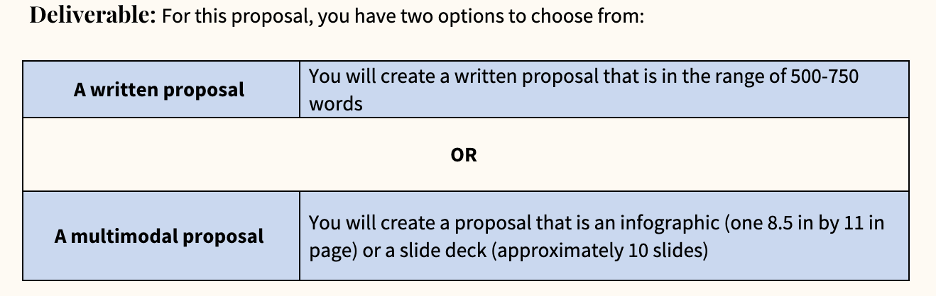
Choice 2: The Research Project
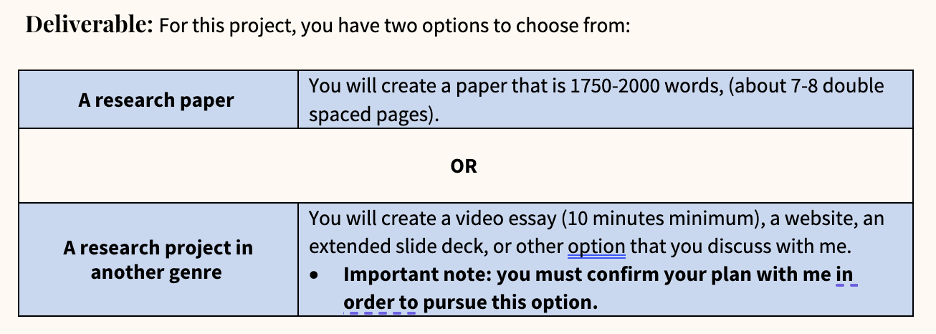
Like many first-year writing courses, our research writing class asks students to engage in a sourced, extended inquiry project they develop throughout the semester. A few years into my teaching practice, I introduced the option of a multimodal project, which might be an involved slide deck, a personal website, or a photo essay. The motivation for this shift evolved from students who were engaging in deeply personal, but also globally useful, projects that were so naturally suited to multimodal presentation. For example, students examining the nutritional statistics of campus meal plans asked if they could represent their project through a day in the life of eating, with pictures of portion sizes with micro-analyses of key ratios. Other students designed projects that benefited from image-heavy evidence, where their collected data was far more visually striking than could be conveyed through text. The research project, then, asks students to think not only about a line of inquiry that is meaningful to them, but how that inquiry might be best represented to a selected audience––and what form of presentation creates the impact they would like their research to have.
Choice 3: The Multimodal Transformation
Like many first-year writing courses, multimodality is embedded in our curriculum: my default assignment is a visual abstract, but one key shift I offer in the mode of social justice is an alternative to a traditionally accompanying presentation. With consideration of presentation trauma, social anxiety, depression, and other mental and physical health concerns, I offer students the opportunity to present on video, as well as informally with me alone, framing multimodality as difference in space as well as medium.
Choice 4: The Reflection
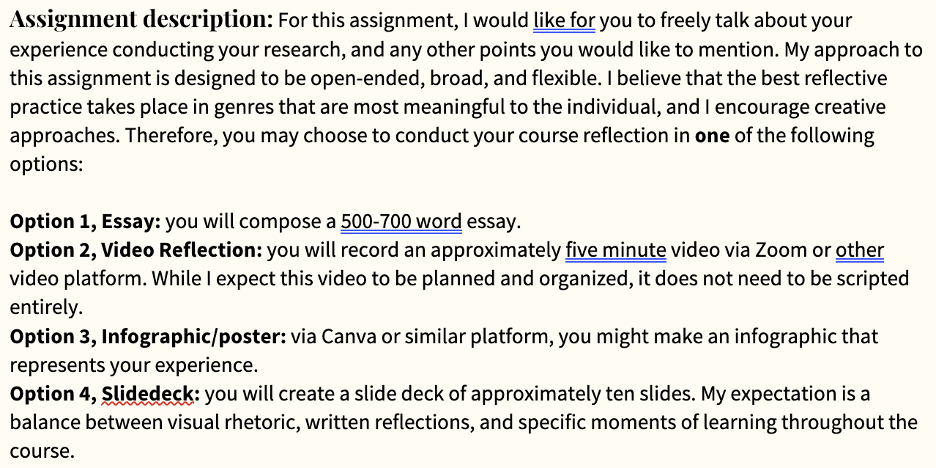
In the final assignment, I try to give students the freest possibility of expression: with very little constriction in terms of expectations, and the greatest number of options to choose from. For me, the reflection is a critical point where students deserve exploratory agency––as they review their semester, think about their learning, unpack their growth as a writer and a researcher, doing so in a genre outlet that feels truest to who they are and their experiences, not just in the course, but who they are becoming. For example, many of my students select the video reflection, and it is always rewarding to see their confidence in speaking about their work in new, interesting ways beyond the written mode. In addition, several of my students have selected the infographic option, where they highlight key takeaways, new skills, or interesting insights into their written process in a fresh format.
For me, multimodality is such a rich, generative avenue for honoring students: not only because it offers freedom of choice and expression, but because it fosters their curiosity––inspiring, what I hope, is an imaginative avenue of research for their present, and their future.
Works Cited
Inoue, A. B. (2015). Antiracist writing assessment ecologies: Teaching and assessing writing for a socially just future. Parlor Press LLC.
McCoy, S. A. (2020). Writing for justice in first-year composition (FYC). The Radical Teacher, (116), 26-36.
Tan, X., & Matsuda, P. K. (2020). Teacher beliefs and pedagogical practices of integrating multimodality into first-year composition. Computers and Composition, 58, 102614.