Although they are excellent learning tools, collaborative writing projects can also become inequitable as students with different commitments, priorities, accessibility needs, and financial limitations struggle to balance the workload and support each other. Part of the problem is that student groups tend to split-up and create different pieces of the final product in isolation, stitch those pieces together, and present the whole to the instructor. While this may be efficient, it often results in disjointed Frankenprojects and at least one group member engaging in “free-riding behavior” (St. John et al.). This is not the kind of collaboration I hope for when I assign a group project. I want students to dialogue, to “meet, clash, and grapple with each other” (Pratt 34) in the contact zone of collaboration, where students are confronted with intersections of power, individual experiences, and community needs. Project groups are micro-communities, and collaborative projects are opportunities to either deconstruct or reinforce unjust racist, sexist, and capitalist notions of what collaborative work looks like. In line with Rebecca Walton et al.’s work on coalition building to redress inequities in technical and professional communication, I believe that we teachers must alongside our students “Recognize, Reveal, Reject, and Replace” labor practices that reinforce unjust and oppressive systems (133).
My favorite way to prepare students for collaboration is through narrative tropes, which Mark Lance calls “explanatory templates” (301). Essentially, Lance argues that we grow up learning and internalizing cultural narratives and stock characters that we draw on to explain and make sense of the world. We “read one another as instances” (302) of familiar stock characters, which then informs how we interact with and interpret one another. I suggest that if we understand one another through the lens of stock characters, then we can draw on other narrative tropes related to team formation and character dynamics to make sense of collaborative projects. Specifically, I use the 5-Man Band trope (Fig. 1) to help students consider what individuals offer the group, what forms of conflict they might contribute to, and why the labor of each group member is valuable. The 5-Man Band consists of five stock characters:
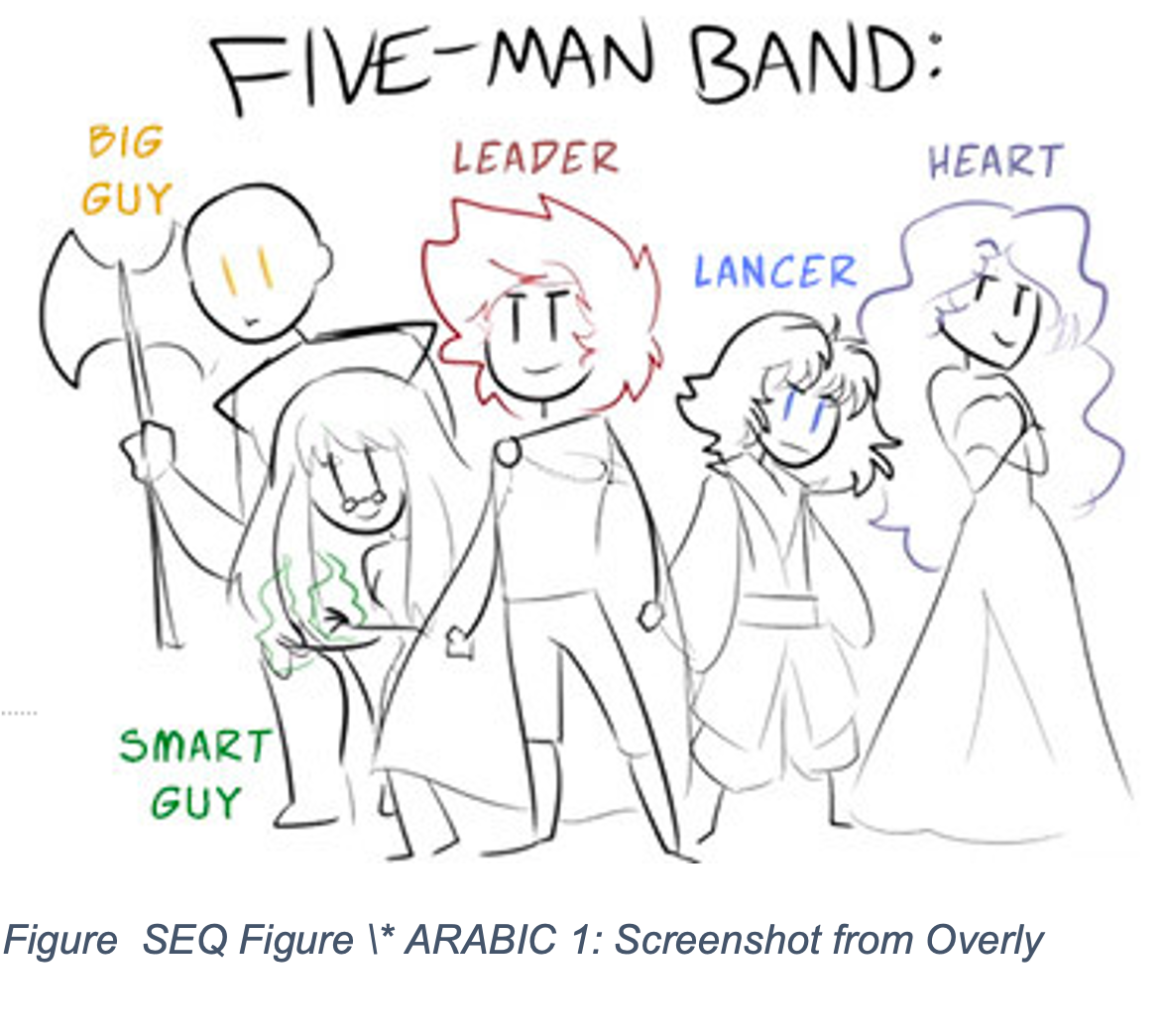
- The leader is highly motivated and takes responsibility for organizing tasks, keeping track of individual progress, and often speaking on behalf of the group. Leaders prioritize the completion of the project, which sometimes looks like micromanaging or dominating the team.
- The lancer balances the leadership style of the leader, typically by offering counter-perspectives and refusing to make choices for others. When they must lead, they take a hands-off approach. Lancers often get the “free rider” label because they prioritize filling gaps: They don’t want to interfere with others and will wait for someone to ask them to do something rather than take initiative.
- The heart is the mediator of the group; they know about their teammates’ lives outside of the project and challenge group members to give one another grace. Hearts prioritize the needs of individual group members, but they can contribute to conflict either by refusing to break confidence or oversharing information about their teammates.
- The brain prioritizes the quality and consistency of the final product. They research more than is required, text the group about new ideas, and edit their teammates’ work. Brains are detail-oriented and excellent organizers, but they can slow the project down by overthinking, redoing parts of the project, and criticizing rather than giving teammates feedback.
- The powerhouse, traditionally the “big guy,” is the source of momentum in the group. In a collaborative project, they jump into projects without much planning, complete (sometimes irrelevant) work when teammates aren’t looking, and often take on undesirable tasks. Powerhouses prioritize productivity in quick spurts: They will finish this project right now, and they do not want to think about it outside of groupwork time.
In class, I explain the concept of stock characters, explanatory templates, and the 5-Man Band. Then, I ask them within their working groups to analyze one Scooby Doo character (Fig. 2) and determine who they are within the 5-Man Band, what they contribute, and what conflicts they may bring to the team.

One thing I love about this lesson is that every time I teach it, I get different answers about who each character is in the 5-Man Band. Partially, this is because there are so many incarnations of Scooby Doo, and students have different experiences and memories with the characters. More interestingly, this activity offers students the opportunity to challenge the structural integrity of the 5-Man Band and explore how characters occupy and shift between roles. While Velma is an obvious candidate for the Brain, students have argued that Velma is a Heart because she brings snacks and calms everyone by reminding them that monsters and ghosts aren’t real. Students have placed Daphne in all the roles as they variously remember her as “a ditzy hot girl,” “the one with connections,” and “the one with the TV show who speaks for the group.” Daphne debates have led to discussions about the devaluation of women’s labor and the importance of invisible labor. We’ve had valuable conversations about accessibility when students argued that Velma is a liability because she loses her glasses and can’t see well. I had a memorable conversation about working with international students, non-native English speakers, and students with unfamiliar accents when a class of (mostly white) students dismissed Scooby because “nobody can understand what he’s saying.” These conversations enable students to consider what organizational, emotional, or cognitive tasks other than text generation/presentation are vital to the completion of a group project: maintaining a calendar, taking notes, sending out reminders, proofreading, operating as a thought partner, and many other significant acts.
At the end of the lesson, I ask students to reflect individually and in their groups about what roles in the 5-Man Band they know they would feel comfortable taking on and what that might look like in the context of their projects. They also consider role subversion, how the Scooby gang often takes turns in different roles, and what role-shifting might look like for their group. When students complete peer feedback reports and self-assessment reflections at the middle and end of the project, I ask them to reflect on what role(s) their groupmates took on and what they each contributed to the group that is (in)visible to me. This lesson creates a common vocabulary for me and my students to address group conflict, recognize invisible labor, and collaborate with equity and mutual appreciation in mind.
And also, while the 5-Man Band is an accessible means of opening conversations about collaboration and labor equity, it can also reinforce harmful stereotypes and unjust collaboration frameworks. For example, the term “leader” can problematically suggest to students that there should be disproportionate power and responsibility within the group. As one student this semester wrote in his midterm reflection, “I feel very unprepared…although I’ve done some leading in the past, it’s never been in a school setting or a group project. So I’ve felt very uncomfortable trying to lead a group that I feel is better than me at what we’re doing.” I worked with this student to redefine what leadership means for him and to open a dialogue with his group about what strengths he sees in his peers and how they can collectively take ownership of their project. From this and other student interactions, I’ve learned to use the 5-Man Band trope first as a tool for understanding and talking about group dynamics and second to show students the pitfalls of committing too fully to any one framework of understanding or meaning-making. The goal is to give students a place to begin and encourage them to reimagine, revise, and reflect on the collaborative frameworks they use for current and future projects.
Works Cited
Lance, Mark. “Counterstories, Stock Characters, and Varieties of Narrative Resistance.” Journal of Ethics and Social Philosophy, vol. 17, no. 3, Jun. 2020, pp. 299-309. https://doi.org/10.26556/jesp.v17i3.1173.
Overly Sarcastic Productions. “Trope Talk: The Five Man Band.” YouTube, uploaded 2 Aug. 2017, https://www.youtube.com/watch?v=lmmNuic_4tQ.
Pratt, Mary Louise. “Arts of the Contact Zone.” Profession, 1991, pp. 33-40. http://www.jstor.org/stable/25595469.
St. John, Jeremy, et al. “Learning by Facilitating: A Project-Based Interdisciplinary Approach.” Journal of Education for Business, vol. 98, no. 7, 2023, pp. 404-411. https://doi.org/10.1080/08832323.2023.2196049.
Walton, Rebecca W., et al. Technical Communication after the Social Justice Turn: Building Coalitions for Action. Routledge, 2019.