
During the leadup to the now-extended deadline for large public entities such as colleges and universities to ensure accessible digital materials as mandated by Title II of the Americans with Disabilities Act (ADA), I’ve been drawn to a number of overlapping rhetorics. In this post, I want to first narrate three vignettes from recent experiences considering and discussing digital accessibility before examining those scenes set against rhetorics of resistance, academic freedom, and care.
Scene 1: Browsing the internet
On the Typewriter Revolution website, where we are called to “resist the artificial,” a remixed WWII poster (Figure 1) centers a young, White woman positioned in front of a typewriter saluting readers under a caption that reads, “FREEDOM OF THOUGHT DEPENDS ON YOUR FINGERS” (Polk, 2026, February 10) . A bottom caption continues “KEEP ‘EM FLYING, MISS U.S.A. Stick to your typewriter and escape the surveillance system! A message from THE TYPOSPHERE.” Elsewhere, the “Typewriter Manifesto” implores adherents to “choose the real over representation, the physical over the digital, the durable over the unsustainable, the self-sufficient over the efficient” (Polt, 2026).
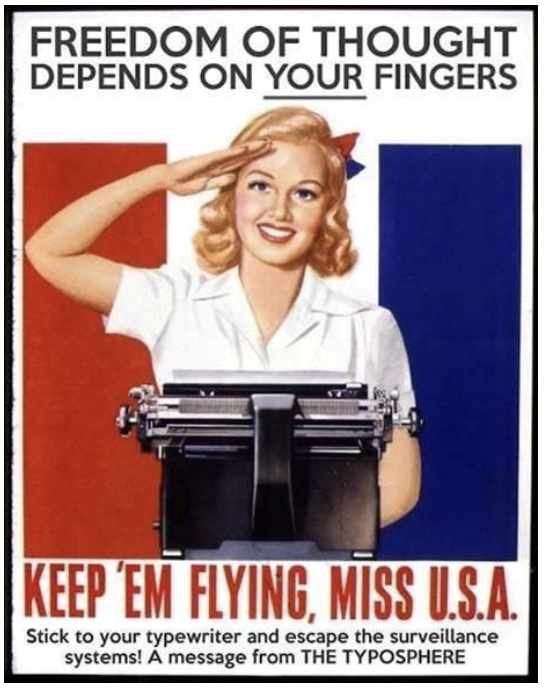
Figure 1: “Keep ’em Flying” poster created by Richard Polt (2026) is a remixed, World War II-style poster extolling patriotic duty through typewriters as non-digital technology.
Scene 2: Speaking in a faculty meeting
During a recent faculty meeting, I spoke with colleagues about self-paced Canvas modules produced by our university’s Office of Teaching and Learning that included resources to help ensure their teaching materials meet ADA accessibility standards. The immediate vocal response was interesting. First, it was suggested that the current use of pdfs without OCR technology for course readings in some sections was unavoidable due to students not purchasing textbooks, and remediation was a labor issue to be resisted. Another voice insisted that using printed course packs was both an important site of academic freedom as well as a mode of resistance to the threat of data extraction to train generative AI.
Scene 3: On a faculty panel at the OTL
As a member of a faculty panel at my institution’s Office of Teaching and Learning, I and other respondents were asked to offer tips for faculty new to digital accessibility. I suggested learning the concept of linearization, specifically in reference to slide deck software and the practice of ensuring correct reading order on slides that have multiple elements (text boxes, shapes, images, etc.). Linearizing reading order is especially important for users who navigate digital interfaces by keyboard or screen reader. Soon after my suggestion, a fellow panel member offered a creative loophole for exasperated faculty: simply print lecture slides and circulate as handouts sans digital files. Digital accessibility standards do not apply, after all, to printouts.
Rhetorics of Resistance, Freedom, Care
A common theme is explicit in each scenario above: a call to (re)turn to print. Polk’s (2026, February 10) “Typewriter Manifesto” not only asks us to choose print within a print/digital dichotomy but attaches moral weight to the choice as well: print ensures “freedom” and is “durable” and “self sufficient” while the digital is a nefarious force restricting freedom in “unsustainable” yet “efficient” ways. In the faculty meeting discussion of accessibility, the digital was framed as a force to be resisted while operating as a litmus test for both exploitation (digital accessibility standards amount to unpaid labor) and academic freedom (do not tread on print-only pedagogy). Similarly on the faculty panel, the tip to print lecture slides as a method to sidestep accessibility leans heavily on a warrant of pedagogical freedom.
Resisting a new communication and information paradigm while favoring the logic and practice of its immediate predecessor is nothing new. In Plato’s Phaedrus, Socrates lauds the virtue of oral communication over the emerging technology of writing. Speaking to Phaedrus, Socrates bemoans writing as mimetic, qualitatively inferior, and a soulless “image” of reality. Socrates recounts an apocryphal dialogue between the Egyptian king Thamus and the inventor of writing, Theuth. Thamus insists writing fosters “forgetfulness in the learners’ souls” and that writers “will be hearers of many things and will have learned nothing; they will appear to be omniscient and will generally know nothing; they will be tiresome company, having the show of wisdom without the reality.” Plato’s dialogue frames writing as a fraught technology that invites fraud and charlatanry, an observation that predates digital (and social) media by millennia. Today, digital reading and writing environments are partially shaped through rhetorics of refusal or resistance: to predatory EdTech, to ethically compromised generative AI, to the infrastructure of mass surveillance. The clarion flags of resistance and refusal are appealing and persuasive rhetorics in such contexts, and I fully support student agency, equitable labor, and sustainable and just futures. But the invocation of academic freedom to be print-exclusive as a tactic to resist or refuse digital accessibility specifically strikes me as deeply flawed since it costs nothing to be both resistant to extractive capitalism and supportive of accessibility.
Hypothetically, in a fully print world accessibility needs would not miraculously evaporate through loopholes. One of the most important aspects of the ADA is that it shifts many of the burdens of responsibility for access and accommodation away from individuals with disabilities and onto businesses, institutions, and other social structures. Accessibility support and accommodation are mandated prerequisites under the ADA, not ad hoc addenda initiated by individuals on arrival, valid exemptions notwithstanding. In higher ed, where the accessibility norm has been systems of student-initiated accommodation through units such as student disability services, the spirit of the ADA imposes a significant paradigm shift away from on-demand accommodation. The flaws of on-demand accessibility services are most evident in downstream barriers. In public comment preceding the U.S. Department of Justice’s final rule requiring digital accessibility, commenters noted “without full and equal access to digital spaces, individuals with disabilities must constantly rely on support from others to perform tasks they could complete themselves” and that quite often, “individuals with disabilities must forfeit privacy and independence to seek assistance” (2024, p. 31328).
If one agrees with the ADA premise that requiring people with disabilities to spend extra time and effort for services readily available to everyone else is discriminatory (again, valid exemptions notwithstanding), then it seems like ensuring accessibility in a fully print world becomes immediately more burdensome for educators. Would (could?) institutions compile a roster of trained stenographers or sign language interpreters to provide CART (communications access real-time translation)? Would all written materials have non-visual alternatives such as Braille and (presumably non-digital) audio recordings? How would such systems respect and ensure student privacy and autonomy? Lacking clear, robust workarounds that do not shift additional burdens onto the student, I question the legitimacy of an exercise in academic or pedagogical freedom when that exercise limits the academic or educational freedom of others.
While technical standards set clear legal requirements, they do little more than provide an opening for a more human-centered world. “Access can represent a form of outsourcing,” argues historian of design and material culture Bess Williamson (2015), “as authorities implement technological change without addressing underlying prejudices and misconceptions” (p. 17). Despite political and social paradigms that encourage individual logics at the expense of collective good, disability activist Mia Mingus (2010) argues that interdependence is the unrelenting reality of our shared existence, and that “care” ought to be a value we practice. “What would access beyond logistics look and feel like?” Mingus asks. “Access that allows people to not just be included, but maintain their dignity and connection to their communities? How do we care for each other in ways that allow us to stay connected to our bodies and stay connected to each other in order to build the kind of world that can care for us all?”
Conversations about disability and accessibility are too easily delayed or derailed by unreflective rejoinders that martial the rhetorics of resistance and freedom while eclipsing a rhetoric of care. Without an intentional rhetoric of care, even commitments to ethically grounded resistance and academic freedom risk animating exclusion and discrimination in practice. I feel like that’s the real slop.
AI Disclosure
No generative AI was used in composing this entry.
References
Mingus, Mia. (2010, August 23). Reflections on an opening: Disability justice and creating collective access in Detroit. Leaving evidence. https://leavingevidence.wordpress.com/2010/08/23/reflections-on-an-opening-disability-justice-and-creating-collective-access-in-detroit/.
Plato. (1990). Phaedrus (B. Jowett, Trans.). Project Gutenberg. https://www.gutenberg.org/cache/epub/1636/pg1636-images.html#link2H_4_0002. (Original work published in 1892.)
Polt, R. (2026, February 10). Keep ‘em flying. The typewriter revolution weblog. https://typewriterrevolution.com/keep-em-flying/2026/02/10/.
Polt, R. (2026). The typewriter manifesto. The typewriter revolution. https://typewriterrevolution.com/the-typewriter-manifesto/.
U.S. Department of Justice. (2024, April 24). Nondiscrimination on the basis of disability; accessibility of web information and services of state and local government entities. (pp. 31320-31396). Federal Register. https://www.govinfo.gov/content/pkg/FR-2024-04-24/pdf/2024-07758.pdf.
Williamson, B. (2015). Access. In R. Adams, B. Reiss, & D. Serlin (Eds.), Keywords for disability studies (pp. 14–17). NYU Press. http://www.jstor.org.proxy.lib.wayne.edu/stable/j.ctt15nmhws.6.
