
Close Menu
    Facebook X (Twitter) Instagram
    Recent Posts
    • 2026 C&W Session Review: Session G: Sustaining Programmatic Assessment: The Role of Digital Praxis and Reflection
    • The Sweetland Digital Rhetoric Collaborative Interviews the editors of Computers and Composition
    • [Utopia]-in-the-loop in an Emergent Age of Full Automation
    • Ghosts-in-the-Loop: Bormann’s Ghost v. AI
    • Relational-in-the-Loop Writing: Reframing Rhetorical Load Sharing as a Rhetorical Assemblage
    • Accessibility-in-the-Loop: Rhetorics of Resistance, Freedom, and Care
    • Operational-Infrastructure-in-the-Loop
    • Surveillance-in-the-Loop Writing
    RSS Facebook X (Twitter) Instagram
    Digital Rhetoric Collaborative
    • Home
    • Conversations
      • Blog Carnivals
      • DRC Talk Series
      • Hack & Yack
      • DRC Wiki
    • Reviews
      • CCCC Reviews
        • 2026 CCCC Reviews
        • 2023 CCCC Reviews
        • 2022 CCCC Reviews
        • 2021 CCCC Reviews
        • 2019 CCCC Reviews
      • C&W Reviews
        • 2025 C&W Reviews
        • 2022 C&W Reviews
        • 2019 C&W Reviews
        • 2018 C&W Reviews
        • 2017 C&W Reviews
        • 2016 C&W Reviews
        • 2015 C&W Reviews
        • 2014 C&W Reviews
        • 2013 C&W Reviews
        • 2012 C&W Reviews
      • MLA Reviews
        • 2019 MLA Reviews
        • 2014 MLA Reviews
        • 2013 MLA Reviews
      • Other Reviews
        • 2018 Watson Reviews
        • 2017 Feminisms & Rhetorics
        • 2017 GPACW
        • 2016 Watson Reviews
        • 2015 IDRS Reviews
      • Webtext of the Month
    • Teaching Materials
      • Syllabus Repository
      • Teaching & Learning Materials (TLM) Collection
    • Books
      • On Visual Rhetoric
      • Memetic Rhetorics
      • Beyond the Makerspace
      • Video Scholarship and Screen Composing
      • 100 Years of New Media Pedagogy
      • Writing Workflows
      • Rhetorical Code Studies
      • Developing Writers in Higher Education
      • Sites of Translation
      • Rhizcomics
      • Making Space
      • Digital Samaritans
      • DRC Book Prize
      • Submit a Book Proposal
    • DRC Fellow Projects
    • About
      • Advisory Board
      • Graduate Fellows
      • 2026-2027 DRC Fellows Application
    Digital Rhetoric Collaborative

    2026 C&W Session Review: Session G: Sustaining Programmatic Assessment: The Role of Digital Praxis and Reflection

    0
    By Sarah Fischer on July 7, 2026 2026 C&W Reviews

    Speakers: Crystal VanKooten (MSU), Bree Straayer (MSU), Stuart Dees (UCF), and Shane Wood (UCF)

    In this session, the speakers reported on the assessment of their respective First-Year Composition (FYC) programs. They provided empirical research and rigorous analysis, which was especially impressive given the large enrollment sizes of FYC at their institutions (MSU and UCF). Session attendees left with nuanced perspectives about data collection, data analysis, and the role of digital projects in FYC.  

    VanKooten and Straayer focused on the impact of digital remix projects, in which students transform one of their earlier projects in the course into a new form, for a new audience. Their research demonstrated that these projects were particularly effective for the development of students’ awareness of rhetorical principles like audience and purpose. In conducting their research, VanKooten and Straayer collected multiple forms of data. They collected pre-semester and post-semester surveys from FYC students, they assessed random samples of FYC students’ reflection essays, and they conducted one-with-one video interviews with FYC students. This approach to research not only allows them to triangulate data for programmatic assessment, but, as they explained in their presentation, this “multimodal” approach to research parallels the kind of multimodal work they ask their FYC students to do. They closed by asking the audience to help them brainstorm ways to communicate their findings to various stakeholders within and beyond the university.
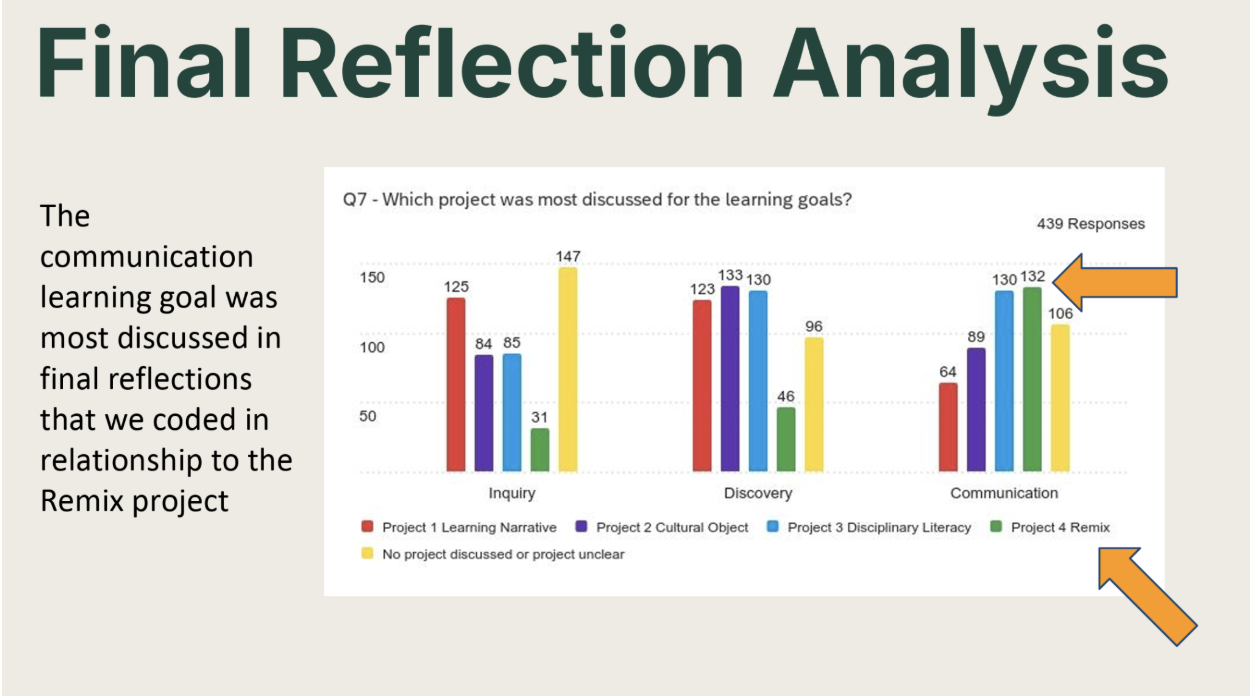
    Caption: a slide from VanKooten and Straayer’s presentation that showcases the complexity of their data
    A slide from VanKooten and Straayer’s presentation that showcases the complexity of their data

    Dees and Wood then discussed the significance of ePortfolios, which all FYC students at UCF complete as their final project in the course. ePortfolios serve as direct measurement of assessment; students select artifacts, demonstrate engagement, and reflect on the student learning outcomes via ePortfolios. As such, Dees and Wood reiterated how ePortfolios are valuable sites for reflection, and described how reflection is evaluated and prioritized in scoring ePortfolios for program assessment. Dees began with a close reading of one student’s ePortfolio, paying special attention to how the student demonstrated sustained and rigorous reflection on student learning outcomes like Writing Processes & Adaptation and Writing and Power. Wood then provided a zoomed-out perspective of the FYC program and the importance it places on reflection “not only as an activity but as a value.” For example, Wood shared how the writing program will be piloting new student learning outcomes, such as Rhetorical Awareness & Metacognition and Reflection & Transfer, next year. Like VanKooten and Straayer, Dees and Wood collected and analyzed FYC assessment data in complex and rigorous ways; they conducted random sampling of ePortfolios and assessed them using calibration, interrater agreement, and primary and holistic scores based on student learning objectives. 

    Both FYC directors, VanKooten and Wood, agreed that sustained assessment requires significant labor, especially from participating FYC instructors, and deserves to be compensated with course releases, meaningful stipends, or both. They encouraged the audience to think more deeply about not only the labor, but the rigor, of programmatic assessment. 

    In the Q&A session, the speakers were asked about the role of generative AI in relation to reflective writing. Speakers agreed that reflective writing embodies the threshold principle of writing to learn and cannot be replaced or replicated by Gen AI. They said that while Gen AI may provide a structure for the reflective writing, it cannot provide the content. 

    This session was filled with attendees eagerly snapping photos of slides, scribbling handwritten notes, and lining up to talk to the speakers after the session ended. Conversations carried into the hallways and continued into the evening. Thank you, Professors VanKooten, Straayers, Dee, and Wood for such an engaging session! 

    Author

    • Sarah Fischer
      Sarah Fischer

      Sarah Fischer is a PhD candidate in the Rhetoric program at Indiana University Bloomington. She studies embodied writing, multimodal composition, and composition pedagogy. Her dissertation examines how video composition is an act of embodied writing that fosters rhetorical awareness.

      View all posts
    Leave A Reply Cancel Reply

    Recent Posts
    By Sarah FischerJuly 7, 20260

    2026 C&W Session Review: Session G: Sustaining Programmatic Assessment: The Role of Digital Praxis and Reflection

    By Alyse CampbellJune 25, 20260

    The Sweetland Digital Rhetoric Collaborative Interviews the editors of Computers and Composition

    By Michael Salvo and John SherrillJune 10, 20260

    [Utopia]-in-the-loop in an Emergent Age of Full Automation

    By Charles GrimmJune 10, 20260

    Ghosts-in-the-Loop: Bormann’s Ghost v. AI

    By Adam PhillipsJune 10, 20260

    Relational-in-the-Loop Writing: Reframing Rhetorical Load Sharing as a Rhetorical Assemblage

    Digital Rhetoric Collaborative | Gayle Morris Sweetland Center for Writing | University of Michigan

    Type above and press Enter to search. Press Esc to cancel.