
“Why do we even need to learn to write if AI can do it for us?” It’s a question that I have encountered from students, colleagues, from scholars, and even strangers across social media. It’s this question contrasted with conversations with industry writing professionals that shows generative AI can’t write well. The writing may look polished, but lacks the important technical details that make it rhetorically effective for a particular audience and purpose. This article argues writing with AI requires expertise to judge genre expectations, contextual demands, and the rhetorical value of AI output. AI does not replace rhetorical judgment; instead, it makes that judgment more visible, because writers must decide what to keep, revise, or reject.
Expertise as Situated Judgment
Like many universities, my university (a small, regional, comprehensive university serving largely underrepresented students in SC) has struggled with policy, practice, and pedagogy of generative AI. Across conversations in teaching, faculty development, and student programming, I’ve emphasized that subject-matter and contextual expertise is necessary if they’re going to use AI for writing. This emphasis on expertise aligns with writing studies definitions that combines knowledge, rhetorical action, and participation in disciplinary practices. Geisler (1994) defines expertise linking domain knowledge with rhetorical action, while later work frames expertise through participatory and disciplinary practice (Wardle & Scott, 2015), enacted through coordinating formal, process, rhetorical, and subject-matter knowledge (Tardy, 2009), and distributed across individuals, groups, and tools, shaped by experience, identity, and collaboration (Tucker-Raymond et al., qtd. in Richter, 2024).
This understanding of expertise aligns closely with genre theory, which treats genre as social action responding to recurring situations within communities (Miller, 1984; Devitt, 2004). From this perspective, writers learn to recognize how conventions function across situations and how rhetorical fit depends on context, audience, and purpose, because genre brings together the content and form of a text with the ongoing rhetorical situations that shape expectations, histories, and consequences (Bawarshi & Reiff, 2010).
Expertise, then, gives us the ability to recognize how conventions work, when they matter, and how they shift across situations. In that sense, expertise is something writers have and something they enact. Writing with AI requires judgment within the writing process to determine whether the text fits the situation it is meant to act within, as seen in figure 1. Expertise extends to visual rhetoric as well since visuals must follow their own conventions and design principles to ensure clarity and readability for users. To develop effective visuals, generative AI depends on human authors to provide the data and expertise necessary for accurate, context-sensitive representation.
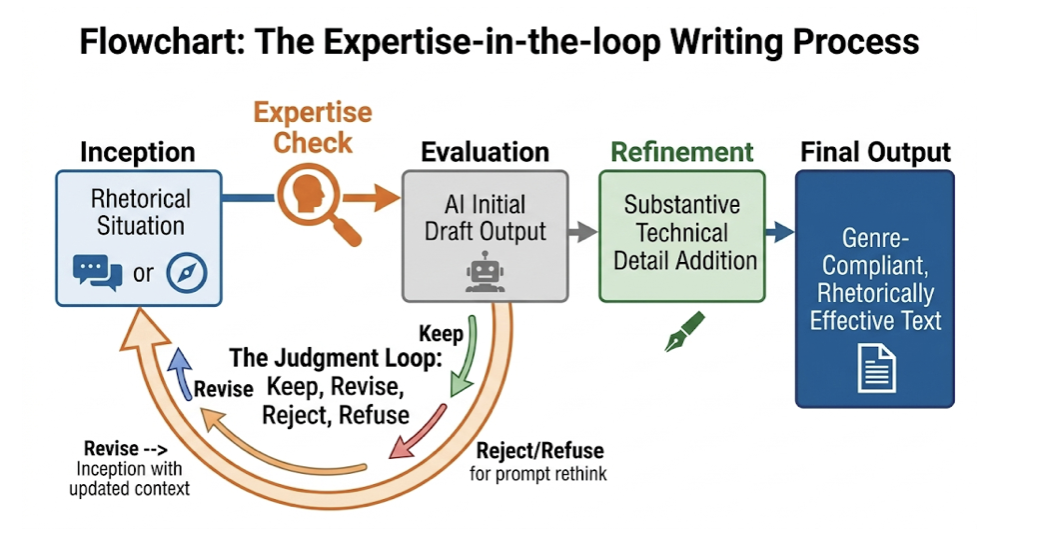
Figure 1: AI-assisted composing as an interpretive loop. Expertise operates through iterative checks of genre fit, context, and ethics rather than as a fixed skill set. Generated using Gemini.
What AI Makes Visible
Examination of genAI outputs surfaces the layers of decision-making that experienced writers do. Work by Mehlenbacher et al. (2024) suggests that expert genre knowledge can be difficult to perceive precisely because it is enacted so seamlessly. Writers routinely calibrate tone, structure, emphasis, and disciplinary convention. Writers have to ask: why does this feel off? What is missing? Where does this not quite align?. They decide when to align with expectations, when to bend them strategically, and when to resist them altogether. Wardle (2009, 2012) describes this as a form of meta-knowledge: understanding not just how to write, but how writing works across contexts.
Experienced writers often do this tacitly, drawing on genre awareness developed across contexts (Wardle, 2012; Bawarshi and Reiff, 2010). With AI, those decisions become harder to ignore. The presence of a plausible draft forces writers to articulate why something works—or does not. At the same time, generative systems blur distinctions among genres, audiences, and institutions. A prompt may yield text that appears broadly acceptable yet remains generic in situations requiring specificity. That flattening effect doesn’t reduce the need for expertise—it intensifies it, shifting the question to rhetorical usability.
Figure 2: The Rhetorical Labor Decision Flow
This graphic illustrates the complex, human-centered decision-making required to navigate writing tasks as a series of diagnostic filters—Audience, Institution, and Stakes—that feed into areas of rhetorical labor including convention to produce a rhetorically sound document. Generated using Gemini.
Context as a Guide
If genre provides a set of expectations, context is what sharpens them. Context in writing can be understood as a complex interplay of cultural, social, cognitive, and situational forces shaping discourse. Johanek (2000) frames context as what characterizes a particular inquiry moment, shaped by audience, researcher perspective, available evidence, and the “actual social practices and norms of justification” that govern how meaning is made (pp. 3, 105, 112). From there, context can be understood more broadly as cognitive, social, and interactional: it draws on prior experience and expectations that guide composing and evaluation (Flower, 1989, pp. 287–288), it exists in the social conditions under which texts are produced and interpreted (Motta-Roth, 2009, p. 16), and it is also a subjective construct through which participants define situations and anticipate consequences (van Dijk, 2008, p. 4).
In my own work in grant and technical writing, context is often where AI-generated text breaks down most noticeably. It may gesture toward the right content, but it misses the stakes, the audience knowledge, or the institutional constraints that shape documents. Context helps writers decide whether AI output is usable, ethical, and situation-specific. Mehlenbacher et al. (2024) highlight how texts can appear rhetorically sound while failing to align with expectations of particular knowledge communities, which becomes more pronounced when texts are generated rather than composed through situated experience.
Although genre shapes broad expectations, expertise is also visible at the sentence level, where rhetorical awareness depends on matching tone, terminology, and specificity to a particular context. A sentence that works in one context may be too vague, too formal, too casual, or too risky in another. A focus on efficiency alone, as often done with AI writing, can produce genericness (Anson et al. 2026) which obscures stakes, flattens differences, or misrepresents knowledge. Context, then, operates as a constraint and a guide anchoring writing in specific situations and reminding writers that rhetorical success depends not on fluency alone but on alignment with audience expectations and institutional realities. Without contextual judgment, AI-assisted writing becomes locally ineffective.
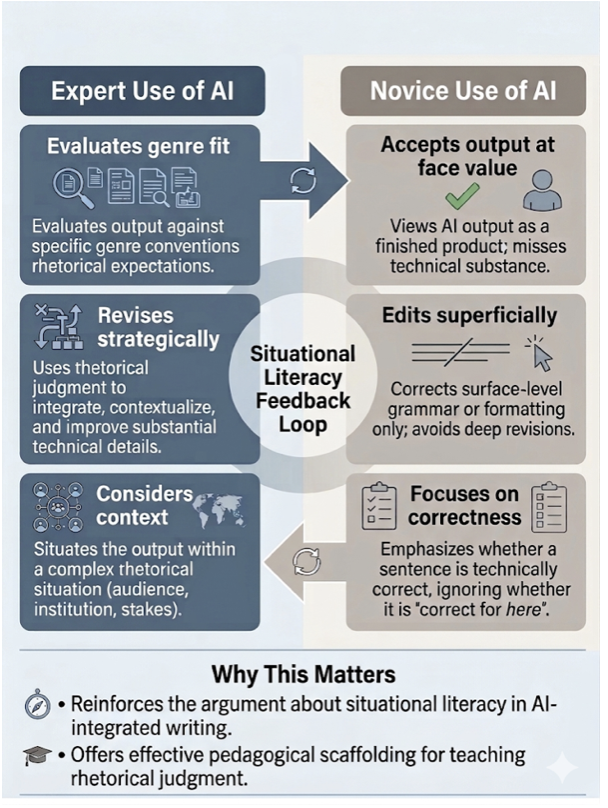
Figure 3: Expert vs Novice AI Use Loop
A comparative analysis illustrating how an expert writer’s deep rhetorical evaluation creates a feedback loop of improvement, contrasting with a novice writer’s linear acceptance, which leads to a repetitive focus on correctness over substance. Generated using Gemini.
Why This Matters
Research on genre and transfer (Wardle, 2009 and 2012; Bawarshi and Reiff, 2010) already emphasizes that writing development depends on learning to navigate shifting contexts, not mastering static forms. AI makes this work more visible and, in some ways, more urgent. If AI instruction focuses only on tool use, it overlooks how learning and process requires judgement rooted in expertise to evaluate and craft effective writing. Effective instruction must therefore combine tool fluency with genre awareness and contextual reasoning. Expertise, in this sense, is not a prerequisite that recedes into the background. It is the condition that makes AI use rhetorically responsible. Writers bring prior knowledge into the loop, but they also enact expertise within the loop—evaluating outputs, making decisions, and revising in response to situated demands.
Conclusion: Expertise in the Loop
Expertise shapes how writers identify genre expectations, judge context, and allocate rhetorical effort. It is a form of situational literacy: the capacity to recognize when conventions matter, when they can be bent, and when they must be refused. AI can accelerate drafting and surface possibilities, but it also raises the stakes of judgment by making rhetorical decisions more visible and more vulnerable. Expertise, then, is not just what writers bring into the loop; it is what sustains the loop as a space of responsible, context-sensitive composing.
References
Anson, C. M., Dannels, D. P., Moore, J. L., & Swerdlow, N. (2026). Sustainable integration of artificial intelligence (SIAI) in writing-intensive courses. Journal of Writing Research, 17(3), 1–35.
Bawarshi, A., & Reiff, M. J. (2010). Genre: An introduction to history, theory, research, and pedagogy. Parlor Press; The WAC Clearinghouse.
Devitt, A. J. (2004). Writing genres. Southern Illinois University Press.
Flower, L. (1989). Cognition, context, and theory building. College Composition and Communication, 40(3), 282–311. https://doi.org/10.2307/357775
Geisler, C. (1994). Literacy and expertise in the academy. Language and Learning Across the Disciplines, 1(1), 35–57.
Johanek, C. (2000). Composing research: A contextualist paradigm for rhetoric and composition. Utah State University Press.
Mehlenbacher, B., Balbon, A.P., & Mehlenbacher, A.R. (2024). Synthetic genres, expert genres: Non-specialist audiences and misinformation in the artificial. Journal of Business and Technical Communication, 38(1), 5–32.
Miller, C. R. (1984). Genre as social action. Quarterly Journal of Speech, 70(2), 151–167.
Motta-Roth, D. (2009). The role of context in academic text production and writing pedagogy. In C. Bazerman, A. Bonini, & D. Figueiredo (Eds.), Genre in a changing world (pp. 321–354). The WAC Clearinghouse; Parlor Press. https://doi.org/10.37514/PER-B.2009.2324
Richter, J. D. (2024). Nurturing distributed expertise with social media in first year composition pedagogy. Composition Forum, 53.
Wardle, E. (2009). Mutt genres and the goal of FYC: Can we help students write the genres of the university? College Composition and Communication, 60(4), 765–789.
Wardle, E. (2012). Creative repurposing in writing about writing. Composition Forum, 27.
Wardle, E., & Scott, J. B. (2015). Defining and developing expertise in a writing and rhetoric department. WPA: Writing Program Administration, 39(1), 72–93.
AI Disclosure: Generative AI tools (Perplexity and CoPilot) were used during the development of this article to support structural revisions, refine phrasing, and review citation formatting. All content was critically evaluated by the author to ensure accuracy and alignment with the scholarly arguments. Gemini was utilized to generate the images within the article based on authorial design notes.
