We began collaborating during COVID-19 while teaching separate sections of first-year writing. We used many of the same assignments, emphasized similar rhetorical moves, and kept running into the same problems from different directions. Like many others, our courses asked students to workshop ideas, draft recursively, and revise projects over time, but the structure of online learning was linear and sequential: learning modules, instructional pages, and assignment submission links. What made sense on paper didn’t necessarily pan out in practice. Our Zoom rooms weren’t empty, but they were hard to read. Cameras off, microphones muted, and long pauses after questions left us wondering if students were sleeping, confused, disengaged, or just overwhelmed. So we started showing up in each other’s classes.
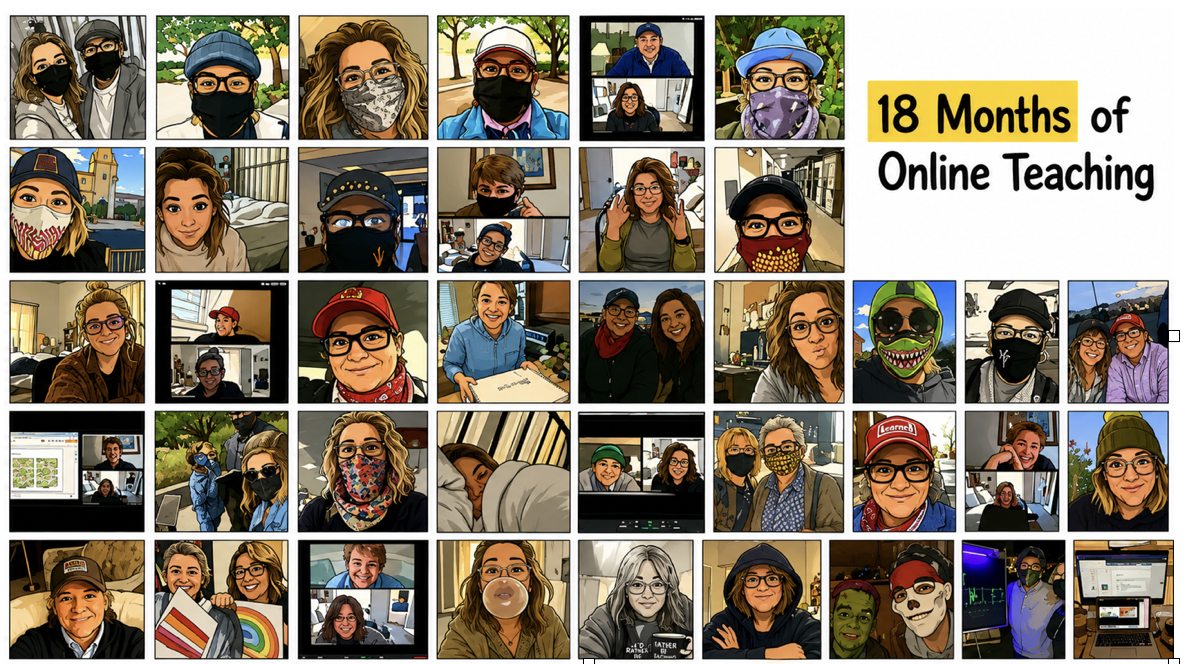
At first, the work was practical. If one of us was leading a discussion and the room went silent, the other could jump in with a follow-up question or try the prompt from a different angle. If an activity didn’t produce the response we had hoped for, we compared notes, and then tried something in later sections: better examples, clearer questioning, and more scaffolding.
Over time, we realized this wasn’t just triage. The small adjustments we were making in real time — when to slow down, when to clarify, and when to let the silence linger just a little bit longer — were the real work of teaching. And because we were doing that work together, it did not belong to a single instructor. It moved between us. One could step in when a question didn’t land. One could notice what the other missed. One class could teach us how to prepare for the next. What began as a way to navigate the stagnant moments in black-box Zoom classrooms slowly became something else: a way to distribute the thinking work of the class.
Alan Knowles’ (2024) concept of rhetorical load sharing helped us recognize what had been happening in our teaching and writing. Knowles asks who carries the thinking work of writing, especially as that work is increasingly shared between humans and AI. His question matters to us, but our collaboration led us to hear it differently. AI may have made rhetorical load sharing feel newly urgent, but writing instructors know that the thinking work of writing has never fully belonged to one person alone. In writing classrooms, that work has always moved across people, conversations, materials, assignments, and moments of response (Bruffee, 1984; Ede & Lunsford, 1990). In our courses, that happened multiple times every day. It happened while we planned, while we adjusted in the middle of class, while one of us noticed students getting stuck, and while we revised materials after seeing students use them. A colleague wasn’t offering feedback after the writing was done. A colleague was inside the loop, helping carry the labor of shaping, responding, and revising as the work unfolded.
Most of the time, that movement didn’t look especially dramatic. It took shape through ordinary routines of pandemic teaching: staying in the same loop, checking in between sessions, rethinking activities, creating shared instructional videos, and noticing student patterns together. These practices normalized collaborative work until it became part of how our courses worked and how we worked inside them. Collaboration was no longer something we added or turned to when a problem occurred. It had become one of the conditions that made teaching feel possible.
When we returned to face-to-face teaching, we wanted to preserve that collaborative energy, but the conditions had changed. We could no longer slip into one another’s Zoom rooms, step in when a question stalled, or keep an eye on the chat. Aligning writing assignment dates was easy. Finding ways to keep the work connected took more creativity.
So we met in the middle. Literally. While we could not bring our classes together in the same room, we could create a shared space in the hallway between them. The Writer’s Inventory, a project where students map and share their writing lives, turned that in-between space into part of the course. Students encountered the literacy histories of peers from other sections, and the hallway became more than a passageway.
Standing shoulder-to-shoulder in front of the shared timeline, students read across one another’s experiences, noticing repeated moments of being read to before bed, learning to read through cereal boxes, encountering the same childhood books, and discovering how often literacy began in ordinary, familiar places. Their comments, including moments of recognition like “I read that, too,” suggested that the activity helped students see their own literacy histories as connected to other people’s stories. The hallway became a place where the rhetorical load of our courses could remain distributed and visible: across instructors, students, materials, and the shared spaces where writing took shape.
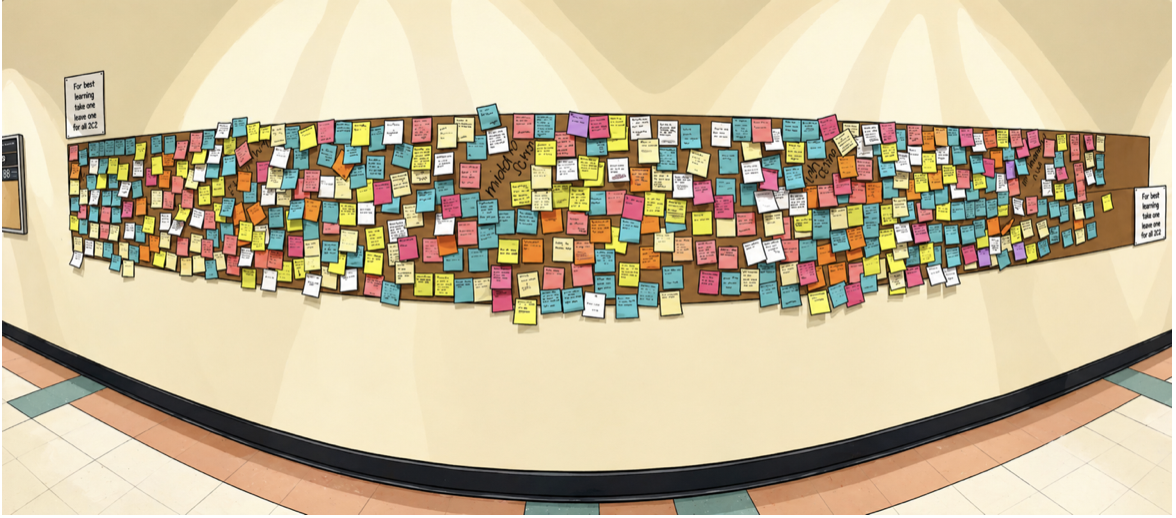
Figure 2: The Writer’s Inventory turned a hallway into a shared writing space across course sections. Original photo by Easton Schlesinger, 2023. AI-assisted illustration generated with ChatGPT/OpenAI from an author-provided image. © Easton Schlesinger, 2023. Used with permission.
The hallway project mattered because it extended what we had learned in Zoom: the rhetorical load of a writing class is never held in one place. A prompt can seem clear when we write it alone and become baffling once students meet it. Working together helped us catch those moments earlier and design more deliberately in response. And once we began to see the loop in this way, as a distributed system for carrying the rhetorical load of the course, our other assignments began to change too. Literacy narratives became illustrated web pages. Traditional essays became podcasts. Annotated bibliographies became curation projects. These shifts grew out of sustained conversation about process, multimodality, and what our assignments asked students to invent, arrange, and compose across forms.
These shifts also showed us something larger: collaboration was never outside the courses we were teaching. It shaped how the courses were written, revised, and delivered.
Students didn’t need us to explain the collaboration to feel its effects. They experienced clearer scaffolding, stronger peer support, and courses shaped by shared problem-solving rather than solitary delivery. Over time, we saw fewer “what did I miss?” emails, more productive writing groups, and more of the student-to-student learning teachers hope for but can’t force. When collaboration shaped the course, student writing became more social, more flexible, and, honestly, more livable.
The carnival asks what’s reliably in the loop.
For us, the answer is less technological than relational. It’s not the newest platform or the cleverest tool. It’s a colleague, not as an outside reviewer or occasional sounding board, but as someone already inside the loop as it unfolds. A colleague who helps carry, shape, and revise the thinking work of the course in real time.
A colleague is in the loop when the work of explaining, revising, and adapting no longer sits with one person alone. A colleague is in the loop when live teaching reshapes written course materials. A colleague is in the loop when a hallway project turns reflection into something public and shared. A colleague is in the loop when classroom practice grows into scholarship and scholarship feeds back into course design. A colleague is in the loop when co-teaching across multiple sections becomes not only possible, but generative.
This does not mean that AI has no place in the loop. It just means that, for us, the work begins between us. As our teaching conditions continue to change, from separate Zoom rooms to shared hallways to team-teaching in the same classroom, we return first to the collaborative loop that brought us here: noticing, questioning, revising, and carrying the work forward together before any tool can extend it.
We began by trying to survive the black-box classroom. What we found, somewhere along the way, was that collaboration had become, and remains, one of the most reliable parts of our writing process.
References
Bruffee, K. A. (1984). “Collaborative learning and the ‘conversation of mankind.’” College English, 46(7), 635–652. https://doi.org/10.2307/376924.
Knowles, A. M. (2024). Machine-in-the-loop writing: Optimizing the rhetorical load. Computers and Composition, 71, 102826. https://doi.org/10.1016/j.compcom.2024.102826
Ede, L. S., & Lunsford, A. A. (1990). Singular texts/plural authors: Perspectives on collaborative writing. Southern Illinois University Press.
Generative AI disclosure
Generative AI was used during revision to help us test structure, phrasing, and organization, and word-count cuts. It was also used to create AI-assisted illustrations from author-provided images. The ideas, examples, teaching experiences, and final editorial decisions in this post come from our collaborative practice.