
Since the public release of generative AI tools in late 2022, writing studies has been filled with debate, uncertainty, and rapid institutional response. Early conversations circulate familiar narratives of technological crisis and anxious headlines and hot takes lamenting that AI “Destroys College Writing?” (Hsu, 2025), “signals death of author” (Lachman, 2025), and might “kill writing career” (Benitez, 2025), largely because AI appeared capable of generating complete texts and appeared to perform writing. At the same time, other scholars and teachers continue to call for refusal, boundary-setting, and renewed attention to humanistic values in writing instruction (Fernandes et al., 2024; Brown et al., 2025; Refusal Collective, n.d.). More recently, however, major disciplinary organizations and institutions have begun to move toward more nuanced responses: the MLA-CCCC Task Force has called for critical AI literacy, AWAC has advocated AI-aware pedagogy, and initiatives such as Ohio State University’s AI Fluency Initiative have framed AI engagement as part of broader literacy education. Together, these varied and sometimes discordant positions, which do not always directly engage one another, suggest that the central question is no longer simply whether writers should use AI, but how AI changes the conditions, positionality, and processes of writing itself.
Initial institutional bans on AI writing tools (Carroll, 2025) were often motivated by the concern that generative AI could produce a complete text and allow students to bypass the writing process. Yet writing studies have long argued that writing is not merely the production of a finished product. Writing is a recursive process of invention, planning, drafting, revising, and reflection (Murray, 1972; Reither, 1985; Barnett, 1989), through which writers engage ideas, sources, audiences, contexts, and their own developing voices. Writers learn through writing as they grasp the “tenor” and “put in oar” (Burke, 1941). From the perspective of writing as a process, the central question is not only whether AI can generate text, but how AI changes the process through which writing comes into being.
AI-mediated writing does not simply add another tool during the existing writing process; it reorganizes the process itself by introducing a new liminal space where human and machine negotiate meaning-making. If writing has long been understood as recursive, AI intensifies that recursiveness by adding new cycles of interaction between writer and machine where writers repeatedly prompt, receive, evaluate, curate, fact-check, revise, reject, and redirect machine output as part of writing (Gupta & Shivers-McNair, 2024). These actions create a multidimensional liminal process in which rhetorical labor is partially shared with AI (Graham, 2023; Knowles, 2023). In this sense, AI-mediated writing brings liminality into the loop, meaning is not simply produced by the writer or generated by the machine, but emerges through ongoing relational negotiation, where agency, authorship, and rhetorical decision-making become unsettled. It is in this threshold space that liminality emerges.
The concept of liminality originates in anthropology and refers to a threshold condition of transition, ambiguity, and transformation. Arnold van Gennep’s The Rites of Passage (1909/2019) describes the liminal stage as the middle phase between separation and reincorporation. Victor Turner (1979) later developed this concept as a state of being “betwixt and between,” where established roles, identities, and structures become temporarily suspended or unsettled. Since then, liminality has been used beyond ritual studies to describe ambiguous and generative spaces in which meaning, identity, agency, and social relations are unsettled and renegotiated (Getz, 2008; Teodorescu & Calin, 2015; Thomassen, 2015). In the AI-mediated writing context, writers now engage in a relational process of negotiating meaning with machine-generated output, re-navigating shifting boundaries about labor, agency, and decision-making in the new rhetorical situation.
Some might argue that writing has always been a liminal act where writers negotiate meaning and ideas with audiences (Gallagher, 2020), resources (Burke, 1941), genres (Miller, 1984), and social and community contexts (Bizzell, 2003). Liminality lies in the writers’ interactions with social contexts, rhetorical situations, and available discursive resources. Here, AI introduces a recursive, relational, and dialectical (Yang and Harker, 2026) process in which writers need to cognitively (Knowles, 2023) and physically (Pigg, 2024) engage with machine-generated output while maintaining responsibility for meaning, voice (Tan et al., 2025), and rhetorical purpose (McKee & Porter, 2022) in acts of meaning-making. As a result, writing becomes less a movement toward a finished text than a series of liminal micro-processes in which writers negotiate unstable boundaries within the larger writing process. Figure 1 below uses research writing as an example to visualize how these liminal micro-processes may unfold when AI is integrated across stages of inquiry, drafting, revision, and reflection.
Figure 1. AI-integrated research-writing process
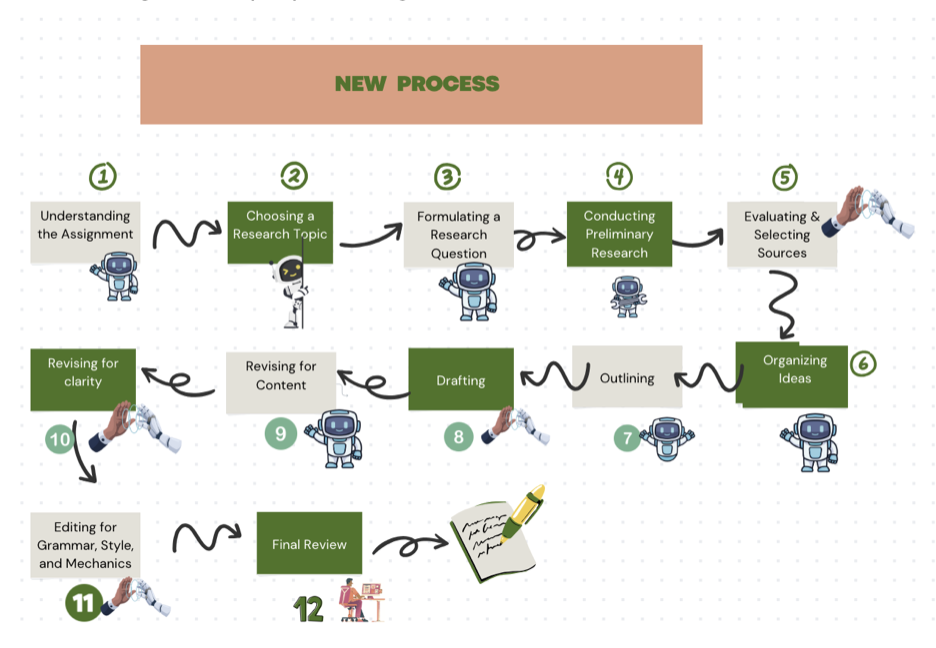
Figure 1. AI-integrated research-writing process
| This figure shows a recursive research-writing process, moving from understanding the assignment to final review. AI icons placed across the stages indicate that AI can function as a rhetorical resource throughout the process, supporting writers during inquiry, drafting, revision, editing, and reflection. The figure illustrates how writers can engage AI while still moving through the full writing process rather than using it as a shortcut to a finished draft. |
Research papers and argumentative writing assignments are common in many first-year writing curricula across U.S. institutions and in writing-intensive courses across the disciplines. These assignments often require students to conduct a research project over several weeks, moving through topic selection, research-question development, source evaluation, outlining, drafting, and revision. If AI is used only to generate a polished draft, it may appear to collapse this process into a few seconds of text production. However, if AI is integrated as a rhetorical extension into each stage, it can support students’ engagement with the writing process rather than replace it, as Figure 1 shows. Students might use AI to test the scope of a research question, identify counterarguments, compare research methods, examine audience expectations, or reflect on a draft’s strengths and limitations.
The liminality of AI-mediated writing lies in the unstable threshold where human input and machine-generated output continually meet, negotiate, and reshape one another. The writer is no longer simply a single agent interacting externally with context or turning to a tool only at the end of the writing process for delivery. Nor is the machine simply producing a finished text on the writer’s behalf. Instead, the human writer engages with another intelligent agent (Mollick, 2024) through recursive exchanges of prompting, responding, evaluating, revising, resisting, and redirecting. In this new liminal space, rhetorical decisions emerge through the “relationality” (Wang & Wang, 2025) between human and machine, where the boundaries among human intention, machine output, rhetorical agency, and authorship become blurry and unstable. The writer must continually make situated rhetorical decisions about what to delegate, what to accept, what to revise, what to reject, and how to maintain human agency and accountability in shaping the final meaning within a relational process with the machine (Yang, 2025; Yang & Harker, 2025). This new liminality is a productive space because as writers engage in a relational process of negotiating meaning with machine-generated output, they are also deliberately re-navigating shifting boundaries about labor and agency in an evolving rhetorical context.
Liminality-in-the-loop writing describes a dynamic and recursive writing process in which human and machine collaborate through ongoing negotiation. In this process, rhetorical intelligence lies not in total independence from the machine, but in the writer’s ability to navigate the liminal space of negotiation. This shift requires writers to develop not only rhetorical awareness or intelligence (McKee and Porter, 2022), but also the ability to engage strategically with AI within a “dialectical” writing process (Yang and Harker, 2026). Writers must learn to work through liminality and relationality within the loop in order to participate responsibly in AI-mediated meaning-making.
References
Barnett, M. A. (1989). Writing as a process. The French Review, 63(1), 31-44.
Benitez, A. (2025, January 14). AI killed my writing career. Medium. https://medium.com/illumination/ai-killed-my-writing-career-99e088cc061a
Bizzell, P. (2003). Cognition, convention, and certainty. Cross-talk in composition theory: A reader, 387-411.
Brown, D. G., Lamb, C. E., & Byl, L. R. (2025). Don’t train your model on my novel: AI refusal statements.
Burke, K. (1973). The philosophy of literary form: Studies in symbolic action (3rd ed.). University of California Press. (Original work published 1941)
Carroll, Robert. 2025. “New Legislation Would Ban AI from New York’s Schools.” The 74. https://www.the74million.org/article/why-ai-doesnt-belong-in-schools/.
Fernandes, M., Sano-Franchini, J., & McIntyre, M. (2024). What Is GenAI Refusal?. Refusing Generative AI in Writing Studies, 12.
Gallagher, J. R. (2020). Update culture and the afterlife of digital writing. University Press of Colorado.
Getz, D. (2008). Event tourism: Definition, evolution, and research. Tourism management, 29(3), 403-428.
Graham, S. S. (2023). Post-process but not post-writing: Large language models and a future for composition pedagogy. Composition Studies, 51(1), 162-168.
Gupta, A., & Shivers-McNair, A. (2024). “Wayfinding” through the AI wilderness: Mapping rhetorics of ChatGPT prompt writing on X (formerly Twitter) to promote critical AI literacies. Computers and Composition, 74, 102882.
Hsu, H. (2025, June 30). What happens after A.I. destroys college writing? The New Yorker. https://www.newyorker.com/magazine/2025/07/07/the-end-of-the-english-paper
Lachman, G. (2025, March 12). AI signals the death of the author. Noema. https://www.noemamag.com/ai-signals-the-death-of-the-author
McKee, H. A., & Porter, J. E. (2022, July). Team roles & rhetorical intelligence in human-machine writing. In 2022 IEEE International Professional Communication Conference (ProComm) (pp. 384-391). IEEE.
Miller, C. R. (1984). Genre as social action. Quarterly journal of speech, 70(2), 151-167.
Mollick, E. (2024). Co-intelligence: Living and working with AI. Penguin.
Murray, D. (1972). Teach writing as a process not product. The leaflet, 71(3), 11-14.
Refusal Collective. (n.d.). What is refusal? https://refusal.blog/what-is-refusal/
Reither, J. A. (1985). Writing and knowing: Toward redefining the writing process. College English, 47(6), 620-628.
Tan, X., Xu, W., & Wang, C. (2025). Voice in AI-assisted multimodal texts: What do readers pay attention to?. Computers and Composition, 75, 102918.
Teodorescu, B., & Calin, R. A. (2015). The base articulations of the liminality concept. Rev. Eur. Stud., 7, 97.
Tham, J. (2025). Navigating AI’s Writing Revolution: A Review Essay and Call for Deliberation. Composition Studies, 53(2), 174-183.
Thomassen, B. (2015). Thinking with liminality. Breaking boundaries: Varieties of liminality, 39-58.
Turner, V. (1979). Frame, flow and reflection: Ritual and drama as public liminality. Japanese Journal of Religious Studies, 465-499.
van Gennep, A. (2019). The rites of passage. University of Chicago Press. (Original work published 1909)
Wang, Z., & Wang, C. (2025). A posthumanist approach to AI literacy. Computers and Composition, 76, 102933.
Yang, L. (2025). AI in the Loop: Rethinking Agency in Human–Machine Collaboration and Its Pedagogical Implications. In The proceedings of the annual Computers and Writing Conference, 2025 (p. 165).
Yang, L., & Harker, M. (in press). Toward a dialectical writing process through AI prompting: Negotiating the rhetorical stakes of business proposal writing with co-invention and genre awareness. In A. Gupta & B. Gogan (Eds.), Writing and rhetoric studies in the loop: A GenAI prompt library. WAC Clearinghouse.
Yang, L., & Harker, M. (2025, August). Three-stage metacognitive reflection framework for AI engagement. TextGenEd: Continuing Experiments. WAC Clearinghouse. https://wacclearinghouse.org/repository/collections/continuing-experiments/august-2025/ethical-considerations/three-stage-metacognitive-reflection-framework/
AI Usage Disclosure: The author used ChatGPT to improve sentence-level grace during editing. The author acknowledges full responsibility for the intellectual content and ensured that all AI-assisted sections were manually reviewed for accuracy.
