
Miriam (professor):
Writing is, of course, a process. I have written for years: on yellow legal pads, index cards, sticky notes, book margins, notebooks, and journals. I have composed on Mac-SE computers with tiny screens, laptops, and iPads—on Word and Google Docs. In 58 years of life and 35 years of teaching, the tools and conditions of composing have changed. The writing experience—as discovery, learning, and craft—has not.
How do first-year college students write—those already used to prompting an LLM for ideas, organization, lexis, grammar, and style? What does process even mean for them? Perhaps, like Prufrock, I grow old.
Theo:
Call me romantic, but I think that writing is a beautifully unique and human thing. It’s a medium through which we can share ideas. It’s a medium through which we can learn about the world around and within us. As any writer knows, it’s also a medium through which we can connect with ourselves. Writing allows us to articulate our interests and passions through our voice. Generative AI has jeopardized this quality. Artificial Intelligence takes the writer out of writing and privileges the destination over the journey. Instead of enabling us to connect with ourselves— our thoughts, our beliefs, our ways of communicating— it radically disconnects us from writing. It tries to tell us who we are, coercing us to identify with a one-dimensional “voice.”
Isaac:
I’ve encountered many students who had Chat GPT bookmarked on their browsers, and paragraphs hastily pasted onto their word processors. Leaving students in the dust and giving them zeros for their AI-generated work makes sense to a professor, but not to us—the Writing Fellows. When I see a student throwing together things they did not say, I see a student trying to swim above water; they’re trying, but it’s too much. When you’re in those foundational English courses, you’re learning to contribute to a thousand-year-old conversation within academia. You’re learning to speak again, but those professors already assume that you’ve learnt the alphabets of academia, when in reality, you’re still figuring out the letter Q.
Lindsey:
Although each student I tutored was unique, they all shared a similar problem when it came to academic writing. Many students would express a struggle in finding their voice while trying to keep up with the academic technicalities and rules. They were caught up in what should be considered good and correct writing instead of what they wanted to express. I encouraged each of them to remember that it is their writing and they can shape it however they want. Even with this encouragement, I believe these students still struggled to fit their voice into the academic guidelines of the writing.
Miriam:
I had no writerly voice in high school. I had fear—fear of point deductions for comma splices, two-word verbs, and fragments. (Word’s editor tells me that “I was afraid” will make my meaning clearer in the previous sentence. My voice tells me it will not.) How do we resist the power of prompt, enter, cut, and paste so that students trust their own voices?
Sydney:
For a student to find confidence and learn to grow their own writing voice, there needs to be validation. Students thrive off being told when they are doing well and specifically what they are doing well. This goes hand-in-hand with good constructive criticism that is detail-oriented and tells you where you have room to grow. It’s not that a student has done badly, but it shows them where they have the chance to pursue growth. With validation comes confidence-building, but you also have to balance between blowing up their ego and always telling them their writing needs improvement. There needs to be a balance of constructive criticism and praise, but there also needs to be the secret third ingredient, which is self-confidence.
Theo:
I think that writers [Miriam: add “teachers”] have a responsibility to reclaim the humanity in their work. We must turn to the most human quality of writing: its communicative ability. By emphasizing writing as a conversation (and not an algorithmic echo-chamber), we can re-empower the craft in its full glory. We must write socially, reinforcing writing as a tool through which to explore ideas— not accept them blindly as summarized facts. We must write unconventionally, reclaiming different mediums and genres as they serve our needs— not as they serve the synthesized status quo. We must write as, with, and for humans. I believe that this approach not only improves our writing but protects it as writing. This should be the interest of students and educators across disciplines.
Miriam:
Human-in-the-loop writing, yes.
Anna:
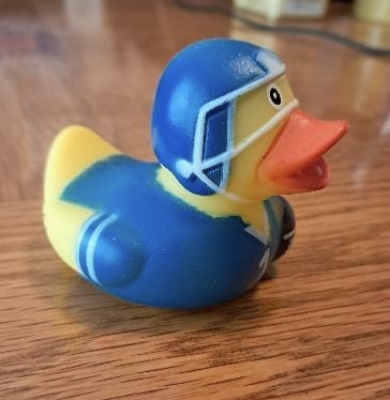
Humans are social creatures, so we enjoy interacting with others, but in a first level college course, it can be hard to make strong connections where a student feels comfortable enough to give more critical feedback than “this looks okay.” When I was in English 1101 my first year, I had not made connections with my peers yet, so when I got feedback or wrote feedback, it was all surface level ideas instead of real critiques. Then, I was introduced to my rubber duck. We were told to record a video of us reading our essay aloud to a rubber duckie, and I found more and more that when I read my essay aloud, I would find places to revise without the help of others.
Writing fellows use ducks to help writers hear their own voices.
Miriam:
During a meeting of the writing fellows, Anna shared the story of reading to a rubber duck in first-year composition. Her experience resonates with my own; the duck is not just a gimmick. Sometimes, the voice we need to hear is our own, and something as simple as a rubber duck helps us listen. Since then, the fellows have adopted the rubber duck as a writing strategy, for themselves and those they tutor.
Sydney:
Having a rubber duck to talk to and to voice out your paper can help you find the mistakes before someone else points them out. This, in turn, builds confidence so you can find and correct things you may not have seen at first. This is great for young writers, especially because it teaches them to have the self-confidence to not only write a paper, but also correct their own work and take it to the next level. Self-confidence is such an important skill in building your own identity as a writer.
Isaac:
The rubber duck is more than what it sits as—it stands for a voice, a person on the other end listening in as you trip up and stutter what you had feverishly written. The rubber duck represents me, a writing tutor. I sit there and listen, because I love it.
Miriam:
So duck-in-the-loop invites human-in-the-loop writing?
Anna:
Sometimes these students just need to talk through their thoughts with a tutor or a duck. I find that students want feedback, but do not know where to find it. This is when the desire to use AI overtakes these writers. I can tell when a student uses generative AI because their essays only have surface level writing that does not dig into the ideas that the student originally discussed.
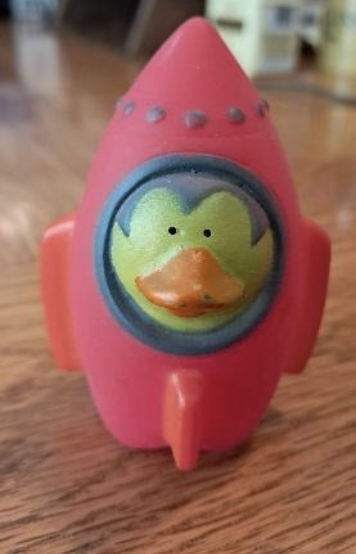
Rubber ducks never interrupt or take over.
Miriam:
That’s cognitive and rhetorical off-loading—whether to a machine or a tutor.
Anna:
To make sure I am not the one writing the student’s revisions, I make my tutoring sessions more about the student’s thoughts than my feedback. I have these students read their essays aloud without feedback from me, and they tend to easily find places to add more context or fix their grammar.
Isaac:
I don’t expect students to know how to write a perfectly formatted MLA paper, so I don’t focus on correcting their formatting—not initially, anyways. I focus on their voice, prose, and ideas. Many of them stay stuck on a blank document, waiting for a paper to generate within their minds—it won’t work; they don’t know how to develop those opinions they really want to express, and so they let something generate their paper instead—Great…
Miriam:
The human-in-the-loop is not going to function like an LLM.
Isaac:
If professors want students to really express themselves, they need someone to talk to—someone to get those opinions out in the air. That’s where I come in. I ask about what they would like to write, and they tell me. They tell me more than they would ever tell their professor, because a professor doesn’t have time for them—I do. I work out an outline; give them questions that guide them through a working thesis and several body paragraphs; challenge their beliefs through a rebuttal paragraph; then they write. They write like a rubber duck had listened to them. I never aim to be their problem solver. I get their ideas out on a whiteboard, and I write down things they say. That’s more than what any other professor would do, and it’s actually more than they need, in my experience.
Miriam:
Duck-and-human-in-the-loop writing is as much about listening to make meaning as it is about talking.
Isaac:
I’m a person (with a knack for writing) who listens to them; students need that now more than ever, because if I’m not there, then who is…? We all know the answer to that, and it’s already “listening” and “helping” thousands of other students as you read this.
Disclosures: This blog entry was composed without the use of generative AI tools. Photos were taken by Miriam Moore, one of the authors.
Biographical Statements:
Miriam Moore is an Associate Professor of English at the University of North Georgia and director of the Writing Fellows program on the Gainesville campus. Her research interests include multilingual writing, pedagogy, metalinguistic awareness, and reflection for first-year writers and preservice teachers.
Lindsey Jones is a recent graduate of the University of North Georgia with a Bachelor of Arts in English, with a Writing and Publication concentration. She is currently preparing to continue her studies in the Master of Arts in Teaching program at the University of Georgia.
Theodore J. Lopata is an alumnus of University of North Georgia with a Bachelor of Arts in English Literature. As a developing academic, he is interested in exploring the intersections between literature and politics. Teaching is his greatest passion, and he hopes to one day become a college-level educator.
Sydney Michaud is a student at the University of North Georgia studying to obtain an English degree with a concentration in Writing & Publication. She has a huge love for creative writing and dreams of one day becoming a published author.
Anna Rundbaken is a student at the University of North Georgia studying English and Psychology to achieve an Interdisciplinary Studies Major. She works two different tutoring jobs at the university—Supplemental Instruction and Writing Fellows—for which she plans study sessions to help students gain confidence in their writing.
Isaac Vazquez is a student at the University of North Georgia getting a Bachelor’s in English, with a minor in Linguistics. One day, he’d love to teach highschoolers the power of rhetoric and prose, arming them with weapons of mass transcription.
